
I occasionally follow a blog called Atomic Junk Shop that covers comics, sci fi and related pop culture.
Never thought I’d stumble on an actual “Atomic Junk” shop!


I occasionally follow a blog called Atomic Junk Shop that covers comics, sci fi and related pop culture.
Never thought I’d stumble on an actual “Atomic Junk” shop!
Google wished me a happy second coronaversary this morning.

Well, not in so many words. But I count March 8, 2020 as my last normal day, the day I went out to de-stress by taking pictures of the ocean, seagulls, and a zillion tiny clams, grabbed coffee at Peet’s on the way home, and came down with the flu that afternoon. By the time I recovered a few days later, everything had shut down.
I never did get back to the office. I’m still at the same company, but they let the lease expire, tossed everything in storage, and set up a new, smaller office for people to come back to when things settled out.
I finally got to see the new office last month. And see some of my co-workers in person. And pick up the stuff I’d left on my desk, like a coffee mug that I would have washed on Monday morning if I hadn’t been sick.
It’s weird how it feels both longer and shorter than 2 years. Everything kind of blurs together. And yet it’s so different now from the start of the pandemic.
We’re not locked down. Just about everything that’s still in business is open, with precautions. Schools and playgrounds and parks are open. COVID tests are little boxes you buy at the pharmacy and use at home instead of driving through an improvised clean room for someone in a hazmat suit to stick a pole through the window.
It’s not “normal,” but it’s a lot closer to the old normal than those first months were.
The virus is still out there, but we understand better how it spreads and how to treat it, and vaccines make it a lot less likely to be severe for those who’ve gotten them.
(If only more people actually trusted the people who know what they’re talking about, rather than the ones telling them what they want to hear.)
On the down side, lots of people are still getting sick and dying, prices are up, the global supply chain hasn’t recovered, cynical politicians have taken advantage of the pandemic to further divide society and cement their hold on people who just want to be told what they want to hear instead of what they need to know, and a large nuclear power has decided now is an excellent time to invade their neighbors and possibly spark a bigger conflagration.
Things are still in flux. Which is probably part of why it’s still blurring together. We’ve still got problems to fix (or mitigate) at every level from home to global. Whatever the new normal is going to be, we haven’t made it yet.
But not having a direction, not having milestones, not having a sense what the landscape is going to be, makes it hard to see accomplishments, hard to be motivated. It’s been a draining two years. And even though a lot of things are better, other things are worse, and it’s still so damn draining. I’m exhausted, my wife’s exhausted, our kid’s switched school situations so many times he barely participates anymore.
I want a new normal. A better normal. But the last few years have also made it abundantly clear that more people than I thought don’t want to make things better, they just want other people to have it worse than them.
And yet I know so many people do have it worse than me. I have a job I can do from home. Even in the lockdown, I was quarantined with my family, not alone. I live in an area with enough open space that even during the heaviest restrictions I could still go out for a walk. My immediate family hasn’t caught COVID, and the extended family members who did recovered from it. And of course I’m not dodging mortar shells or fleeing a battle zone. So what am I complaining about? By some standards my life is charmed, so what business do I have feeling depressed and anxious?
Brains are weird. You spend a little time in fight/flight/freeze mode and you’re able to stop or dodge danger. You spend a lot of time in it and your brain just stops classifying input properly.

Apparently this was a 1976 comic book to promote the then-new county bus system with campy knock-off superheroes (and really wonky perspective). I mean, Bus Ryder looks suspiciously like Superman, and there’s no question where the Busonic Woman got her name.
For human-readable HTML, I can write:
<a href="https://example.com">Lois Lane</a>
For machine-readable HTML:
<a rel="author" href="https://example.com">Lois Lane</a>
For IndieWeb microformats:
<a class="p-author h-card" href="https://example.com">Lois Lane</a>
But for inline Schema.org I have to write:
<span property="author" typeof="person"><a property="url" href="https://example.com"><span property="name">Lois Lane</span></a>
I’ve been grumbling about all the redundancy in putting multiple sets of metadata on a page: classic meta tags, OpenGraph, Twitter cards, Schema.org, microformats2. So I’ve been looking to consolidate as much as I can.
I thought, Hey, Schema.org has inline markup implementations! I can probably just tag the same elements I used for microformats2!
But there are so many things like author where it wants a multi-part hierarchy when you could easily use a single tag.
At this point the added complexity to the code isn’t worth it. I may as well stick with the JSON-LD lump of text in the header. Heck, the extra spans and divs might actually add up to more bytes than the no-longer-duplicated content.
It’s not actually that much extra space, though, and the site in question generates all the markup from one set of markdown front matter. It just bugs me that to fill in all of them I need multiple copies of everything.
Though it is kind of funny to compare design decisions:
Facebook: We want a single block that can be copied and pasted and all looks the same. We don’t want to reuse existing tags and we don’t care about DRY.
IndieWeb: Invisible metadata inevitably gets out of date, and all this stuff that should already be on the page or in the head anyway, so let’s use what’s there and make it simple to mark up the actual page content.
Schema.org: CATEGORIZE ALLLLL THE THINGS!!!!!
Saw this while out walking this morning. I guess holiday decorations can last as long as you want them to!

From this afternoon’s walk along the greenbelt: About as many monarch butterflies in one photo than I’ve seen in the last few years!
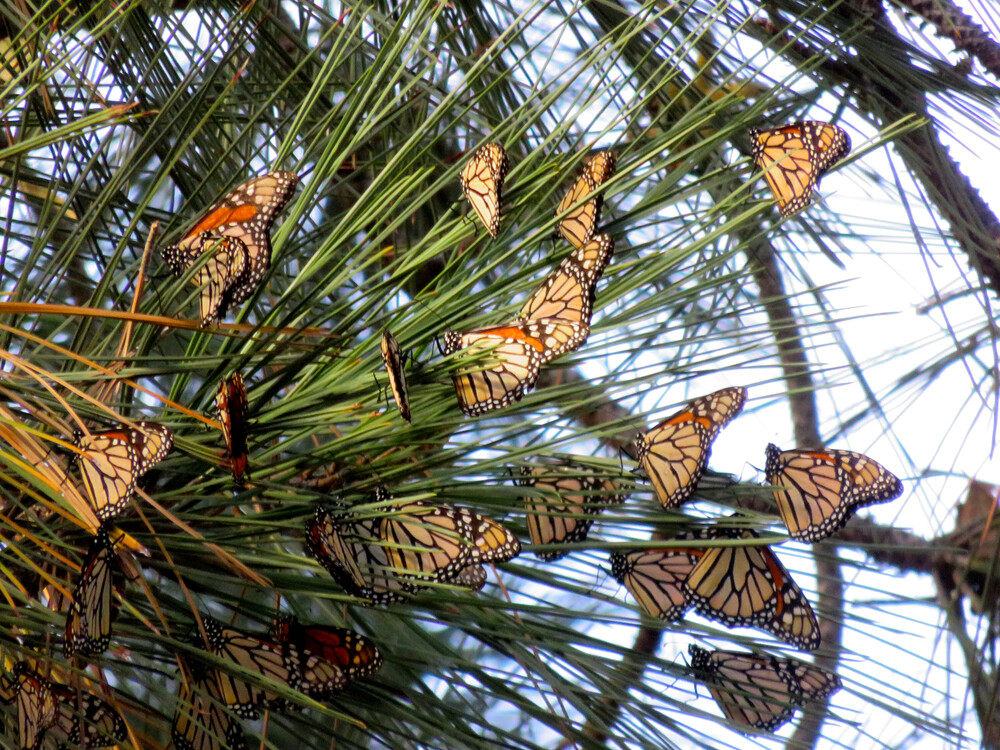
There were a whole bunch of them clustered on a pine branch above the path. I wouldn’t have even seen them, but other people out walking had stopped to check them out.
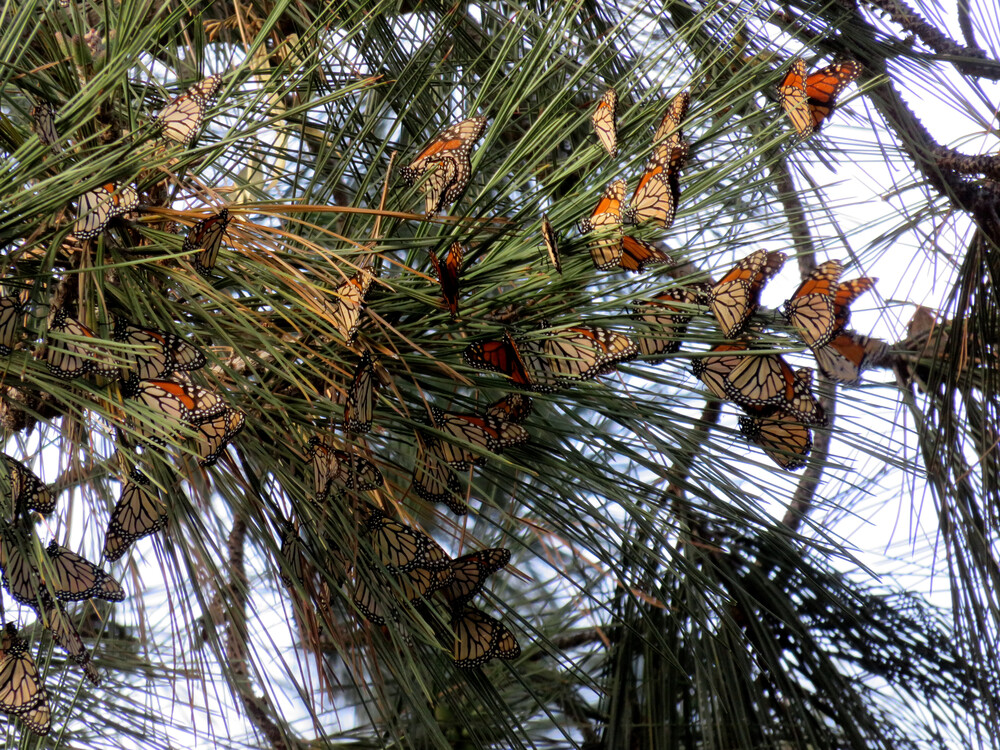
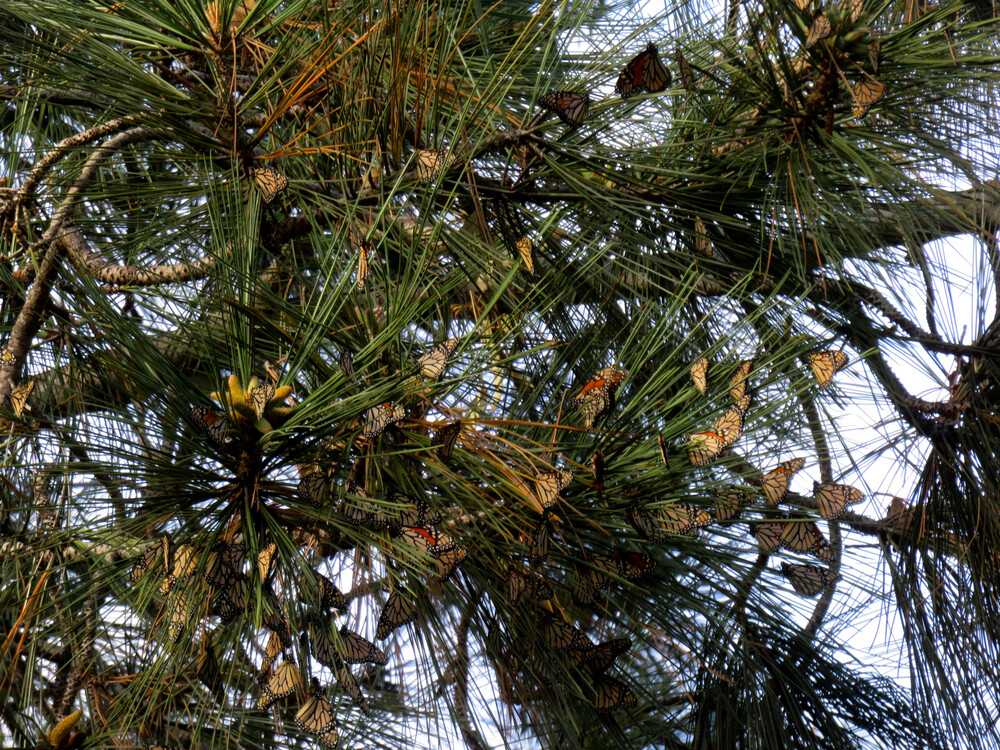
I was just reading that this year’s overwintering monarch count is up to over 200,000 – a huge improvement over last year’s count of, I kid you not, 1,914. Though still not up to the millions that were regularly seen as recently as the 1990s. That article lists ways you can help the iconic species rebound, or you can follow the Xerces Society’s Monarch Call to Action.
We actually got quite a bit of rain (for Southern California, anyway) in December, and the mountains have stayed cold enough that the snow has stuck around for a few weeks!
Here’s a view of the San Gabriels in mid-December, after a big storm.
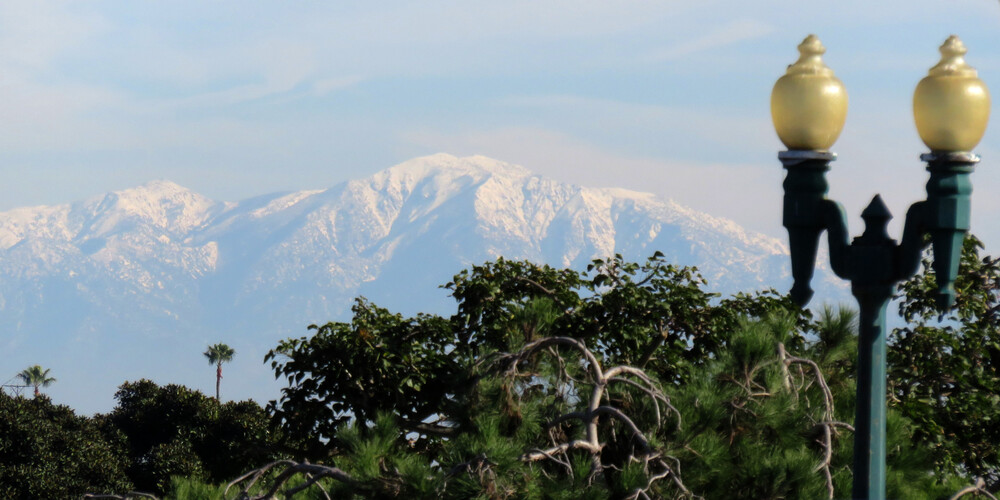
And here’s a comparable view a week into January.
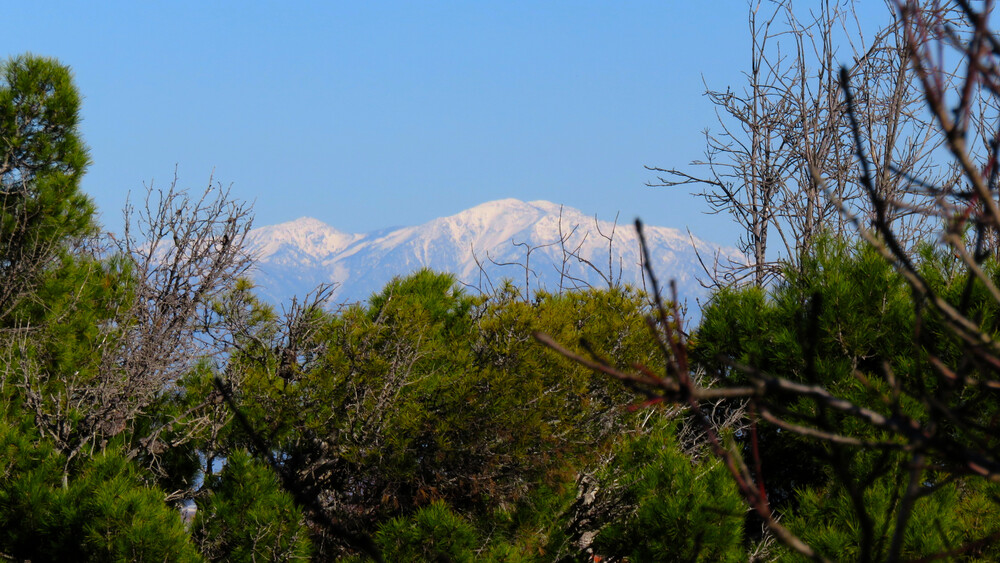
Nowhere near as impressive as, say, the entire range being covered in 2008, but that’s a rare occurrence even in non-drought years…and we’ve had mostly warmer and drier years since then.