Between Google trying to bury its search under an “AI” chat and me moving most most of my website over to a new domain, I’ve been checking to see how well-indexed the old and new pages are at various search engines.

“Marineland of the Pacific” seemed to be a good phrase to test. Marginalia Search still has the old location for my Remembering Marineland (or not) post, but that search also turned up a page with scans of a Marineland ad flyer from 1962.

As someone who’s spent a lot more time hiking the Palos Verdes Peninsula than visiting an ocean theme park that closed when I was a child (not to mention way too much time updating OpenStreetMap), I was immediately drawn to the map…which strangely enough, shows Crenshaw Boulevard running over the hill, down through the Portuguese Bend landslide and connecting to Palos Verdes Drive South along the coast, just east of Wayfarer’s Chapel.
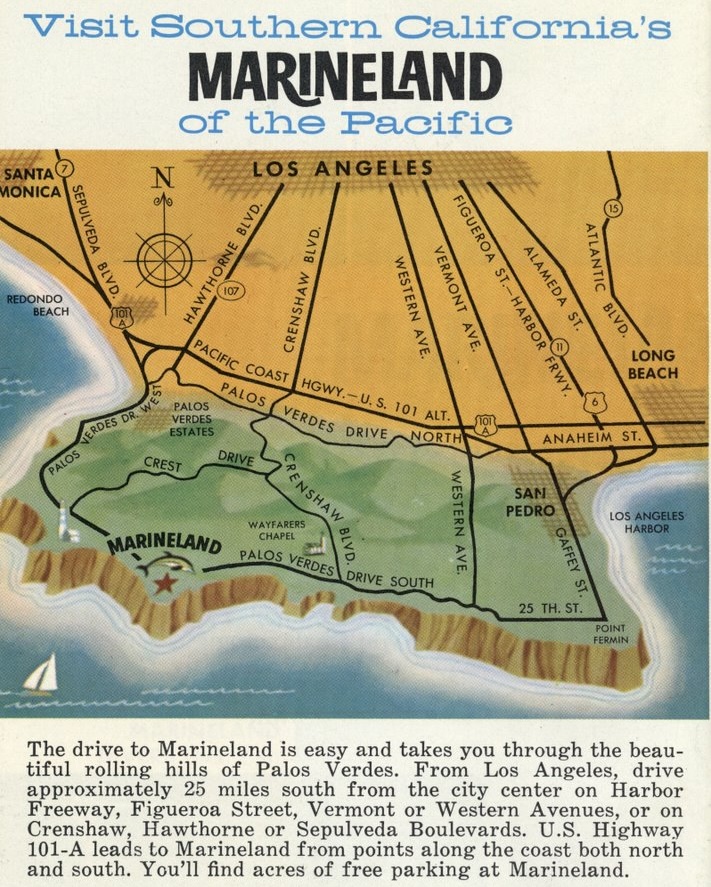
Simplified map of the Palos Verdes Peninsula showing Palos Verdes Drive around the peninsula, Marineland on one of the promonitories, major roads connecting to Los Angeles (Sepulveda, Hawthorne, Crenshaw, Western), and roads going *over* the hill including Hawthorne, Crest, and...wait, Crenshaw?

Wait, did Crenshaw actually connect sometime in the past? If so, how?

Today, Crenshaw runs up to the top of the hill and stops just past Crest Road, at Del Cerro Park. A dirt road continues past a locked gate, narrowing to a switchbacked path through the Portuguese Bend Nature Reserve. A landslide below it has been moving slowly for decades, preventing much in the way of construction on the land. Some people bought land and built houses on adjustable stilts so they could level the house every few months.

The first time I checked out the view from Del Cerro back in 2011, I took this photo of the area to the east, where Crenshaw appears on that map.
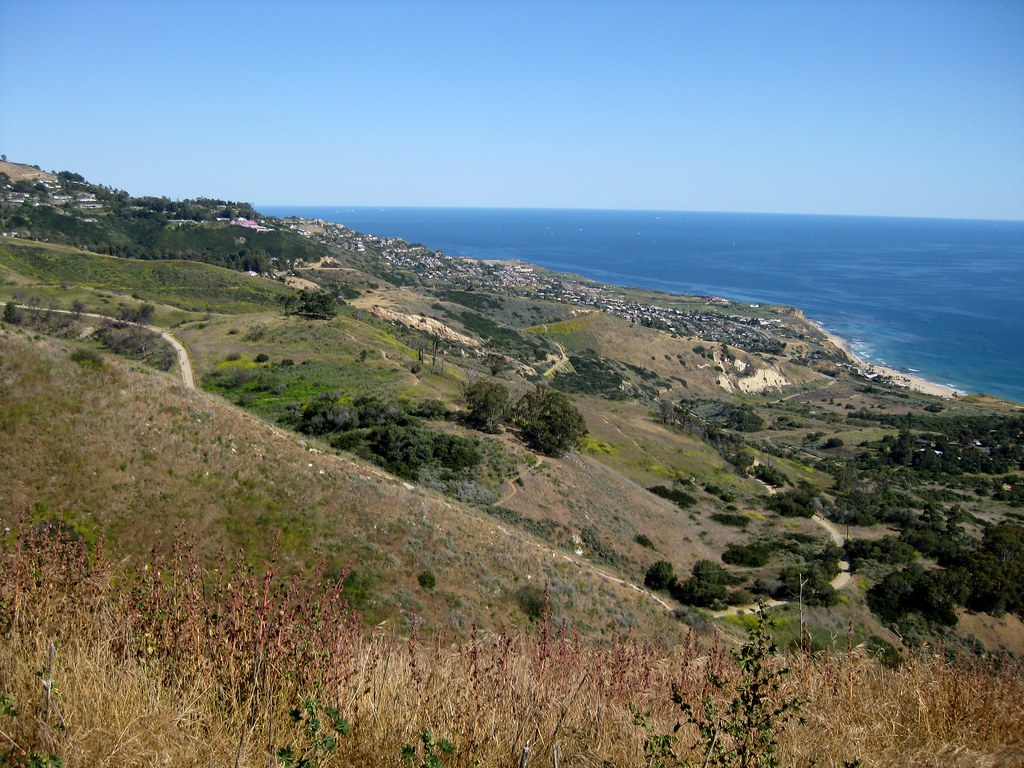
Looking out along a hillside sloping down to the ocean. Most of it is dry chaparral, with some clusters of darker trees, and a jumbled suburban neighborhood off in the distance as it levels out near the base. A dirt road snakes its way around the curves.

Over the last few years the land has been sliding faster, and a lot of the area has been closed for safety. Wayfarer’s Chapel has been dismantled to prevent it from flat out collapsing.

It’s no longer possible to connect Crenshaw to the coast.

But had it connected in the past, and been wiped out by the landslide? I went looking for the history, and found some articles that answered my question. I must have read this 2023 LA Times article when it was published, which means I’d forgotten a key detail about Crenshaw Boulevard’s relation to the landslide:

It caused it.

Crenshaw never connected to the coast. An extension was planned, and initial construction reactivated an ancient landslide in 1956, as crews moved enough dirt around to shift the underlying structure out of balance. At the time, the Portuguese Bend section hadn’t moved in roughly 4,800 years. In the 70 years since, it hasn’t really stopped.

If the map was drawn when the park was new, it would have been reasonable to assume that the road would be completed soon enough, and draw it in early. (“It’s finished on the map!”) But the scan shows a 1962 copyright date at the bottom. That’s six years into the landslide, more than enough time to realize the road was never going to be completed and paint over it for the latest printing. That makes me wonder why they hadn’t fixed it by then.
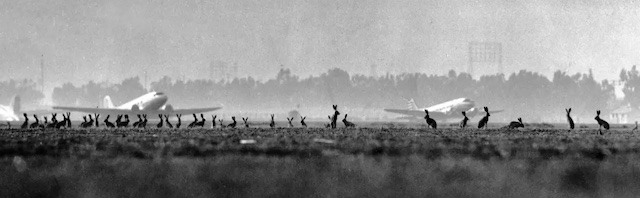
Line of rabbits along the ground, silhouetted against some old-looking airplanes and trees in the distance.

When wild jackrabbits roamed the fields of LAX. (Los Angeles Times)*

From time to time passengers in giant air liners are amused when giant jacks race the plane on take-off. Until now, none of the rabbits has left the ground.

I’m reminded of all the rabbits we used to see near UCI in the 90s, especially out in the housing complexes on the edge. A lot of that open space has been filled in since then. I’m told they were still all over the place as of 2010, but I can’t remember seeing any the last few times I was on campus. Though several of those were Wayzgoose, which I’m sure would have most of the rabbits hiding in their burrows, waiting for all the people to leave so they can see what food they might have dropped. Then again, I don’t remember noticing squirrels at the time either, and I’ve seen squirrels walk up to me and pose like Oliver Twist asking for more soup.

Anyway, the rabbits at LAX were eventually wiped out by foxes, who have since disappeared from the airport as well.

About Those Foxes…

But the foxes are still around! Just not on the runways. LAist ran a story about the local population of red foxes on the Palos Verdes Peninsula just last month. The LA Natural History Museum has an article on the species’ history in the area, from being imported and farmed for hunting and fur in the early 20th century, to going feral, to a population boom in the 1980s.

The red fox coexists with the native gray fox on the peninsula, but coyotes will kill them, and the current population is believed to be fairly low.

Could be worse, though. The Channel Island fox almost went extinct through a Rube Goldberg food chain of events. SFGate reported on their plight and rebound (on the same day LAist published the piece on red foxes, oddly enough!) due to the feral pigs (way more than 30-40) left over from the islands’ farming days. The pigs not only overran the islands’ vegetation — it was basically trees and grass and nothing in between for years — but they attracted predatory birds from the mainland who, once they were in the area, went after the smaller, easier prey: the foxes. By 2004, there were only a dozen on each of two islands.

The National Park Service hired an outfit to hunt down the feral pigs over the next few years. The islands’ vegetation — and the foxes –rebounded. By 2016, the island fox was removed from the endangered species list entirely.

*Photo credit: Art Rogers, originally published in the Dec. 2, 1946, edition of Life magazine and later in the Aug. 4, 2011 LA Times.

Expanded from a Mastodon post I wrote back when the LA Times highlighted the LAX rabbits in a “From the archives…” story in 2017.

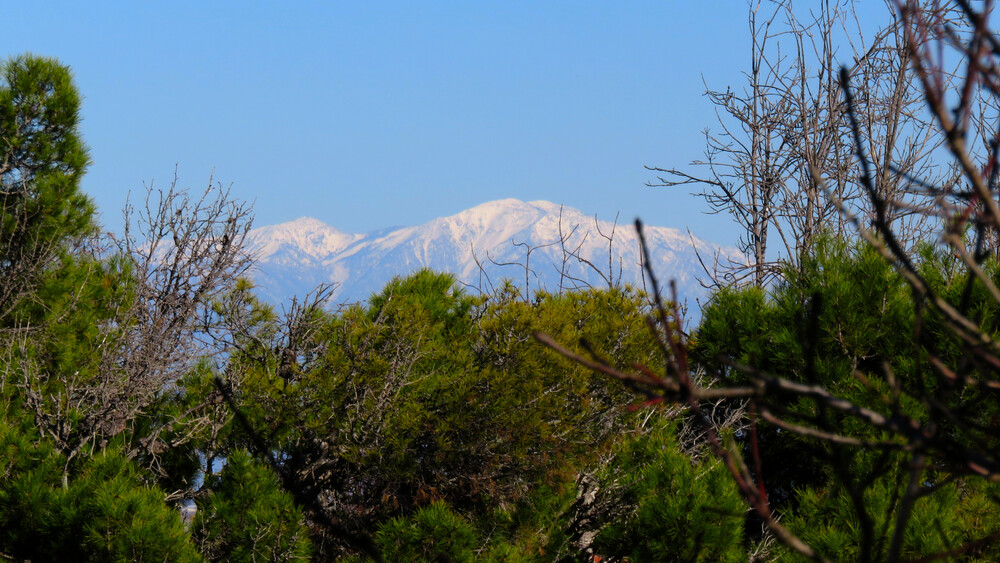
We actually got quite a bit of rain (for Southern California, anyway) in December, and the mountains have stayed cold enough that the snow has stuck around for a few weeks!

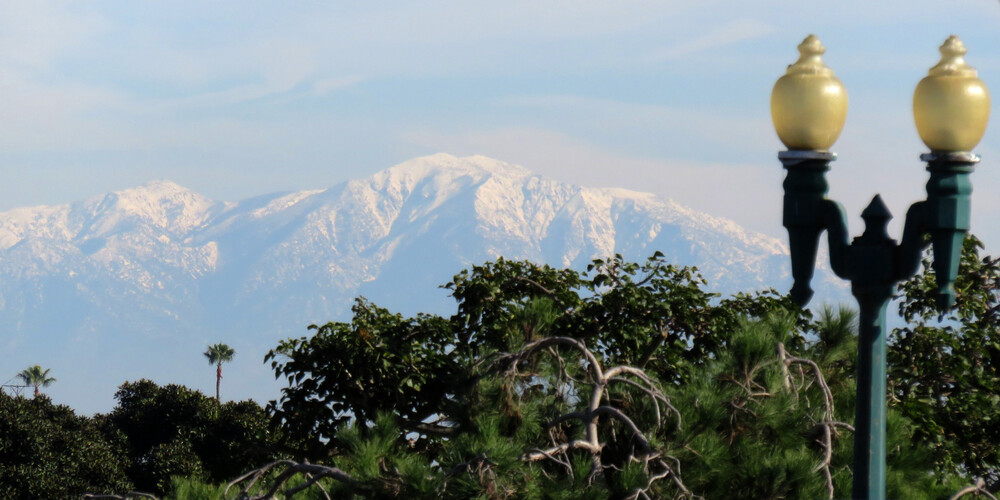
Here’s a view of the San Gabriels in mid-December, after a big storm.

Snow-covered mountains in the distance, with partly cloudy sky above and green trees and a lamp post in the foreground.

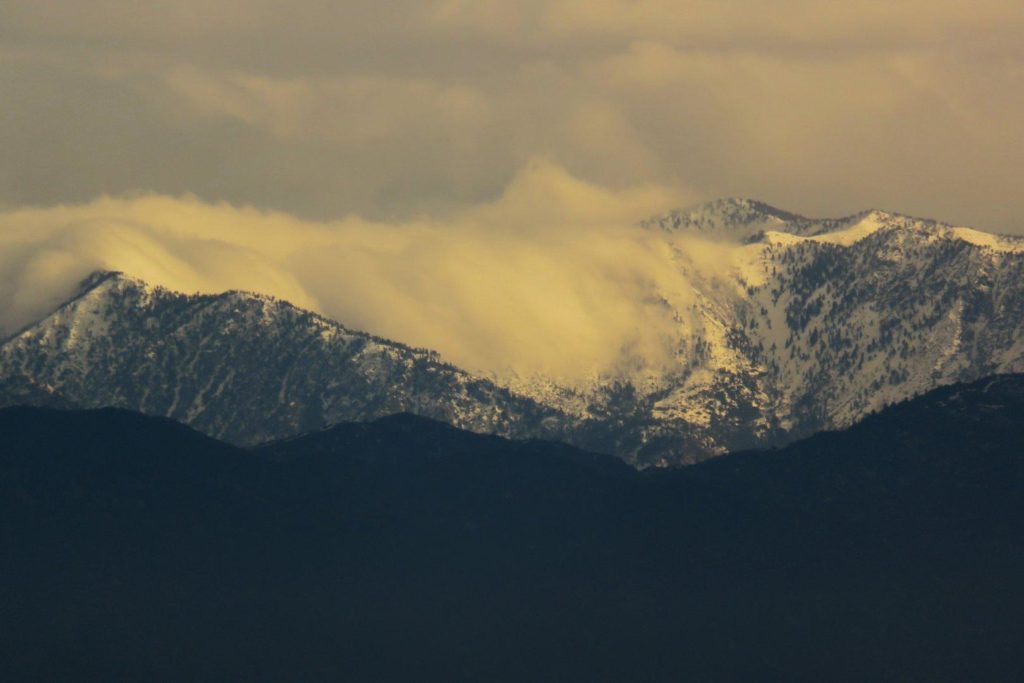
And here’s a comparable view a week into January.

Snow-covered mountains in the distance, with blue sky above and green pine trees in the foreground.

Nowhere near as impressive as, say, the entire range being covered in 2008, but that’s a rare occurrence even in non-drought years…and we’ve had mostly warmer and drier years since then.

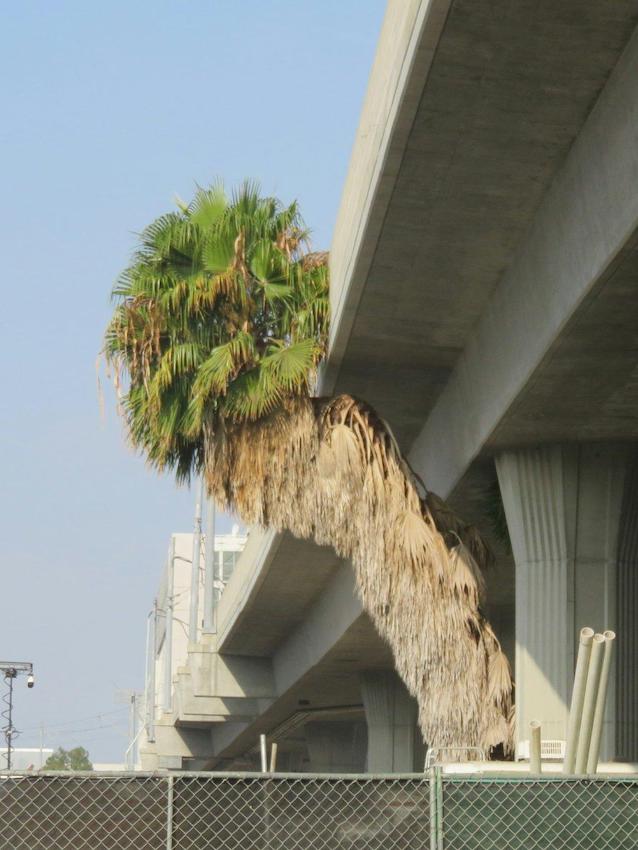
A palm tree growing along the column supporting a bridge...and then diagonally sideways until it gets out from under the bridge entirely.

I finally stopped to take a photo of this tenacious palm tree. I’m not sure whether it was planted or if it just took root next to the support pillar back when the Green Line was new two decades ago. It’s clearly not actively maintained, judging by all the old dry fronds still attached, and I keep wondering if it’ll get taken out as part of the construction of the Crenshaw line (this is right next to the Y connector where the new line branches off, and the fences are part of the construction site)…but that construction’s almost done, and the tree’s still there.

Cnet has a report on how police departments are being inundated with false alarms from Amazon Ring alerts because people have freaked out over the camera footage of innocent activities. In one case someone called to report footage of themselves walking into the door!

I’m reminded of a case that happened nearby just a month ago. In Manhattan Beach (near Los Angeles), police from five cities — and an LA Sheriff’s helicopter — descended on a neighborhood because someone panicked over Ring footage of a food delivery sent to the wrong address. It took them an hour and a half to confirm that there was no crime in progress.

The story basically filled a bingo card:

  • IoT doorbell camera (and of course it was Ring)
  • Gig/app delivery service
  • Upscale neighborhood
  • Paranoid reaction to, you know, people
  • NextDoor posts quoted in article (because of course they are)
  • Massive police over-response
  • SMS alerts sent to neighboring cities

It was absurd. Fortunately no one was hurt or arrested, so it remains an absurdity, but between the waste of resources, the increase in fear, and the risk that something could have gone wrong, it fits right in with these other cautionary tales. As Fight for the Future puts it:

Ubiquitous, privately owned surveillance camera networks are NOT going to make our neighborhoods safer. They just make us all paranoid. Soon we’ll be snitching on our neighbors Red Scare style. Enough

ยปAll pages site-wide with this tag