Between Google trying to bury its search under an “AI” chat and me moving most most of my website over to a new domain, I’ve been checking to see how well-indexed the old and new pages are at various search engines.

“Marineland of the Pacific” seemed to be a good phrase to test. Marginalia Search still has the old location for my Remembering Marineland (or not) post, but that search also turned up a page with scans of a Marineland ad flyer from 1962.

As someone who’s spent a lot more time hiking the Palos Verdes Peninsula than visiting an ocean theme park that closed when I was a child (not to mention way too much time updating OpenStreetMap), I was immediately drawn to the map…which strangely enough, shows Crenshaw Boulevard running over the hill, down through the Portuguese Bend landslide and connecting to Palos Verdes Drive South along the coast, just east of Wayfarer’s Chapel.
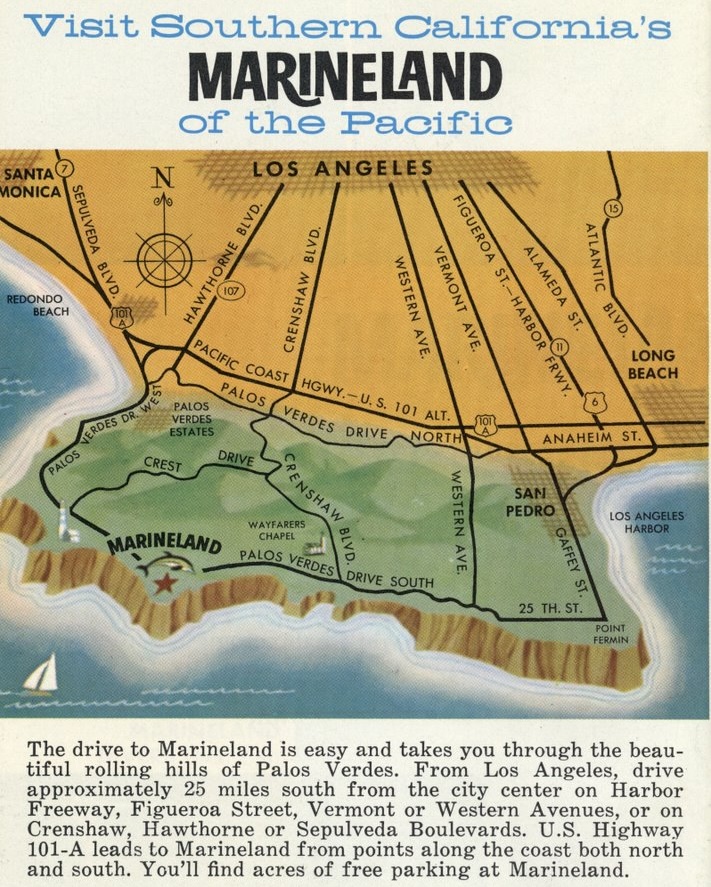
Simplified map of the Palos Verdes Peninsula showing Palos Verdes Drive around the peninsula, Marineland on one of the promonitories, major roads connecting to Los Angeles (Sepulveda, Hawthorne, Crenshaw, Western), and roads going *over* the hill including Hawthorne, Crest, and...wait, Crenshaw?

Wait, did Crenshaw actually connect sometime in the past? If so, how?

Today, Crenshaw runs up to the top of the hill and stops just past Crest Road, at Del Cerro Park. A dirt road continues past a locked gate, narrowing to a switchbacked path through the Portuguese Bend Nature Reserve. A landslide below it has been moving slowly for decades, preventing much in the way of construction on the land. Some people bought land and built houses on adjustable stilts so they could level the house every few months.

The first time I checked out the view from Del Cerro back in 2011, I took this photo of the area to the east, where Crenshaw appears on that map.
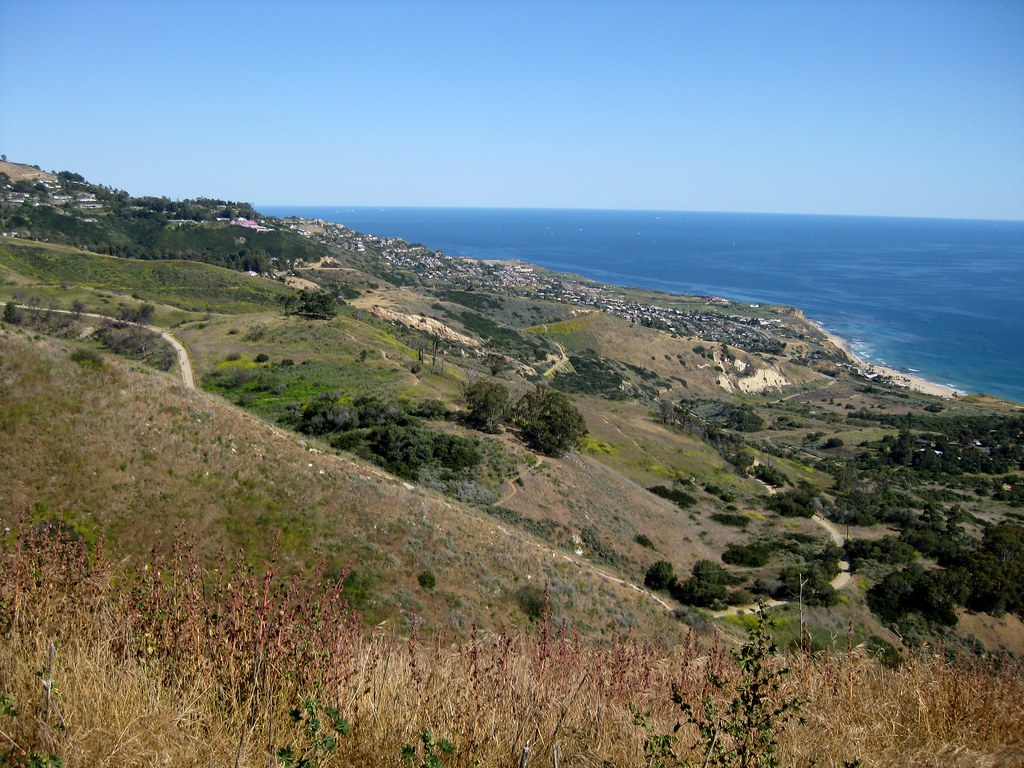
Looking out along a hillside sloping down to the ocean. Most of it is dry chaparral, with some clusters of darker trees, and a jumbled suburban neighborhood off in the distance as it levels out near the base. A dirt road snakes its way around the curves.

Over the last few years the land has been sliding faster, and a lot of the area has been closed for safety. Wayfarer’s Chapel has been dismantled to prevent it from flat out collapsing.

It’s no longer possible to connect Crenshaw to the coast.

But had it connected in the past, and been wiped out by the landslide? I went looking for the history, and found some articles that answered my question. I must have read this 2023 LA Times article when it was published, which means I’d forgotten a key detail about Crenshaw Boulevard’s relation to the landslide:

It caused it.

Crenshaw never connected to the coast. An extension was planned, and initial construction reactivated an ancient landslide in 1956, as crews moved enough dirt around to shift the underlying structure out of balance. At the time, the Portuguese Bend section hadn’t moved in roughly 4,800 years. In the 70 years since, it hasn’t really stopped.

If the map was drawn when the park was new, it would have been reasonable to assume that the road would be completed soon enough, and draw it in early. (“It’s finished on the map!”) But the scan shows a 1962 copyright date at the bottom. That’s six years into the landslide, more than enough time to realize the road was never going to be completed and paint over it for the latest printing. That makes me wonder why they hadn’t fixed it by then.

I don’t remember much about Marineland of the Pacific. It was an ocean park/aquarium like Sea World that operated near Los Angeles for several decades, closing in 1987. I know I visited at least once, with my grandparents, but all I remember is:

  1. The view from what I assume was Palos Verdes Drive, as the car crested a low summit, brown hills rising to the right and falling gently toward the ocean on the left. The park stood on a promontory jutting out into the ocean. I haven’t been able to locate the spot, but that could just mean the road’s been moved.*
  2. A sign saying “CAFE” visible from the parking lot, which I misread as rhyming with “safe.” (Evidently I was very young at the time.)
  3. That’s about it.

You’d think I’d remember the sea life at least a little, though I suppose it’s possible I’ve misattributed some memories to Sea World (which, come to think of it, I don’t remember super-well either).

Not much of Marineland remains aside from a few names at Terranea Resort, which now occupies the site. But a piece of that history is coming back. In 2014, a 35-foot whale statue from the park entrance was found in a maintenance yard. The city has approved plans to place the statue at Point Vicente Park just up the road. Update April 2026: The statue still hasn’t been installed. I was out walking around Point Vicente over the weekend (the day after this year’s Whale of a Day and lighthouse tours, annoyingly enough) and got to wondering about it. The latest article I’ve found is from 2023, when they were still trying to arrange funding to restore the fiberglass statue, after a half-million estimate derailed the original plans.

Apparently the decline and closure of the park was rather sordid: HBJ, the textbook company that owned Sea World at the time, had tried to buy Marineland’s star orcas. They weren’t selling. So HBJ bought the park in December 1986. Late in January, they secretly loaded Orky and Corky onto trucks in the middle of the night and drove them down to San Diego. (Update: the moving process was traumatic for the whales as well.) A week later, they announced the park would close in March. They shut it down halfway through February, and by May they’d sold off the property to a real estate developer. Plans for a conference center were never realized, and the site was abandoned for 20 years until construction began on Terranea.

*Update: My dad pointed me to the Wikipedia article, which led me to a post at Modern Day Ruins, which led me to the California Coastal Records collection of aerial photographs. I found one from 1986 that indicates that Rancho Palos Verdes Drive is in the same spot as it was back then, but the housing developments on either side to the east of the turnoff weren’t there at the time. That’s probably why I didn’t recognize it. Or the road I remember could be the one down to the parking lot.

ยปAll pages site-wide with this tag