Between Google trying to bury its search under an “AI” chat and me moving most most of my website over to a new domain, I’ve been checking to see how well-indexed the old and new pages are at various search engines.

“Marineland of the Pacific” seemed to be a good phrase to test. Marginalia Search still has the old location for my Remembering Marineland (or not) post, but that search also turned up a page with scans of a Marineland ad flyer from 1962.

As someone who’s spent a lot more time hiking the Palos Verdes Peninsula than visiting an ocean theme park that closed when I was a child (not to mention way too much time updating OpenStreetMap), I was immediately drawn to the map…which strangely enough, shows Crenshaw Boulevard running over the hill, down through the Portuguese Bend landslide and connecting to Palos Verdes Drive South along the coast, just east of Wayfarer’s Chapel.
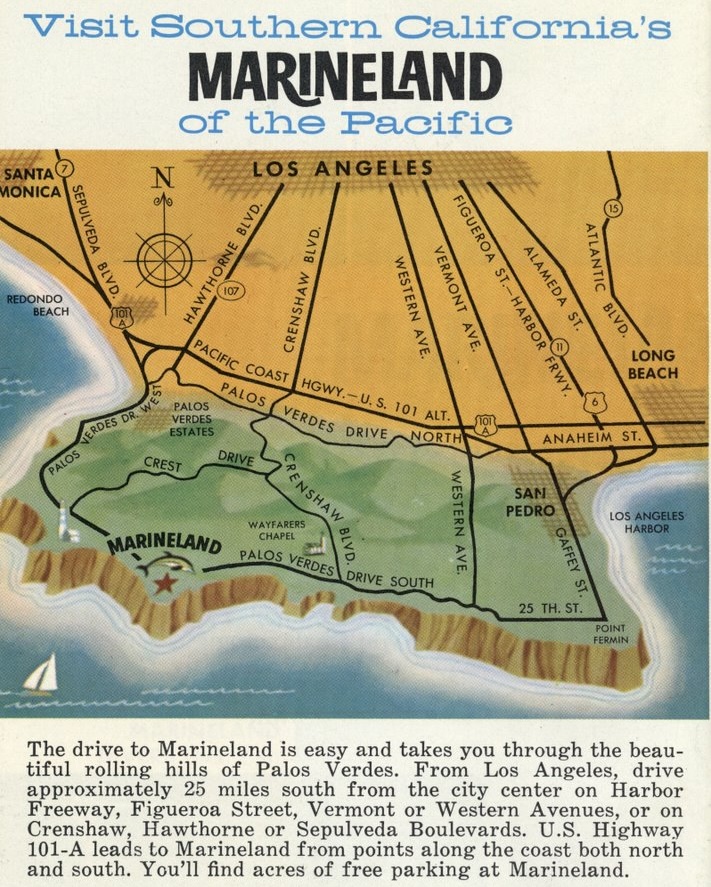
Simplified map of the Palos Verdes Peninsula showing Palos Verdes Drive around the peninsula, Marineland on one of the promonitories, major roads connecting to Los Angeles (Sepulveda, Hawthorne, Crenshaw, Western), and roads going *over* the hill including Hawthorne, Crest, and...wait, Crenshaw?

Wait, did Crenshaw actually connect sometime in the past? If so, how?

Today, Crenshaw runs up to the top of the hill and stops just past Crest Road, at Del Cerro Park. A dirt road continues past a locked gate, narrowing to a switchbacked path through the Portuguese Bend Nature Reserve. A landslide below it has been moving slowly for decades, preventing much in the way of construction on the land. Some people bought land and built houses on adjustable stilts so they could level the house every few months.

The first time I checked out the view from Del Cerro back in 2011, I took this photo of the area to the east, where Crenshaw appears on that map.
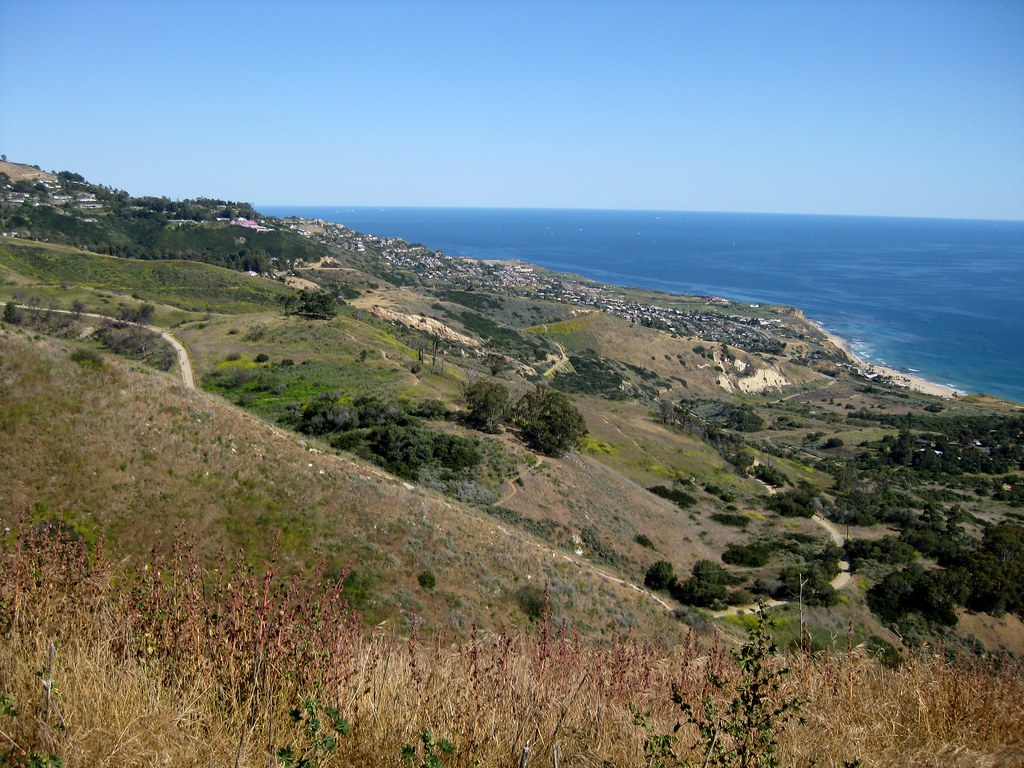
Looking out along a hillside sloping down to the ocean. Most of it is dry chaparral, with some clusters of darker trees, and a jumbled suburban neighborhood off in the distance as it levels out near the base. A dirt road snakes its way around the curves.

Over the last few years the land has been sliding faster, and a lot of the area has been closed for safety. Wayfarer’s Chapel has been dismantled to prevent it from flat out collapsing.

It’s no longer possible to connect Crenshaw to the coast.

But had it connected in the past, and been wiped out by the landslide? I went looking for the history, and found some articles that answered my question. I must have read this 2023 LA Times article when it was published, which means I’d forgotten a key detail about Crenshaw Boulevard’s relation to the landslide:

It caused it.

Crenshaw never connected to the coast. An extension was planned, and initial construction reactivated an ancient landslide in 1956, as crews moved enough dirt around to shift the underlying structure out of balance. At the time, the Portuguese Bend section hadn’t moved in roughly 4,800 years. In the 70 years since, it hasn’t really stopped.

If the map was drawn when the park was new, it would have been reasonable to assume that the road would be completed soon enough, and draw it in early. (“It’s finished on the map!”) But the scan shows a 1962 copyright date at the bottom. That’s six years into the landslide, more than enough time to realize the road was never going to be completed and paint over it for the latest printing. That makes me wonder why they hadn’t fixed it by then.
I love Netflix. I love their selection. I love being able to just make a list of movies I’ve been meaning to watch, and see them show up one by one. But the queue model doesn’t work so well when you want to watch a specific movie now. That’s where you need a retail store, or download-on-demand.

One of our local movie theaters is running a series of “Flashback Features”, and this coming Wednesday is Young Frankenstein. I thought, given the number of references, if would be fun to watch Son of Frankenstein before we went. No time for Netflix, and Blockbuster didn’t have it, so I decided to try a local video store.

You can find all kinds of things at local stores. Blockbuster might toss something that doesn’t pull in $X/month, or doesn’t fit their market research. Shelf space at a Blockbuster is precious. They stock lots of copies of new releases. They keep their aisles wide. And they store movies face outward, so each title takes up more space. A local video store will cram as many movies as they can onto the shelf, spine-outward, sometimes laid sideways on top of each other, and they can add more shelves until they run up against fire regulations. The space freed up by tossing an underperforming movie is nothing compared to the possibility that someday, someone might rent it. This store had videotapes that were still in the oversized boxes that went out of style in the late 1980s!

The downside, of course, is that they probably won’t have enough staff to keep this larger selection sorted. The S section at this store consisted of at least eight shelving units with four or five shelves each. I found all sorts of movies I’d forgotten about or never even heard of in the first place (there’s a Skulls III? With Glory?). If I’d been looking for a random movie to watch, it would’ve been great, but I was looking for Son of Frankenstein. By the time I gave up looking, I figured there was no point in asking a clerk whether they had it or not. Even if they did, I’d still be stuck searching through 40+ shelves.

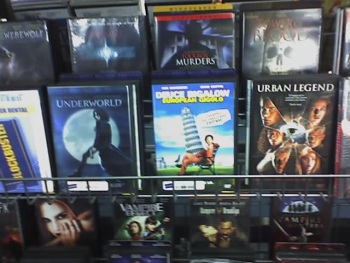
Not that Blockbuster gets it right all the time. I noticed an anomaly in the Horror section today:

Horror shelf at Blockbuster, featuring... Deuce Bigalow: European Gigolo?!?

Although given what I’ve heard about Deuce Bigalow: European Gigolo, perhaps Horror is the right category for it.

In the end, I called up my parents and asked if they had a copy of Son of Frankenstein. It turns out they did, so the whole thing dropped out of the realm of commerce and into the realm of borrowing.

ยปAll pages site-wide with this tag