Sure, I like electronic gadgets. But I dislike planned obsolescence more.

It’s one thing when the newer model really is that much better. “All About the Pentiums” exaggerated it, but computer hardware in the 1990s really was improving by leaps and bounds. (And the software was devouring those performance gains, both in demanding more resources, and being less efficient as programmers were told to optimize for their own time, not for disk space or RAM.) That eventually settled out around the time smartphones and cloud computing started taking off, which is why I was able to run a 2012 model CPU all the way through 2024. A faster PC would have been nice, but I didn’t need one yet.

As I recall the tech industry freaked out when demand for new PCs dropped. There was probably a rash of “Millennials are killing computers!” articles.

But smartphones were going through the same kind of rapid improvement. You could easily justify buying a new phone after only two years: it was a lot faster, had a better display, had a better camera and more storage, and so on. And the carriers were happy to hand you a “free” new device to keep you on their service. Heck, if you really wanted (and could afford) to buy a new phone every year, you could make a case for it.

In that environment, you could kind of accept a company only offering 2-3 years of support for their phones.

Eventually that settled out too, and it takes longer for new phones to really be worth the upgrade. Of course the industry has tried to keep the pace going. If the hardware still works, and it’s still able to run the apps people want to use, there’s no good reason for the company to stop supporting it after only three. Especially with something whose main purpose is to be constantly connected to the Internet.

I have an Android phone from 2020 and a tablet from 2019. The tablet still works fine. (It’s great for digital comics, or PDFs that are pre-formatted for 8.5×11″ pages.) The phone worked until two days ago. (Technically it still does, but I don’t want to overload the already-swollen battery.) But they’re both unsupported. Not because the hardware has failed (up until Monday). Not, like the Poke3, because they can’t handle today’s apps. Simply because Google and Samsung don’t want to provide updates anymore. Not even bugfixes. Not even security fixes.

It’s maddening.

Especially with prices on new electronics skyrocketing due to the AI datacenter-driven RAMpocalypse.

There are many things I dislike about Microsoft, but I appreciate that they finally realized that a large chunk of their customer base can’t or won’t upgrade their hardware just to install Windows 11, no matter how they try to convince us, and has extended Windows 10 support twice with minimal hoops to jump through.

The Fairphone 4 (2021) that I pressed into service to replace the dying Pixel 5 (2020) is more or less comparable in terms of speed. I still need to experiment with the camera. But it’s still supported through 2028, meaning it’s safer to use online. Which, again, is what cell phones are for.

Blaugust 2026: My Posts

I had a migraine this morning that really threw me for a loop. Then I spent the afternoon and evening dealing with a different kind of headache: getting my phone number transferred to a new(ish) phone.

We picked up a Fairphone 4 a few years ago as sort of a hedge in case the electronics industry and/or tariffs and/or international trade went bonkers and one of our phones died. (We weren’t expecting all three.) The teenager used it for a bit before we bought him a phone that was closer to what he actually wanted to use. So the Fairphone returned to the back bench, so to speak.

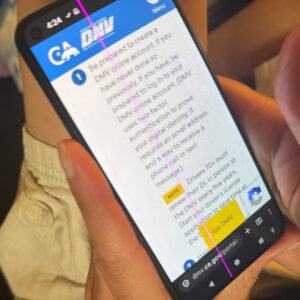
A cell phone held in a hand, showing the California DMV website. A bright magenta line is running vertically down the entire screen, including the status bar at the top and the onscreen buttons at the bottom.Today, a bright vertical magenta line appeared on my Pixel 5’s screen. I’d noticed it was running hot lately, and when I pulled it out of the case, sure enough it had started bulging.

I know it’s old. I’ve been trying to get as much use out of it as I can, which, well, I guess I have.

(Edit: added photo)

I do not like spicy pillows, Sam I Am.

So I reset the Fairphone and started setting up the most important apps: authenticator, password manager, stuff like that. And I set about unlocking the SIM protection on my phone number and got ready to call customer service.

I knew from experience that the Fairphone 4 works fine on T-Mobile’s US network, but their apps don’t know how to activate the e-sim. So I was prepared to talk someone through.

But because we’d been swapping back and forth between phones, the sim was still registered as attached to the teen’s number, even though the number is actually pointing to his current phone. It took over two hours (at least 45 minutes of that on hold) and three levels of escalation to first figure out that’s what the problem was, and then find someone with the access to fix it.

They did finally get it all sorted out, but it was not the way I wanted to spend my afternoon.

(And when I let the old phone cool off, the screen went back to normal, though it’s still bulging.)

Edge-on view of the phone showing that the glass screen is splitting away from the plastic case.

And to top it off, Nextcloud’s photo uploading has stopped working reliably, so I have to go through the last couple months of photos and make sure I have everything copied over. I went through some of them tonight, and need to get the rest…soon.

For now, I’ve turned the old phone off completely overnight.

Once I’ve got the photos transferred, I should figure out whether it’s worth repurposing the device with a new battery or just running it without one. And then dispose of the fire hazard.

Blaugust 2026: My Posts

I really wish GNOME’s “Oh No! Something went wrong!” screen would let me restart just the crashed components instead of forcing me to log out completely. Or let me decide if I’m willing to continue without whatever crashed. If the audio broke, and I’m not doing anything that needs sound right now, it shouldn’t block me! — just like if the extension I’m

Heck, I’d even settle for just being able to interact with the applications that are still running. I can see them on the overview, and the thumbnails still update! Fortunately I haven’t had it happen while I was editing something, but I’d sure like to be able to click on “save” if I need to!

When I first started using Linux, it was a lot less stable than it is today, but when something broke, I always felt like I could fix it. Even if a window manager crashed, I could relaunch it and pick up where I left off.

I keep coming back to GNOME, but it has an infurating tendency to weld the hood shut on things that “just work” most of the time, because you should never need to fix that issue! (See also: Geary not offering manual sync, GNOME Software wanting to reboot the system when you update Firefox, etc.)

I’ve been meaning to disconnect from Jetpack for a while now. This seems like a good time to do it, and to finally clear out the older Tumblr and WordPress.com blogs I don’t use anymore.

Tumblr and WordPress to Sell Users’ Data to Train AI Tools404 Media

It’s the kind of thing that you expect from Google or Facebook, or from any number of start-ups, but there’s been this sense that Automattic should know better — and with Tumblr being login-walled and ad-saturated, and the push to upsell in their WordPress plugins, and now this…it’s looking like they don’t.

I don’t think they’ve hit the “trust thermocline” yet, but selling user data is a pretty clear line.

As for AI access to the Firehose: My previous understanding of the firehose is that it’s basically an aggregation of what you’d see in a bunch of blogs’ public RSS feeds. Which, OK, fine. Analyze your heart out. Display my posts in your RSS reader. Just make sure private posts and comments don’t leak.

But LLM training isn’t the same as analytics, or showing a properly attributed post in a reader. And quietly changing the terms to allow more kinds of re-use on something most people using the service don’t know about? Not cool.

And not making it clear what is and isn’t included for which purposes? That breaks down trust.

Before this, I wasn’t worried about the Firehose. But now I’m not sure I can trust Akismet, never mind Jetpack, and I’m looking for a new spam filter.

Originally posted across several threads through my GoToSocial test site.

Update: Automattic did clarify that self-hosted blogs with Jetpack are not included in the training data. Only company-hosted blogs on Tumblr and WordPress.com. But I still uninstalled Jetpack from this site, just to be sure. Like I said, I’d been meaning to for a while.

It’s been 18 years since drug companies replaced pseudoephedrine with phenylephrine to keep their cold medications available over the counter when the people waging War On Drugs(tm) decided to restrict the main ingredient in Sudafed (and what it was named after) because it could be used to make meth.

Though I remember some other decongestant plugging the idea that “unlike those medications, we chose not to change our formulation…” Yeah, because you weren’t using an ingredient that got semi-banned!

From the start, the new formulation clearly wasn’t as effective. When I found out that I could still buy the real medication as long as I asked at the pharmacy counter (and showed ID so that the DEA or whoever knows I’m not trying to get around limits by hitting every pharmacy in town), I stopped bothering with the OTC versions entirely.

I wasn’t surprised when studies showed that phenylephrine doesn’t work.

Back in 2015.

(Restricting sales of the real stuff didn’t seem to make much of a dent in the meth problem, either.)

“Only” eight years later, the FDA reached the same conclusion.

And yet the industry is complaining that “if oral phenylephrine were not available over the counter, it would be a significant burden to consumers.”

HOW?????

It doesn’t work. People who buy it are wasting their time and money on snake oil instead of buying a different medication that might actually do something for them. (Not that this is a problem for the supplement industry, where “not evaluated by the FDA” might as well be a selling point.)

We all ended up worse off: cold meds that don’t work, submitting to surveillance to get the meds that do work, and it didn’t even slow down the meth epidemic.

Update: It took another year for the FDA to recommend pulling it.

Food companies are adding sesame flour to foods that didn’t have sesame so they can “comply” with new labeling requirements by always labeling “contains sesame” instead of instead of adding it to their existing cross-contamination protocols.

Meaning people with sesame allergy are suddenly finding that foods they used to be able to eat are now hazardous.

This is like a skydiving outfit deciding to stop maintaining their parachutes and disavow responsibility in their waiver instead of complying with a requirement to maintain their parachutes a little better than they were doing before.

Actually it’s worse than that. It’s like actively damaging some of the parachutes, and adding fine print saying that people who want well-maintained parachutes shouldn’t fly with them. And not mentioning it to repeat customers outside of that fine print.

You wouldn’t add wheat to a dish just to avoid having to guarantee it was gluten-free. Or add lead to your water so you don’t have to worry about keeping environmental contamination out. Or…

Ugh, those sound way too probable. People can be awful sometimes, and business has a tendency to remove ethics from decision making.

Update: Malicious compliance is a good term for it.

Not the first time

And apparently this wasn’t the first time companies have done this crap, either. After the 2016 labeling law went into effect, some companies added peanut flour to foods that didn’t have it. Not enough to impact the baking or texture or flavor…but enough to trigger an allergic reaction.

Disturbingly, I missed that previous round. I say disturbingly because I actually am allergic to peanuts, so I’m lucky I didn’t end up in the ER from something that used to be safe. I can only think of two explanations for why I didn’t notice:

By 2016, I was doing most of my grocery shopping at some of the slightly crunchier stores, and buying snacks from smaller brands that were either less likely to take that shortcut, or already had foods I was allergic to by the time I took my first look at the ingredients panel.

2016 was also the year the Epi-Pen price-gouging scandal boiled over.

Corporations behaving badly

Pharma giant Mylan had already gained a virtual monopoly on epinephrine auto-injectors. After FARE spent years lobbying for states to require epinephrine to be stocked in schools for emergencies, Mylan raised the price of the auto-injector drastically (a factor of 5 or 6), to the point where many people who needed them couldn’t afford it anymore.

Whether FARE was used itself, or a co-conspirator who used its members, I lost a lot of trust in them and stopped following their newsletters as closely. That was also the last year I participated in FARE’s Walk for Food Allergy fundraiser, and I only did that after they stopped accepting money from Mylan.

(Interesting note: The Intercept article mentions that Mylan deliberately set out to stop selling single Epi-Pens in the early 2010s and only sell the two-packs in order to justify charging more. I was already carrying two-pack at my allergist’s recommendation, which turned out to be highly fortunate the time in 2006 or so when I was hit by anaphylaxis and messed up the first injection.)

Expanded from a thread on Wandering.shop

»All pages site-wide with this tag