Sure, I like electronic gadgets. But I dislike planned obsolescence more.

It’s one thing when the newer model really is that much better. “All About the Pentiums” exaggerated it, but computer hardware in the 1990s really was improving by leaps and bounds. (And the software was devouring those performance gains, both in demanding more resources, and being less efficient as programmers were told to optimize for their own time, not for disk space or RAM.) That eventually settled out around the time smartphones and cloud computing started taking off, which is why I was able to run a 2012 model CPU all the way through 2024. A faster PC would have been nice, but I didn’t need one yet.

As I recall the tech industry freaked out when demand for new PCs dropped. There was probably a rash of “Millennials are killing computers!” articles.

But smartphones were going through the same kind of rapid improvement. You could easily justify buying a new phone after only two years: it was a lot faster, had a better display, had a better camera and more storage, and so on. And the carriers were happy to hand you a “free” new device to keep you on their service. Heck, if you really wanted (and could afford) to buy a new phone every year, you could make a case for it.

In that environment, you could kind of accept a company only offering 2-3 years of support for their phones.

Eventually that settled out too, and it takes longer for new phones to really be worth the upgrade. Of course the industry has tried to keep the pace going. If the hardware still works, and it’s still able to run the apps people want to use, there’s no good reason for the company to stop supporting it after only three. Especially with something whose main purpose is to be constantly connected to the Internet.

I have an Android phone from 2020 and a tablet from 2019. The tablet still works fine. (It’s great for digital comics, or PDFs that are pre-formatted for 8.5×11″ pages.) The phone worked until two days ago. (Technically it still does, but I don’t want to overload the already-swollen battery.) But they’re both unsupported. Not because the hardware has failed (up until Monday). Not, like the Poke3, because they can’t handle today’s apps. Simply because Google and Samsung don’t want to provide updates anymore. Not even bugfixes. Not even security fixes.

It’s maddening.

Especially with prices on new electronics skyrocketing due to the AI datacenter-driven RAMpocalypse.

There are many things I dislike about Microsoft, but I appreciate that they finally realized that a large chunk of their customer base can’t or won’t upgrade their hardware just to install Windows 11, no matter how they try to convince us, and has extended Windows 10 support twice with minimal hoops to jump through.

The Fairphone 4 (2021) that I pressed into service to replace the dying Pixel 5 (2020) is more or less comparable in terms of speed. I still need to experiment with the camera. But it’s still supported through 2028, meaning it’s safer to use online. Which, again, is what cell phones are for.
Blaugust 2026: My Posts

I think there’s been a lot of talking past each other on privacy lately because there are so many layers to it.

Google or Dropbox keeping your cloud files from showing up on someone else’s drive or a public share is one layer. Keeping your data from leaking in a data breach is another. Protecting messages in transit from your device to their service. Google and Meta (Facebook, Instagram, and now Threads) are good at those.

But then there’s ensuring that Google or Meta doesn’t misuse it themselves, or sell it to someone who will.

And, well, to put it mildly, they’re not so big on that aspect!

Continue reading

Eventbrite has worked well for buying tickets to events I’ve attended…

But over the last few months I keep getting spam for events that are not only not remotely interesting, they aren’t anywhere NEAR me. Sorry, but I’m not hopping on a plane for a pub crawl on the other side of the continent or a 2-hour “gong bath experience” on the other side of the planet.

At first I thought they were bogus. But everything pointed to Eventbrite’s servers. I’ve been blocking the campaigns in Eventbrite as I get them, but at this point my account settings show 10 organizations I’ve blocked, even though I’ve theoretically unsubscribed from “all Eventbrite newsletters and updates for attendees.”

Of course searching online is useless, because (1) everything’s about how organizers can keep their messages from landing in spam folders, and (2) searching online in 2023 is more or less useless anyway. It’s the end result of years of SEO trying to get into the first page (now with generative AI to flood the zone with even more bullshit!) combined with Google and Bing giving up on trying to give relevant results when what they really care about is ad impressions — and no, DuckDuckGo results aren’t much better.

I haven’t bought tickets to an event that uses Eventbrite since 2019 (for obvious reasons). I’m thinking at this point I should just cancel my account [Update: I did], and the next time I want to go somewhere that uses them for tickets, I can open a new one. With a different address.

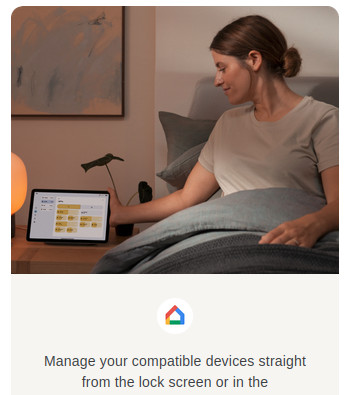
A woman sits in bed, reaching for a tablet device on the night stand. Just behind her hand is a houseplant with a long stem and one leaf, seen almost on edge such that it looks like a claw hammer in profile.

From an ad Google sent out today for their new Pixel Tablet, where they’re plugging it as a hub for controlling “smart home” devices. At first glance, it looked like she was about to smash it with a hammer.

I suppose that says something about my attitude toward IOT?

(At second glance, it looked like a hummingbird sculpture on a post. At third glance I realized it was a houseplant.)

The Verge makes an interesting point about Microsoft’s acquisition of Bethesda: for the most part, Microsoft doesn’t care what hardware you run their stuff on, they just want you to buy the software. So it’s less likely to be about trying to gain Xbox exclusives and more likely to be about getting more games for Game Pass.

It reminds me of a blog post I read a few years back comparing the core businesses of various major tech players:

  • Apple sells hardware, and their software and media stores are a way to give you something to do with the hardware.
  • Microsoft sells software, and the hardware is to give you something to run their software on.
  • Google sells ads on services, and their hardware, operating systems, and software (Android, Pixel, Chromebooks, Chrome, etc. ) are there to connect you to their services.
  • Amazon sells stuff, and their hardware is a way to sell you virtual (and sometimes physical) stuff.

That’s why, for instance, you can run Gmail on anything, and Microsoft Office on almost anything, but iTunes, the main Apple program that actually runs on a non-Apple system, is designed primarily to hook you up with an iPhone (previously an iPod). And it’s why you can read Kindle eBooks on a Kindle device, or a Kindle app on an Android or iOS device, and they make it really easy to buy e-books from them, but really inconvenient to import anything from another eBook store.

Facebook is similar to Google in that their core strategy is a service with ads, and their apps and (when they branch out into it with things like Portal) hardware are ways to keep you using their services. Heck, they’re even tying the Oculus headsets to Facebook accounts now.

The post predates the rise of smart speakers and doorbells…but remember how the Echo was originally mostly a way to voice-order things through Amazon? Or Amazon Key, whose primary purpose was to allow delivery services to drop off packages inside your house so you wouldn’t have to worry about porch pirates?

Plus of course everyone wants to sell you subscriptions now!

And yet…it still fits remarkably well.

I never thought I’d see Microsoft throw in the towel on their browser engine. Or that, by the time it happened, I’d see that as a bad thing.

But it’s true: like Opera did a few years ago, Microsoft is dropping not only the old Internet Explorer engine, but the newer Edge engine, and will be building Edge on Chromium going forward. That means Edge, Chrome, Opera and Safari are all built on the same codebase. (Chromium split from Apple’s WebKit a while back, but they still have a lot in common.)

Monoculture is still a problem, no matter who runs it. We’re already at the point where webdevs are treating Chrome like the defacto standard, the way they did IE6 back in the day.

Firefox is going to be even more important in the future, ensuring that the web continues to be built on interoperable standards instead of one stakeholder’s goals.

Mozilla is a non-profit organization, and like many, they’re running a year-end donation drive. Now is a good time to contribute to their mission to keep the internet and the web open. (I’ve already made my annual donation to them.)

I think I may want to finally shut down or retool that old Alternative Browser Alliance site I ran during the Second Browser War. The last time I made a significant update to it, Chrome was the new upstart.

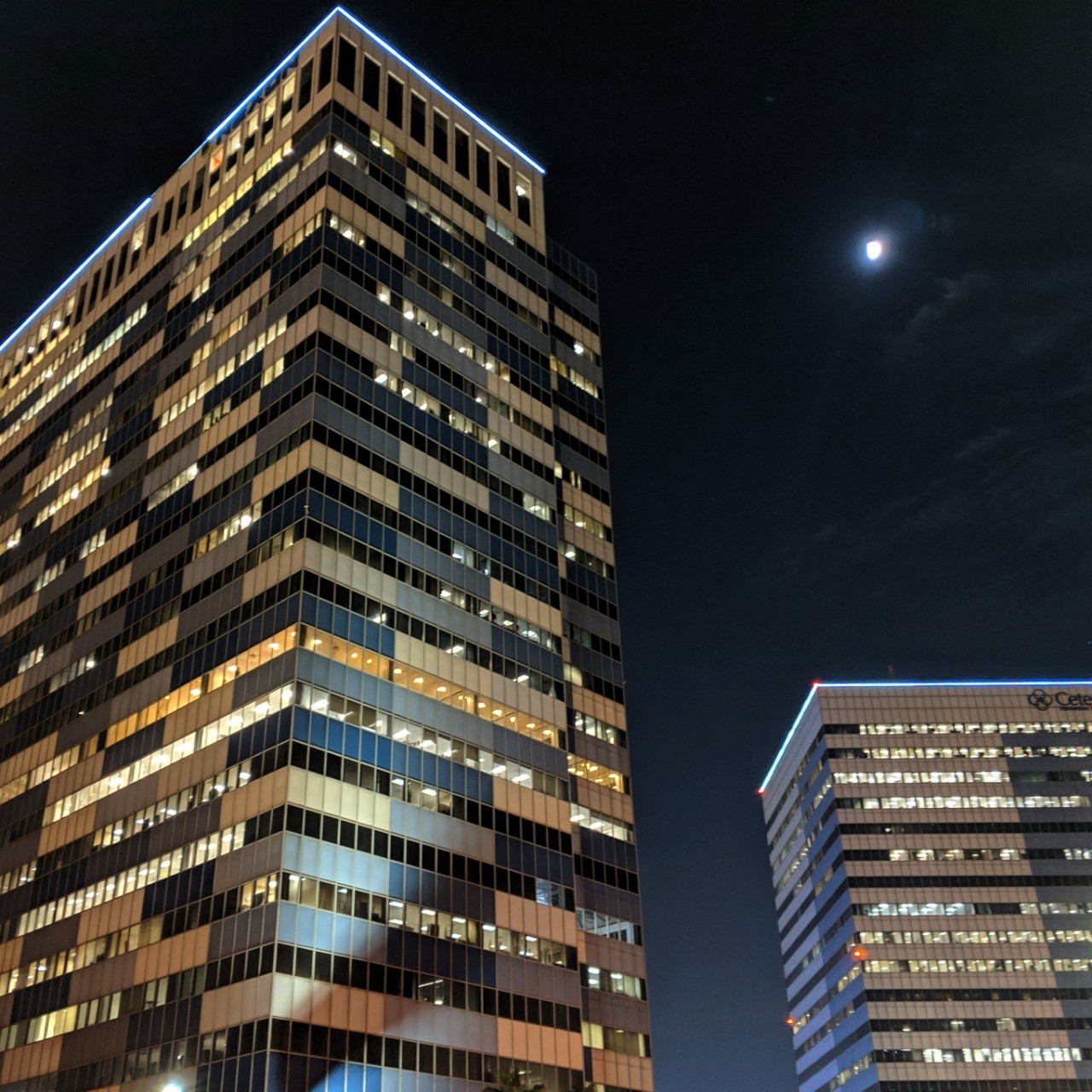
Google has a new camera mode on its Pixel phones called Night Sight, for handling low-light conditions. The short version is that instead of taking a long exposure, it takes a series of short exposures and stacks them to avoid motion blur from hand movements (plus a lot of additional processing). The long version is fascinating. My Pixel 2 already takes better low-light photos than I would have expected, but I couldn’t wait to try out the new feature when I learned about it. When the updated Camera app finally hit the Play Store, I had to give it a try. Two high-rise office buildings at night. This is adjusted slightly to keep the colors from being too light. And it actually isn’t the best example, as it turns out the nighttime city scene already has enough light for the existing HDR+ mode. I’m going to have to try it on some darker scenes somewhere, but it’s still pretty cool. After the cut I’m posting a version with the phone’s regular mode, and the unaltered Night Sight photo. You can see they’re pretty close, but the Night Sight version picks up a bit more of the color, and it’s a little brighter. Continue reading

ยปAll pages site-wide with this tag