

Took the Macbook in for battery service yesterday. Fortunately it was easy to tell which store to bring it to!
Took the Macbook in for battery service yesterday. Fortunately it was easy to tell which store to bring it to!
The Verge makes an interesting point about Microsoft’s acquisition of Bethesda: for the most part, Microsoft doesn’t care what hardware you run their stuff on, they just want you to buy the software. So it’s less likely to be about trying to gain Xbox exclusives and more likely to be about getting more games for Game Pass.
It reminds me of a blog post I read a few years back comparing the core businesses of various major tech players:
That’s why, for instance, you can run Gmail on anything, and Microsoft Office on almost anything, but iTunes, the main Apple program that actually runs on a non-Apple system, is designed primarily to hook you up with an iPhone (previously an iPod). And it’s why you can read Kindle eBooks on a Kindle device, or a Kindle app on an Android or iOS device, and they make it really easy to buy e-books from them, but really inconvenient to import anything from another eBook store.
Facebook is similar to Google in that their core strategy is a service with ads, and their apps and (when they branch out into it with things like Portal) hardware are ways to keep you using their services. Heck, they’re even tying the Oculus headsets to Facebook accounts now.
The post predates the rise of smart speakers and doorbells…but remember how the Echo was originally mostly a way to voice-order things through Amazon? Or Amazon Key, whose primary purpose was to allow delivery services to drop off packages inside your house so you wouldn’t have to worry about porch pirates?
Plus of course everyone wants to sell you subscriptions now!
And yet…it still fits remarkably well.
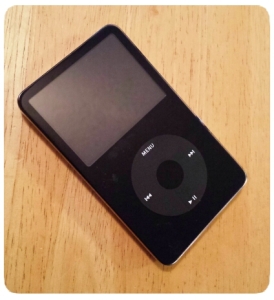 As I moved our iTunes library last week, I worried that the new system might not be able to sync with the old iPod, but relaxed when I saw that Apple still sold the click-wheel iPod Classic. They discontinued it a few days later, but fortunately we were able to sync the old devices.
Why do I prefer the older iPods with physical buttons and tiny screens?
Because I listen to music in the car, and a touch screen is a terrible interface for quick actions while driving.
While touch screens are better for menus, searches, finding albums, playlists, artists, and just about anything else, they’re actually dangerous for driving. A physical control of some sort is best for any action you might have to take while behind the wheel of a moving car.
Pause/Play, Skip and Volume. Those are the key things you want to be able to do with music without thinking too much about where you’re reaching, or taking your eyes off the road. (Especially if you have a mix of quiet and loud songs.) Volume’s on the dashboard, but it’s so much easier — and safer — to hit an actual button for pause/play or skip than to jab at the touch screen until you get it right.

I don’t know about paranoia, but there’s certainly a lot of anxiety about jobs these days…
Apple and Amazon have settled their two-year legal dispute over the term “app store.”
It’s about time common sense prevailed. Even though Apple had the gall to deny it, “app store” is as obviously descriptive of a store selling apps as “book store” is of a store selling books, or “grocery store” of a store selling groceries. Insisting on trademark protection was ridiculous.
Actually, that reminds me of the time way back when that Barnes & Noble (I think it was B&N, anyway) tried to bring a false advertising claim against Amazon for saying that they were the world’s largest book store. The idea was that since Amazon didn’t have a physical storefront, they weren’t a book store, but a book seller. I seem to recall that didn’t stick either, but took a similarly ridiculous time to settle out.
The other night I had to take the MacBook into the Apple store to get it checked out after a toddler-related spill. I got there for my appointment and waited…and waited…and waited….
Killing time with my Android phone felt a bit weird. If I hadn’t needed to stay close to the Genius Bar I could have at least browsed the gadgets and played with an iPad or a newer laptop with a Retina display, or something. There’s only so long you can spend looking at boxes of headphones and cases for devices you don’t own. I briefly considered reading the new Flash comic book I’d picked up earlier in the day, but thought to myself, “Nah, I bet this isn’t supported here.”
Then I saw this on the wall:

Well then, I guess it’s supported after all!
A few months ago, Amazon opened a section of their online store where they sell apps for Android devices. Following the same boring-but-descriptive naming scheme that Microsoft pioneered with such products as a word processor called Microsoft Word, a flight simulator called Microsoft Flight Simulator, an windowed desktop called Microsoft Windows, and so forth, they call it the Amazon Appstore. (Edit: I’d forgotten that Microsoft themselves filed a complaint over Apple’s “App Store” trademark in January, which was rather amusing.)
Apple, of course, is suing them for trademark infringement. Amazon’s stance: “App store” is a generic, descriptive term for a store that sells apps. Apple counters: “Is not!”
It’s a bit more eloquent than that, but look at this:
“Apple admits that the current edition of the Oxford English Dictionary defines ‘app’ as, in part, ‘[a]n application, esp. an application program,” Apple said in the court filing. “Apple further admits that the current edition of the New Oxford American Dictionary defines ‘store’ as, in part, ‘a retail establishment selling items to the public: a health-food store.'”
And the best part:
“Apple denies that, based on their common meaning, the words ‘app store’ together denote a store for apps,” the document said. [emphasis added]
Really? Funny, I thought that was how the English language worked.
(In the interest of full disclosure: I own an Apple laptop, and Android phone, and use Amazon’s affiliate program…but not their app store.)