Dry lot in Irvine SpectrumOver the last week or so, newspapers and radio announcements have been proclaiming that California is experiencing drier than usual conditions, already using its reserves for day-to-day living, and we should really start saving water now.

Finally.

We really could have used this campaign earlier in the year. We knew by the end of spring that it had been a really dry season. There were articles in the newspapers, though they weren’t screaming for attention on the front page. Water districts were aware of it. Or, if you’re the sort to pay attention to such things, you might have noticed that the hills still hadn’t turned green by April.

But ads on the radio, encouraging people to conserve, plugging a website with water-saving tips?* I didn’t hear a single one until a few days ago.

I grew up in California in the 1980s, during which we had some really wet years followed by a major drought. It never got really bad where I was, but I remember a lot of little things that changed. Before, restaurants would set down one glass of water for each person, as soon as they showed you to your table. Afterward, they asked whether you wanted water. They taught us water-saving tips in school, like not leaving the water running while you brush your teeth, or taking what they called “navy showers”—turning off the water in the middle of the shower, when you’re not actually using it.

I’ve been looking around some sites on water conservation, and so many of the tips are things I remember from 20 years ago.

Mt. Saddleback viewed from Tustin foothills

It seems like the population has been slowly forgetting these water-saving habits. Or maybe we’ve just had enough people come in from other areas that don’t have them. In the last few years, I’ve seen some restaurants plopping down those glasses of water without asking. I’ve seen people hosing down sidewalks. And while I turn the water off when I brush my teeth, I went back to normal showers years ago (though lately I’ve made an effort to keep them short).

And now, suddenly we’ve got a crisis on our hands.

A lot of the standard tips aren’t massive inconveniences. They’re simple tactics: Water your lawn in the morning, so that the water doesn’t evaporate before it has a chance to seep in. Fix leaks. Keep your showers short. Don’t toss stuff in the toilet that can go in the trash can. Use a broom instead of a hose to clean the sidewalk. These are things we should be doing all the time, not just when things get bad enough to start tossing around the “d” word.

Something to think about when things settle back to normal. Well, as normal as they get around California, anyway.

*According to the whois record, bewaterwise.com has been around for 4 years.

Posted as part of Blog Action Day.

Flash v.1 #193: Captain Cold holds up a photo labeled 'Censored' and says, They wouldn't let me show you what I did to the Flash.  Do you dare read this issue and find out for yourself!?I didn’t think I had anything to add to the discussion on the infamous Heroes For Hire #13 cover. (Some of those links possibly NSFW.) Something stuck in my mind, though. Typolad suggested that “you would never, ever see Marvel or DC make a cover like this with a male protagonist. Yes, a male hero may be shown in peril, but his face will be defiant. He won’t be shown as submissive.” Lea Hernandez’ remix of the cover alters the expressions to do just that.

Now, I agree—that cover was way past the line, and I can’t imagine DC or Marvel doing the same thing with male characters, especially when you take into account the sleaze factor. But phrases like “never, ever” tend to read like a challenge. Looking just at the defiant/passive stance, I knew I’d seen at least one cover with the Flash beaten to within an inch of his life, unable to put up a fight or even a glare, so I took a trip through the Grand Comics Database’s cover gallery. Continue reading

NPR’s “Morning Edition” ran a story today on the rise of the Spanish-language television market, and Univision in particular. They led into it with a remark that Spanish-language coverage of the World Cup has been getting higher ratings than the English-language coverage.

This should surprise no one, given that soccer (as we norteamericanos call what everyone else seems to refer to as football) isn’t terribly popular in the USA, with two notable exceptions: Parents of 6-year-olds who want to put their children into a sport, and the duration of the World Cup. El fútbol, however, is wildly popular in Europe and Latin America, and we have a lot of recent immigrants from Latin America.

So no, I wouldn’t be surprised at all to learn that there are more Spanish-speaking hardcore soccer fans than English-speaking ones.

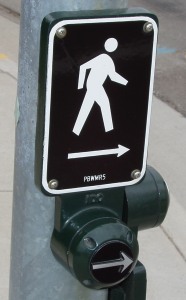
Walk button with raised arrow.I recently took a walk through some streets that have only recently opened to traffic. One of the things that struck me was that the buttons for triggering the walk/don’t walk signs had a new design. Instead of a tiny recessed button, or a larger rounded button, they had a ~2″ flat button with a raised arrow.

My first thought was, why the extra arrow? It’s pointing in the same direction as the sign. And it means you have to press the button carefully instead of just whacking it with your hand. The answer hit me later in the walk. I was leaning on the button with my hand when the light changed, I and felt the button vibrating. Of course! It was for blind pedestrians!

The raised arrow makes it easier to hit the right button, rather than just hope that the buttons have been placed in standard orientation. And vibrating the button makes it clear not only that it’s safe to cross, but in which direction it’s safe to cross. That’s one thing I could never figure out about the chirping walk signs in San Diego. It tells you the light’s changed, but if there’s any indication as to which light is green, I’ve never noticed it.

Yesterday, Mark Evanier quoted Justice Antonin Scalia using an aphorism in a debate on government funding of the arts. The phrase he used:

“He who pays the piper calls the tune.”

It’s a reminder that the person who funds something invariably has a say in just what they’ve funded. (In this case, he pointed out that simply by choosing to fund some artistic endeavors, you have to choose which arts you fund.) But it reminded me of a similar phrase with a very different meaning:

“It’s time to pay the piper.”

In this case, the meaning is basically, OK, you’ve had your fun, now you need to pay the price. I don’t know for sure, but I suspect it comes from the story of the Pied Piper of Hamelin, in which the townspeople refused to pay him after he led all the town’s rats to drown in the river—so he exacted revenge by leading all the town’s children away. Not surprisingly, it’s this phrase that’s most often used with the Flash villain/ally of that name.

It’s interesting that two phrases with the same archaic base—who would describe a musician as a “piper” these days?—should be so different.

This is incredibly bizarre. Today I’ve started getting spam which is clearly coming from zombies and using fake return addresses and forged headers, but the content is a plaintext message encouraging hurricane relief donations and linking to the legitimate Red Cross and FEMA websites. There’s one further link, to arc.convio.net, but the ISC reports that the site is legit.

It literally looks like some spammer decided to encourage donations to the relief effort, picked an organization he figured most people would recognize, and plugged the message into his usual spam software.

I can’t decide what to do about them! On one hand, they’re spam. They’re unsolicited, they’re using spammer techniques, and they’re clearly not associated with the Red Cross. And we’ve always said the issue is “consent, not content.” But if the ISC is right, they’re not trying to pull a fast one like the scams and spyware installers that are leeching off of the catastrophe.

I keep thinking I should train the filter on them anyway, just like I would add political or religious spam, or an everyday charity that decided to start spamming for donations… but for some reason I just can’t bring myself to do it.

I’m thinking of a word. The definition is “a feeling of shock, sadness, compassion and sometimes guilty relief in response to a disaster that happens somewhere else.” It’s not “horror,” “rage,” pity,” or “sympathy.” It could be German in origin. It’s what a good chunk of the world felt after last year’s tsunami, and it’s what a goodly number of Americans are feeling now about Hurricane Katrina.

And it doesn’t exist.

People are good at making up words. The variety of creations added to the OED each year, and the number of suggestions that are rejected, prove that beyond a doubt. We even make up words without meaning to, running together utterances like “bighuge” and “goaheadand.” We have a word—emo—for “loud, emotionally charged pop-punk music.” Some of us know the word schadenfreude and aren’t afraid to use it. If we can encapsulate stuff like this, we should be able to pick a word or two to define the enhanced survivors’ guilt and horrific fascination, laced with uncharacteristic compassion, gripping so many of us.

So far, we haven’t.

Disasters happen all the time, and always have. We’re just getting better at broadcasting them all. Before the age of telegraph and radio, it was often too late to send rescue-type aid by the time bad news arrived. Today, we can get the news in an instant, but the majority of us are simply unable to give the kind of aid—airlifts, rebuilding, law and order—we perceive as most meaningful. We are isolated by distance and circumstance, so we send money, and watch, and hope. The more we are able to watch, the more we need a word for what’s making us watch. So everybody who’s working on the projects for how to write “whole nother” and finding the modern negative of “used to,” you have a new assignment. Due date: next disaster.

»All pages site-wide with this tag