Step 1: Refuse to confirm a SCOTUS judge for a year.
Step 2: Install a judge you prefer.
Step 3: Get a SCOTUS ruling upholding a voter purge law that disproportionately impacts people who are more likely to vote for your opponents.

Voter purges aren’t about getting rid of invalid registrations. They’re about suppressing votes. The US, unfortunately, has a long history of finding ways to disenfranchise a group without explicitly identifying them. Look up where “grandfather clause” came from.

The modern version is subtler, but it works like this:

You want more people from group A to be able to vote than group B. Find some classification that applies to more members of group B than group A. Target that classification, and you change the balance of the electorate.

What Ohio did was notice that members of one major party tend to vote in every election, while members of the other tend to skip elections where they don’t feel they have a good choice.

Technically they targeted occasional voters.
Effectively they targeted a political party.
A family member was incorrectly removed from the voting rolls. She hasn’t moved in about 7 years, hasn’t done anything to lose eligibility, and has been active in every election during that time. Even the local ones.

She cast a provisional ballot and is trying to sort out what the hell happened to her registration.

Lessons learned:

  1. Just because you HAVE registered to vote doesn’t mean the state or county hasn’t lost your info since then through a screw-up (or malice).
  2. California has a process for this on election day, but it’s better to check first.

What happened?

It’s not clear what caused her case, but she was far from the only one with similar problems in this election.

Santa Clara county dropped voters from the rolls through a broken de-duplication effort. And in Los Angeles County, over 100,000 registered voters are missing from the rosters due to a “printing glitch.”

I don’t like to be paranoid, but one of the two major political parties in the US loves suppressing voter participation in areas and demographics that lean toward the other party.

And San Jose and Los Angeles do lean toward that other party.

Imagine a dangerous road curve. Do you blame the drivers and call it a day? After all, not everyone crashes over the edge or into oncoming traffic.

Or do you bank the turn, calculate a safe speed limit and add a railing?

It won’t stop all crashes, but it’ll reduce them.

Re-engineering the road doesn’t ignore the driver’s decisions, but it acknowledges that they don’t happen in isolation. Change the circumstances, and you change how many drivers crash and burn.

Net Neutrality ensures your cable company can’t pick winners and losers from the sites you visit and services you use online. It was a guiding principle of the net until ISPs tried to violate it. After a long effort, the FCC stepped in and made the principle a legal requirement in the US.

The new FCC is rolling it all back, which helps no one except Comcast, AT&T, etc. Congress can stop it. The big ISPs are trying to present it as big government vs. business in order to make it partisan.

It’s not government vs. business. It’s everyone vs. your cable company.

Net Neutrality helps you, your business, your friends, your political organization, the people who make your favorite shows, games and books, literally everyone except the big ISPs. (And possibly entrenched players with deep pockets who would cheerfully let ISPs stifle any start-ups that might threaten them with *gasp* competition.)

The Senate is voting soon on a resolution to undo the FCC’s rollback and keep net neutrality alive. But those big ISPs have convinced most of the GOP senators that they’re the only side that matters. We need to convince them otherwise. Right now we need one more vote in the Senate to pass the CRA, and then we can move on to the House.

Contact your lawmakers today at Battle for the Net!

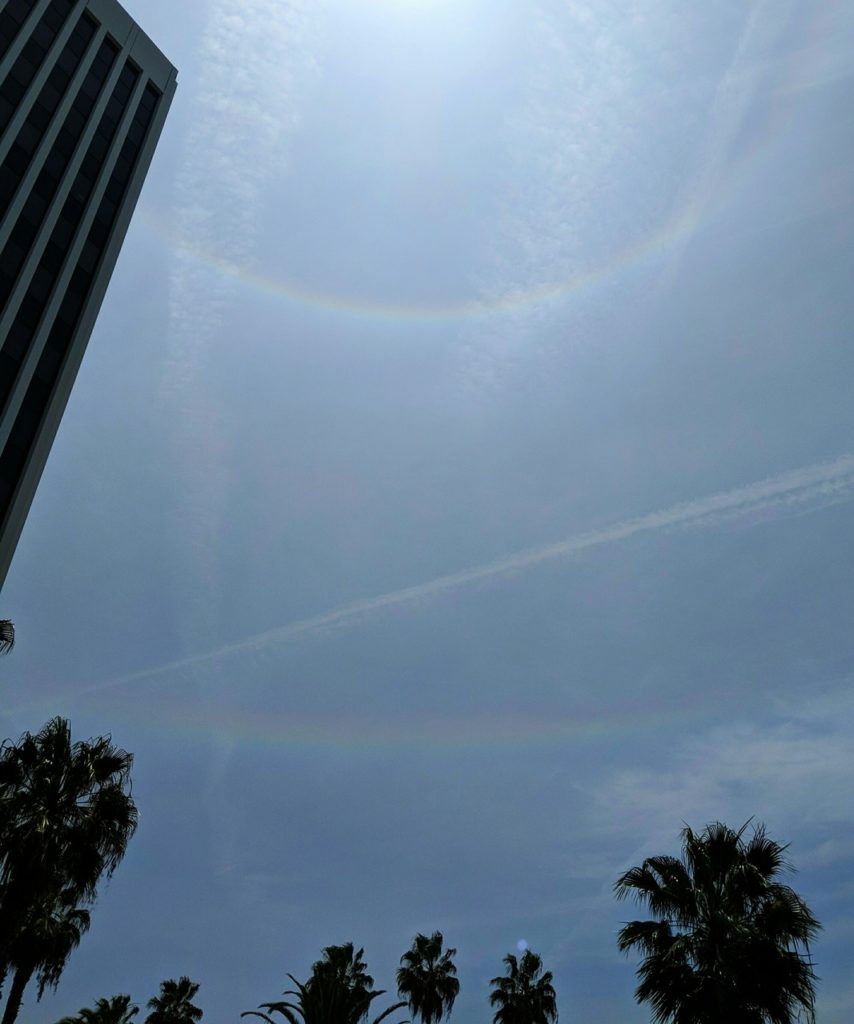
Thin clouds and contrails cross the sky. A bright rainbow-like ring circles a spot just out of view above the frame. A fainter rainbow-like line runs across the sky below it.

Two solar ice halos spotted at lunch today.

The 22° halo around the sun is really bright and clear, and not that uncommon even in Los Angeles. I’ve seen so many that I still take photos, but I often forget to post them unless there’s something unusual about the view.

The circumhorizon arc below it, on the other hand, I’ve only seen a few times, usually fragments. It’s faint, but it’s the longest and least wispy of these arcs that I’ve seen (though the best was probably this one from 2010).

The lower one could be an infralateral arc. It wasn’t quite long enough to tell in person whether it curved upward or was parallel to the horizon, and it’s hard to tell how much of the curve in the photo is due to lens distortion. But according to Atmospheric Optics, they’re a lot rarer than circumhorizon arcs.

It’s cool to be able to get pictures of these with my phone. There was a time I’d run to get a camera and hope it wouldn’t fade first.

Saturation enhanced. It was really hazy!

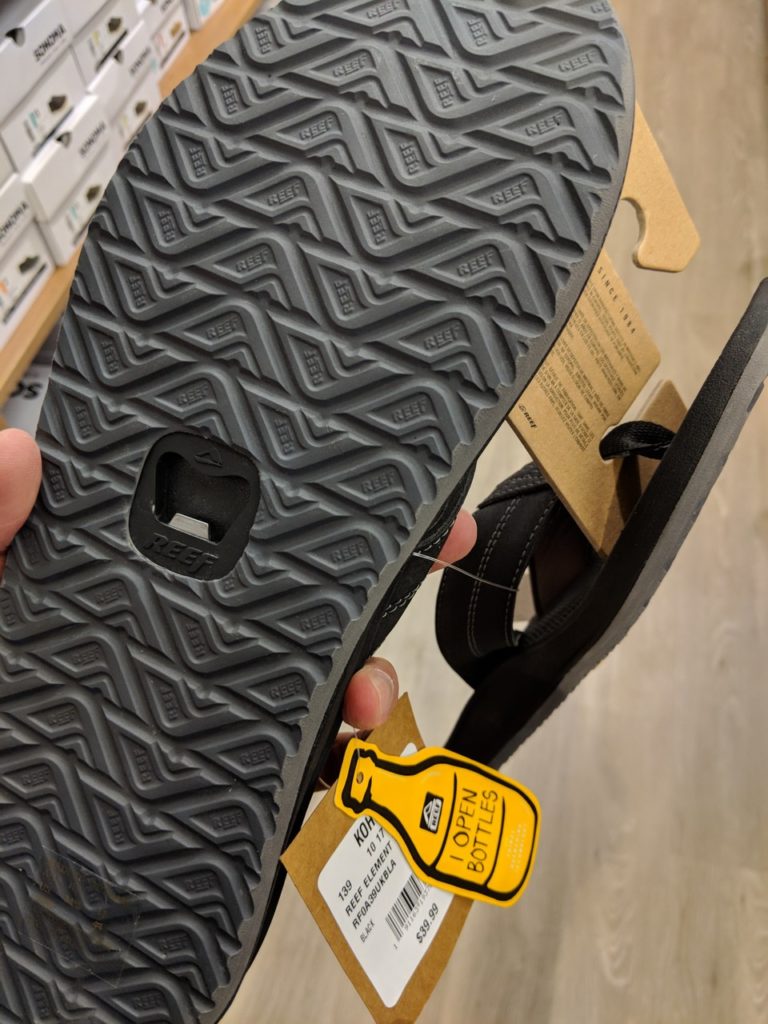
I was looking for sandals and found these. They’re flip flops with a built in bottle opener, I suppose to make them more…cool? Gadget-y? But it’s on the sole of the shoe.

Someone really didn’t think this design through.

Update: There are some replies at Wandering Shop from people who’ve worn or used these. Apparently there’s another variation with a built-in flask.

»All pages site-wide with this tag