DC Comics recently canceled its Minx line of graphic novels aimed at teen girls, leading to much discussion amongst comics bloggers. I don’t want to talk about why the line folded, but why the line existed in the first place. Why did DC create an entirely new brand in order to go after this audience?

A big advantage to creating a new label: no preconceptions. Prospective readers won’t look at the cover, see a DC logo, and wonder where the super-heroes show up and rip off people’s arms. And they won’t see a Vertigo logo and assume that it’s a “mature readers” book. On the downside, a new label has to build its credibility from the ground up, instead of starting with name recognition.

This got me thinking: an established brand associated with customers of one gender creates a new brand in order to target the other half of the population. Where else have I seen this?

I own a jacket labeled Claiborne, which is of course made by the Liz Claiborne company.

Mervyns sells (or used to) H&H Men clothing, which was clearly a variation on their Hillard and Hanson brand.

All the examples I could think of (other than Minx itself) were companies that had traditionally been aimed at women, but were adding lines aimed at men. It made me wonder: is it the names? Do men feel odd buying a product named “Liz,” while women are used to buying brands named after both men and women? (Sara Lee notwithstanding.) Maybe it’s the stigma of a man participating in something perceived as feminine? Sort of like the assumption in children’s TV that boys will only watch shows about boys, while girls will watch shows about girls or boys (so they make shows about boys instead of girls, figuring they’ll get a bigger audience).

Then Katie pointed out LEGO Belville, the line aimed at girls which entirely misses the point of LEGO by making as much of each set prefab as possible. And pink. On the plus side, unlike Claiborne, Belville doesn’t try to hide the fact that it’s a LEGO product.
That makes it more like Men’s Vogue, a copy of which is sitting in the lunch room at work. In this case they’d have to call it something different (unlike a clothing line) because it’s not just a brand, but the title of the magazine.

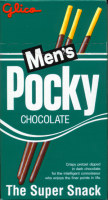
I still think the craziest example of this has to be Men’s Pocky. It’s a cookie. One which I’d hardly consider a “girlie” cookie, but maybe it’s more associated with girls in Japan. I still can’t figure out whether it’s a case of cultural translation or deliberate absurdity.
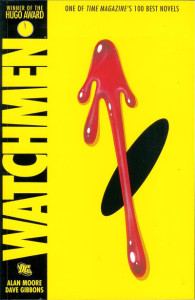
WatchmenDC Comics has posted a list of 30 Essential Graphic Novels (that are published by DC or one of their imprints).

I’ve read:

  • Watchmen
  • The League of Extraordinary Gentlemen vol. 1 & 2
  • V for Vendetta
  • Sandman vol. 1: Preludes & Nocturnes
  • Sandman: Endless Nights
  • Fables vol.1: Legends in Exile
  • Batman: Arkham Asylum
  • Batman: The Long Halloween
  • Batman: Dark Victory
  • Batman: The Dark Knight Returns
  • Batman: The Dark Knight Strikes Again
  • Kingdom Come
  • Identity Crisis
  • JLA vol.1: New World Order
  • Crisis on Infinite Earths
  • Transmetropolitan vol.1: Back on the Street

I haven’t read:

  • Superman for All Seasons
  • Superman: Birthright (but it’s on my to-read list)
  • Superman/Batman: Public Enemies
  • Batman: Year One
  • Batman: Hush vol.1 & vol.2
  • Green Lantern: Rebirth
  • The Quitter
  • Hellblazer: Original Sins
  • Y: The Last Man vol.1: Unmanned
  • Kamikaze Kaito Jeanne
  • Sword of the Dark Ones
  • Ex Machina vol.1: The First Hundred Days

The list is a bit heavy on Batman at a full 25% of the titles. And since it’s roughly 50/50 super-hero stuff and, well, other stuff, that means half their “essential” super-hero books are Batman. Come on, DC, show people a few more facets of your line!

On the plus side, they’ve chosen just one volume each for series like Transmetropolitan, Fables, etc.—so they can recommend as many different series as possible—and it’s the first volume. Unlike the well-known super-hero books, where the average potential reader probably knows enough to hit the ground running, it helps to start at the beginning, with a book that’s specifically designed to introduce each concept. And many of them are big, long stories. You wouldn’t recommend starting Lord of the Rings with The Two Towers, you’d tell someone to start with Fellowship of the Ring or get a combined edition.

Personally, I’d drop The Dark Knight Strikes Again (does anyone really consider it a “must read?”) and possibly the second volume of The League of Extraordinary Gentlemen. Maybe even Endless Nights, though I suppose it represents the overall tone of Sandman better than the first book does. Maybe Dark Victory, since it’s essentially a continuation of The Long Halloween. With the Justice League, I might replace New World Order with Rock of Ages.

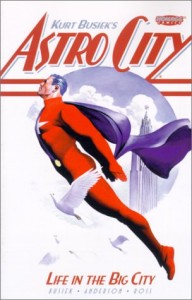
I’d add the first Astro City book, no questions asked. For the other space(s), I’d plug in something less well-known, but highly regarded. Maybe some more WildStorm, like Planetary
or The Authority Or how about a another DC hero, like Wonder Woman, Starman, or the Flash?

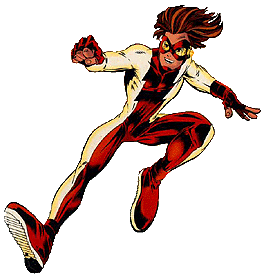
[Flash Logo]Last month, Comics Should Be Good ran a fan poll for the top 50 DC characters and top 50 Marvel characters. They’ve been posting the results over the last few weeks, finishing on Friday. The four main Flashes all made it to the top 50, and one even made it to the top 5.

#3.  Flash: Wally West
#29. Flash: Barry Allen
#41. Flash: Jay Garrick
#42. Kid Flash/Impulse: Bart Allen (tied with Bizarro)

Master list of all winners. Profiles of all four Flashes (and dozens of fill-in, alternate, and one-offs) at Flash: Those Who Ride the Lightning.

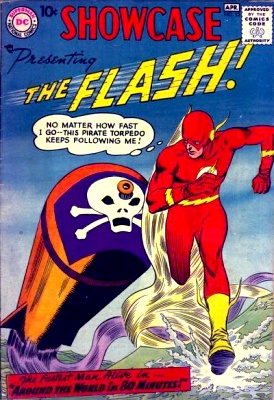
Arr! Barry Allen may not know how to celebrate Talk Like a Pirate Day, but he do celebrate Jog Like a Pirate Day!

Showcase #13: The Flash runs across the water from a torpedo with a pirate flag on front. 'No matter how fast I go---this pirate torpedo keeps following me!'

From Showcase #13, it’s “Around the World in 80 Minutes,” a tale of the Flash. (Mostly he runs around the world, helps people out, and gets kissed by women. Aye, it be good to be a superhero.)

(Cover via GCD. This story appears in Showcase Presents: The Flash vol.1 and The Flash Archives vol.1.)

OK, DC’s next big event is called Final Crisis. Does anyone believe they’ll simply stop with the events? They might actually stop putting the word “crisis” in the title, I suppose, but what will they call the next event after?

  • Final Crisis II
  • Post-Final Crisis
  • Final Crisis X-2
  • Final Crisis Leopard
  • Final Crisis Vista
  • Son of Final Crisis
  • Finaler Crisis
  • Final Crisis Again
  • Final Crisis: The Final Chapter

(List put together at the Ghirardelli ice cream shop late Saturday evening after three long days of Comic-Con.)

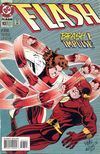
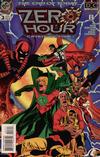
Bart Allen, a.k.a. Impulse.Superman, Batman, and Max Mercury have all been cited as giving comic-book speedster Bart Allen the name Impulse. Batman most famously in Impulse #50, and Superman just recently in the previews for next month’s All-Flash #1. But who named him originally?

Cover: Flash #93
Cover: Zero Hour #3The name first appears on the cover of Flash #93 (August 1994), with an out-of-control Bart Allen fighting the Flash. The cover is captioned, “Brash Impulse!” Over the next few issues, Wally West’s inner monologue refers to Bart as being impulsive, or (at one point) as “Mr. Impulse.”

It first appears on-panel as a name in Zero Hour #3 (September 1994), when Bart meets Superman for the first time, but Bart introduces himself as Impulse. Dan Jurgens writes.
Continue reading

ยปAll pages site-wide with this tag