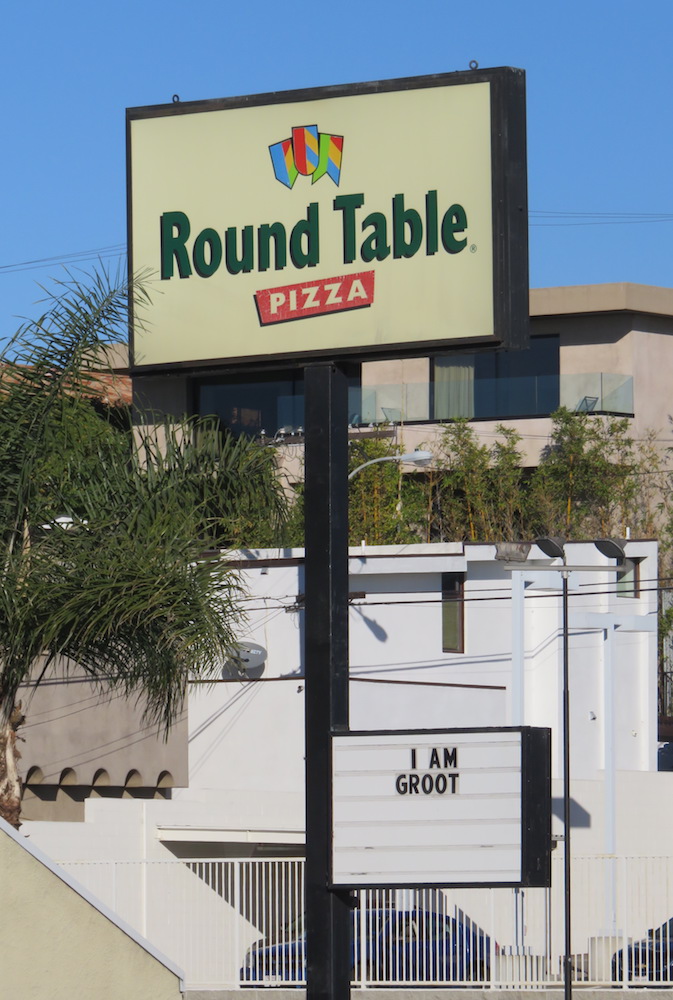
Groot reminds us that Net Neutrality is critical to internet freedom, and we should call Congress TODAY, before Thursday’s FCC vote to eliminate the only thing preventing your cable or phone company from blocking competition, burying news they don’t like, and shaking down startups.

Unless you trust your cable company to have your best interests at heart, head over to Battle for the Net and get Congress to remind the FCC that they work for you, not Verizon and Comcast.

Amazing what Groot can fit into just three words, isn’t it? 😉

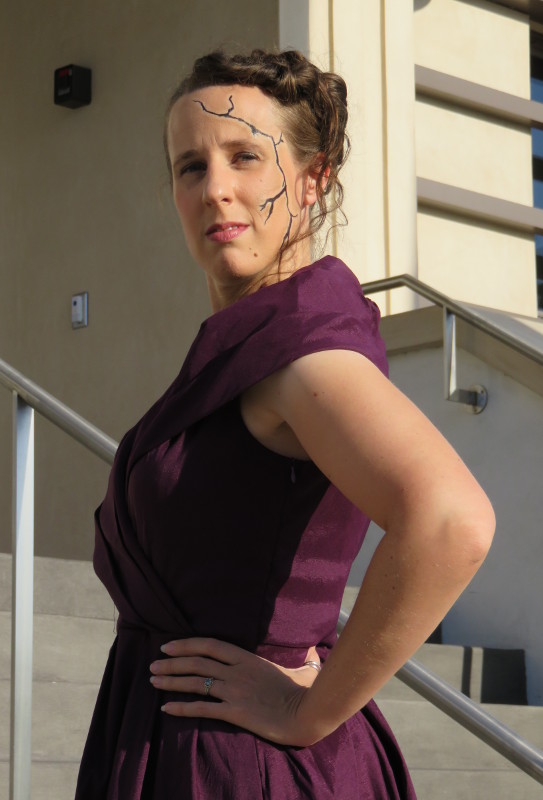
Whitney Frost Cosplay (Madame Masque): Looking up at a woman in a 1940s style purple dress, spidery cracks running down the side of her face, and hair with half a victory roll and curls on one side.

The “big bad” of Marvel’s Agent Carter Season 2: Whitney Frost, a scientist/actress who becomes imbued with what she calls Zero Matter, a destructive energy force (just visible in the form of the jet-black scar). She’s adapted from the comic book villain Madame Masque. Like the Once Upon a Time Alice, she doesn’t seem to be a commonly cosplayed character.

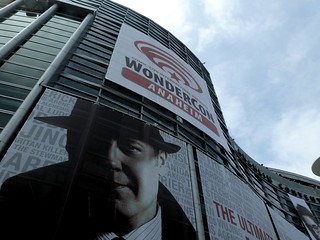
The plan was to debut the costume at Long Beach Comic Con this weekend, but for various reasons, Katie couldn’t make it. We did the full makeup and hair anyway, and found a suitably art deco-looking building nearby to do a quick photoshoot on the public sidewalk.

With any luck, Comikaze will work out.

Update: We all made it to the renamed LA Comic Con!

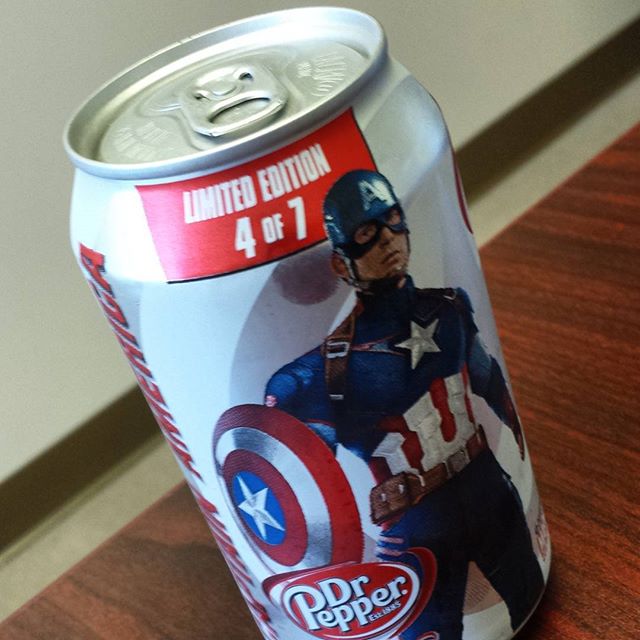
Limited Edition 4 of 7 Dr. Pepper Can: Captain America

I guess collecting is sort of the point with a lot of media tie-in packaging (well, that and cross-promotion, of course), but I really have to wonder how people typically collect food packages. I mean, do you keep the can unopened and hope it doesn’t leak? Do you drink it even though the can won’t be in mint condition anymore?

Oh no. I just had a horrible thought about those Minions-labeled bananas!

I’ve always considered myself a DC fan. I think it’s mainly that it’s where I got started, so I got invested in the DC Universe. That’s what’s familiar, while Marvel always seemed like I’d need to do a ton of research just to get started. (Not necessarily true, of course, that’s just how it seemed.) Most of the Marvel books I’ve read were either stand-alone or set off in their own corner of the universe (Alias, True Believers, Astonishing X-Men when Joss Whedon was writing it, etc.)

In short: the complexity of the universe I knew kept me in, and the complexity of the universe I didn’t know kept me out.

These days I still consider myself a DC fan, and I follow all the DC-related news and commentary, but I don’t actually read many of their books anymore. It’s down to one: The Flash. The rest of the line just doesn’t appeal to me anymore. But neither does Marvel’s. Actually, about half of my pull list is from BOOM! right now, with the rest of it scattered around DC/Vertigo, Dark Horse, Aspen, Image, etc.

Previously posted on Reddit

After reading the “Who cares what Earth this takes place on!” intro to the Justice League: New Frontier tie-in comic, I started thinking about the whole Earth-1, Earth-616, etc. thing. The confusion over Earth-1 vs. New Earth in DC (something which overshadowed discussion of the actual story in the first issue of Tangent: Superman’s Reign) highlights the question: just how important is it to label these fictional universes, anyway?

And once you’ve decided to catalog them, how do you label them?

A few multiverses that come to mind are DC’s, Marvel’s, and Michael Moorcock’s.

The multiverse of Moorcock’s Eternal Champion cycle is extremely fluid, with details changing whenever he wants to tell a different story. Just looking at the Elric stories, there are three or four origins for Stormbringer, and as many for the Melnibonéans and their pact with Arioch. There are several versions of the 20th-century Count Ulrich Von Bek (depending on whether you include Count Zodiac). Worlds are less like parallel lines and more like streams that can run together, mingle, and separate again (kind of like the briefly-used Hypertime as used by DC).

DC and Marvel, on the other hand, favor a discrete structure in which each universe can be precisely identified. This may have something to do with the focus on continuity as a key element of comic-book storytelling, and would explain why, for instance, Marvel has made an effort to number what seems to be every single alternate reality they’ve ever published.

Approaches to numbering:

  • Sequential. DC started out like this, with Earth-1, Earth-2, Earth-3, etc.
  • Random. Current DC multiverse, except for the first few we saw at the end of 52 which were based on worlds from the original DC multiverse (Earth-2, Earth-3, Earth-5 from Earth-S, Earth-10 from Earth-X). Marvel’s main continuity, Earth-616, was reportedly picked at random (though there is some disagreement on this point).
  • Referential. Things like choosing Earth-S for the worlds of Shazam or Squadron Supreme, or Earth-C for Captain Carrot. Earth-97 for Tangent (which appeared in 1997) and Earth-96 for Kingdom Come (which appeared in 1996) would also fall into this category (but see the next point).
  • Systematic. Taking referential labels a step further, using a consistent scheme. Marvel derives most of its designations from publication dates.

Personally, I prefer to just name them. “The Tangent Universe” or “New Frontier” or “Supremeverse” gets the idea across more directly than, say, Earth-9.

»All pages site-wide with this tag