After reading the “Who cares what Earth this takes place on!” intro to the Justice League: New Frontier tie-in comic, I started thinking about the whole Earth-1, Earth-616, etc. thing. The confusion over Earth-1 vs. New Earth in DC (something which overshadowed discussion of the actual story in the first issue of Tangent: Superman’s Reign) highlights the question: just how important is it to label these fictional universes, anyway?

And once you’ve decided to catalog them, how do you label them?

A few multiverses that come to mind are DC’s, Marvel’s, and Michael Moorcock’s.

The multiverse of Moorcock’s Eternal Champion cycle is extremely fluid, with details changing whenever he wants to tell a different story. Just looking at the Elric stories, there are three or four origins for Stormbringer, and as many for the Melnibonéans and their pact with Arioch. There are several versions of the 20th-century Count Ulrich Von Bek (depending on whether you include Count Zodiac). Worlds are less like parallel lines and more like streams that can run together, mingle, and separate again (kind of like the briefly-used Hypertime as used by DC).

DC and Marvel, on the other hand, favor a discrete structure in which each universe can be precisely identified. This may have something to do with the focus on continuity as a key element of comic-book storytelling, and would explain why, for instance, Marvel has made an effort to number what seems to be every single alternate reality they’ve ever published.

Approaches to numbering:

  • Sequential. DC started out like this, with Earth-1, Earth-2, Earth-3, etc.
  • Random. Current DC multiverse, except for the first few we saw at the end of 52 which were based on worlds from the original DC multiverse (Earth-2, Earth-3, Earth-5 from Earth-S, Earth-10 from Earth-X). Marvel’s main continuity, Earth-616, was reportedly picked at random (though there is some disagreement on this point).
  • Referential. Things like choosing Earth-S for the worlds of Shazam or Squadron Supreme, or Earth-C for Captain Carrot. Earth-97 for Tangent (which appeared in 1997) and Earth-96 for Kingdom Come (which appeared in 1996) would also fall into this category (but see the next point).
  • Systematic. Taking referential labels a step further, using a consistent scheme. Marvel derives most of its designations from publication dates.

Personally, I prefer to just name them. “The Tangent Universe” or “New Frontier” or “Supremeverse” gets the idea across more directly than, say, Earth-9.
I read Shadowpact #2 last night. So far the book does read better than Day of Vengeance, probably in large part because Bill Willingham can set his own schedule instead of the must-be-6-issues policy of the Infinite Crisis lead-ins.

One of the villains struck me as familiar, though: an albino swordsman with a magic sword, apparently allied to a sinister god-like being, who has picked up the nickname, “the White Rabbit.”

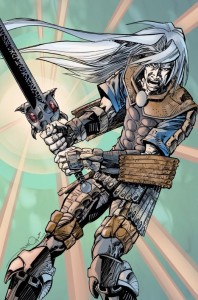
Elric: The Making of a Sorcerer #3Maybe it’s just the timing—just a few days ago I read a comic about Elric, an albino swordsman with a magic sword, allied to a sinister god-like being, with the nickname, “the White Wolf.”

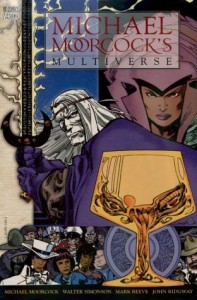
Michael Moorcock's MultiverseActually, I was first reminded of Count Zodiac from Michael Moorcock’s Multiverse, largely because Zodiac is based in the 20th century, rather than an ancient sword-and-sorcery landscape. Count Zodiac is one of at least three versions of Count Ulric von Bek*—the others appear in The Dragon in the Sword and the trilogy that begins with The Dreamthief’s Daughter—and, like Elric, an incarnation of the Eternal Champion.

The Eternal Champion in all his forms fights for the balance between order and chaos, and often finds himself fighting for order while indebted to a lord of chaos. At least two versions** of von Bek are albinos who wield the Black Sword (Ravenbrand, rather than Stormbringer), and while I don’t recall Ulric himself being linked to a demon the way Elric is reluctantly linked to Arioch of Chaos, the von Bek family has ties to Lucifer going back to the Hundred Thirty Years War. Continue reading

DC has announced their comics for June, and I’m really looking forward to three books.

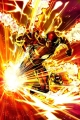
Cover of The Flash: The Fastest Man Alive #1First, they finally announced a release date for the re-launch of The Flash: The Fastest Man Alive. It was getting to the point where I was in more suspense over when they’d launch it than who was going to be wearing the mask. And at least we know that Wally and Bart are “not dead” (in the words of Infinite Crisis writer Geoff Johns), though that doesn’t necessarily imply we’ll see them anytime soon. Now I only have to worry about who’s going to be “the” Flash, and whether the new book will be any good.

Cover of Solo #11Almost as good was the surprise return of Michael Moorcock & Walter Simonson’s Elric: The Making of a Sorcerer. They got half-way through this mini-series in 2004, and issue #3 just never appeared. It looks like they’re finally going to finish it. Which reminds me, I should look for the final book in the Elric/Von Bek trilogy and see if it’s in paperback.

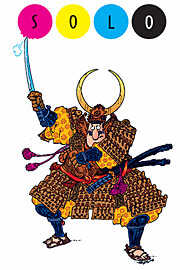
And then there was the real surprise: An issue of Solo by Sergio Aragonés and Mark Evanier. (Shouldn’t that be Duet?) Need I say more?

Also interesting: Astro City: Samaritan and Fables #50.

I was thinking about Star Wars, the “bringing balance to the Force” prophecy, and RPG character alignments, and realized that while you can neatly map the Jedi and Sith to good and evil (Anakin’s confusion notwithstanding), you can’t map them so neatly to order and chaos.

The Sith are a chaotic organization. They thrive on emotional chaos, they spread chaos to meet their ends… but when they get in charge, they impose order on everyone else.

The Jedi are extremely ordered. They try to purge emotions, they deny attachments. They’re hidebound by tradition. The organization is very structured. And yet they fight not to impose order but to protect it. The Jedi actually strive to preserve the balance of law and chaos.

I’m actually reminded a bit of Michael Moorcock’s Eternal Champion series, in which the cosmic balance between order and chaos is treated as its own faction. The Eternal Champion, in his various incarnations, always fights for the Balance, bringing order to Chaos worlds and chaos to Order worlds.

So the Sith are chaotic, but impose order, while the Jedi are ordered, but fight for balance. The problem, of course, is that the Jedi are not balanced themselves. Anakin does three things to correct this:

  1. He destroys the old Jedi order
  2. He destroys the Sith (two decades later)
  3. Destroying the Jedi ensures that Luke and Leia, heirs to the Force, will grow up as people first, Jedi later.

Luke and Leia have the opportunity to re-create the Jedi without all the baggage that dragged the old Jedi order down… and they can rebuild it with Jedi who are actually in balance themselves.

»All pages site-wide with this tag