Jack the Giant Slayer isn’t a great movie by any stretch, but it’s a fun, escapist adventure that doesn’t take itself too seriously most of the time. Something that struck me as really unusual, though, is that once the story gets going, the plot never depends on major characters holding the idiot ball. There are complications galore, and there’s the dumb sidekick for the villain (think Pinky and Jafar), but generally speaking, the main characters are competent, at least in terms of their respective specialties and common sense. The complications arise not from people doing stupid things when they should know better, but from unforeseen circumstances and the scheming, strength, or skills of their opponents.

People see through poor disguises, get suspicious about the turncoat, take measures to actually protect the kingdom from invasion when they get wind of the danger, and so on.

Compare this to, for example, Prometheus, in which highly trained scientists take their helmets off on an alien planet and try to pet the unidentified creatures they find while they’re lost in an underground warren even though they have a map. Talk about too stupid to live.

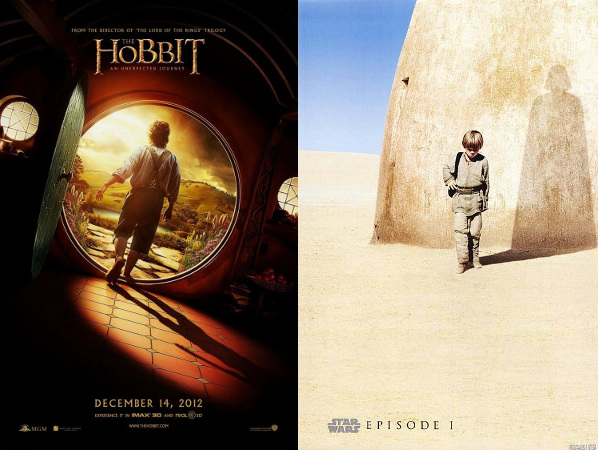
Posters for The Hobbit: An Unexpected Journey and Star Wars Episode I: The Phantom Menace

As the release date approaches for the first movie in The Hobbit triogy, I find myself comparing the circumstances to the Star Wars prequels. Why? In both cases you have…

  • A visionary director returning to…
  • A high-profile trilogy set in a fantastical world…
  • After years away…
  • To tell a prequel set a generation earlier…
  • Including significant events that set up the other story (Vader’s turn to the dark side and the rise of the Empire, Bilbo finding the One Ring and the Necromancer of Mirkwood).
  • Some cast are returning as younger versions of the same characters (Palpatine, C-3PO, Gandalf, Elrond)
  • Other characters have been recast (Obi-Wan, Bilbo).

But of course, Star Wars isn’t Lord of the Rings, and Peter Jackson isn’t George Lucas. Let’s look at four big differences.

1. Time

The Phantom Menace came out 22 years after Star Wars: A New Hope and 14 years after Return of the Jedi. An entire generation of children grew up with the original trilogy and were adults by the time the prequels started. And with 14 years of no Star Wars films, the prequels had to justify the wait.

With Lord of the Rings, it’s only been 10 years since Fellowship of the Ring, and 8 since Return of the King. We’ve spent half the time away from Middle Earth as we did from that galaxy far, far away. Children have become teenagers, and teenagers have become adults, but there isn’t quite the same level of “My childhood is back!” nostalgia that could make or break the films for a large section of the audience.

2. Directorial Experience

According to IMDB, George Lucas stopped directing after the first Star Wars film in 1977. He kept writing and producing, of course, but he hadn’t directed a film in two decades when he picked up The Phantom Menace

Peter Jackson may have slowed down a bit, but between wrapping up the extended edition of Return of the King in 2004 and picking up The Hobbit in 2010, he’s directed King Kong and The Lovely Bones.

3. Source Material

This is a big one. The Star Wars saga was an original story by George Lucas. When he wrote Episodes I-III, he was free to do anything he wanted as long as it didn’t contradict Episodes IV-VI. The Hobbit films are based on Tolkien’s novel, the appendices from Lord of the Rings, and his published notes. The core of the story is a lot more well-established.

4. Executive Meddling Potential

Zillionaire George Lucas wrote, directed and produced the Star Wars prequels, financing them himself. Nobody was in a position to tell him no. On one hand, this is good, because there weren’t any suits with more money than talent to tell him to add an extra car chase here, or add a love triangle there, and does Revenge of the Sith *really* need to be PG-13, can’t we dial down the violence a bit? On the other hand, it also meant no one could say, “George, don’t you think Jar-Jar is a little over the top?” or “This fireplace scene just isn’t working.”

Peter Jackson lucked out with the Lord of the Rings trilogy in being able to mostly do his own thing. But the legal battles and rights-wrangling that have caused The Hobbit to take so long to reach the screen indicate that the studios might be trying to exert their influence to “protect” their investment (which usually seems to involve killing the goose that lays the golden eggs). Certainly the decision to stretch the story out to three movies sounds like the studio trying to multiply their ticket sales, though I can also see Jackson and Weta deciding that this is their last chance to explore Middle Earth, so they might as well make the most of it.

Well, it’s just one week until The Hobbit: An Unexpected Journey opens and we all get to see how it turned out. One thing that’s definitely changed for me: Unlike Episode I, there’s not a chance that I’ll be standing in line for hours to see a midnight (or 2AM) showing. I can wait until Saturday afternoon.

There are two books I picked up recently that demonstrate how not to tell a story with pictures: Teen Titans #27 and the manga of The Nightmare Before Christmas.

First, Teen Titans #27, first half of a two parter by fill-in team of Gail Simone and Rob Liefeld. I’d planned on writing a more thorough review, but Comics Should Be Good beat me to it. And yeah, reviewing Liefeld’s art feels like a cheap shot, but sometimes ya just gotta go for it. Simone’s story isn’t bad, but it’s hard to follow. In particular, there are too many places where the art isn’t about story or action, it’s about showing the heroes or villains in dramatic poses. And yeah, you want the occasional dramatic pose, because you want to show off the costumes. That’s part of the genre. But you need to convey what’s actually happening. As dramatic as the last two pages were, I couldn’t figure out just what Kestrel was doing without looking at the “Next issue” blurb!

And then there are the places Liefeld left out dramatic poses that should have been there. The issue introduces a quartet of teen villains, but only one of them gets a full-body dramatic view, two get only action shots, and one—well, let me put it this way. I had to flip back to the beginning to be sure that there really were four of them and not just three. He’s in two panels with only his head and shoulders visible in the entire book. He’s not named, there’s no sign of powers or special skills, and he’s wearing a shirt and tie. I have to wonder whether Liefeld just didn’t get around to designing a costume since the character gets eliminated halfway through the book.

Anyway, onto The Nightmare Before Christmas. Continue reading

Y’know, something I just can’t understand is the tendency, in rants about how the Star Wars prequels have not measured up to and/or sullied precious memories of the originals, to make sure there’s a dig about them being soulless computer-generated films, often citing the superiority of earlier effects with actual models and the presence of real actors.

Haven’t Pixar and DreamWorks demonstrated that it’s entirely possible to make a well-constructed, entertaining film entirely with CGI? Hasn’t Hollywood’s studio machine demonstrated that it’s entirely possible to make a shallow, soulless film entirely with real actors? Remember the original reviews of Jurassic Park that accused the milestone CGI dinosaurs of being more lifelike than the actors?

It ain’t the CGI, folks.

The effects are top-notch. The visual design, even when referencing other films, is impressive. Acting. Directing. Writing. This is where Episodes I and II have broken down. And if you’ve seen the right movies, you know the leads can act—when they’re given a chance.

No, it’s the dialog and the directing—both primarily Lucas’ work, and both tasks he let others take on or at least polish in earlier films. From what I hear Tom Stoppard has polished the dialog in Episode III. One can only hope that Lucas’ “practice” directing the last two has given him the experience needed to make the final film stand out.

ยปAll pages site-wide with this tag