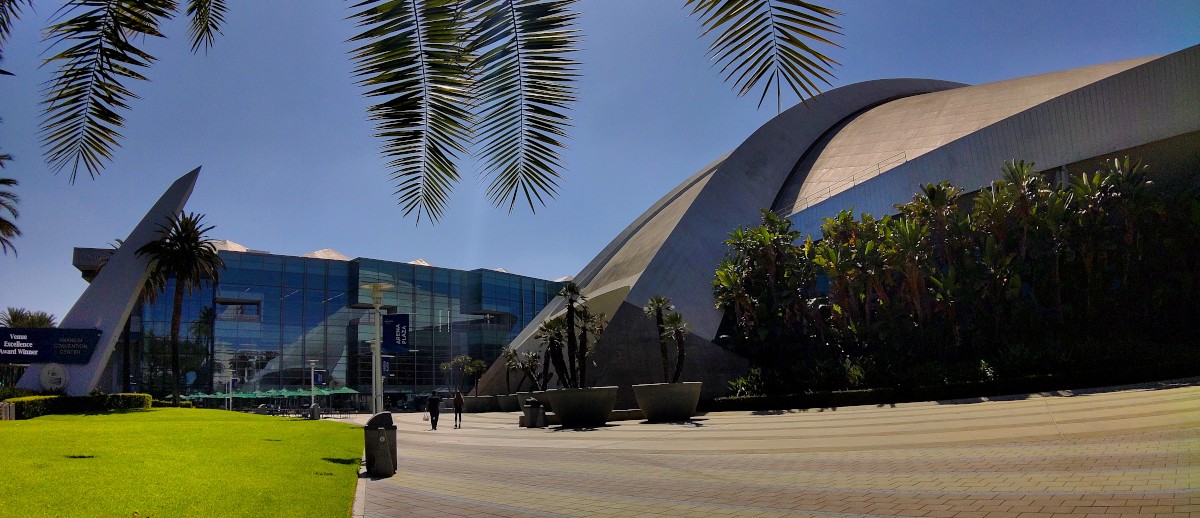
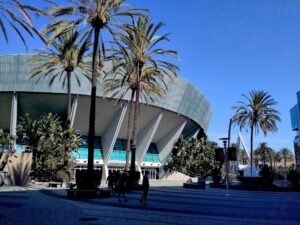
 This year’s Worldcon, LAcon V in Los Angeles (well, Anaheim), felt small. And it wasn’t just comparing to older cons like Chicon 7 (2012) and LAcon IV (2006). I don’t know how much of it was that we only went on Sunday (the last Sunday in August), and how much of it was that the section of the convention center they booked was just way too big for the number of attendees, but I gather from what I’ve heard that it was in fact comparatively small for a Worldcon. (It’s also been suggested that some people who ordinarily would have traveled internationally to attend figured it might not be worth the risk.) I don’t know how anyone managed to catch Covid there.
At least the lines for the food trucks were short.
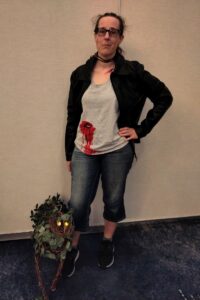 I mentioned in the post about Katie’s October Daye cosplay that this was our first con since 2019. It was also our first general sci-fi/fantasy con in ages. More bookish, skewing older than comic cons, less cosplay. (There was more cosplay at the Undertale concert we went to on Friday the same weekend. A lot more.) Katie went to several panels on writing and worldbuilding, and I made sure to catch the Murderbot book-to-TV panel.
 The teenager made a beeline for the video game room, only to discover that it was one person promoting his own games (which at least were interesting), a handful of old game consoles, and another person keeping track of a library of cartridges you could check out. It was cool to try out the old consoles, but the novelty wore off pretty quickly since the sparse attendence meant there wasn’t anyone to play the games with except when I joined him there. The other cool thing he found was an electronics workshop with circuit boards shaped like (among other things) caffeine and theobromine (chocolate) molecules, with LEDs and soldering stations where you could attach the LEDs yourself.
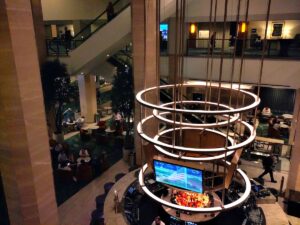 The con was split between the Hilton (which has been there forever) and the newest section of the convention center, next to the classic flying-saucer arena. (I think it was under construction the last time we were here for WonderCon.) Stylisticaly it looks like the expansion built in the 2000s: A curved full-height lobby with floor-to-ceiling windows, a lower level for general space, and an upper level. The difference is that the upper level is also big enough for general space, with portable walls to create breakout conference rooms. This meant even the hallways were gigantic, contributing to the feeling that, as Katie put it, the people were rattling around in a space too big for them.
 I had a few other panels that I was sort of interested in, but decided to prioritize going through the entire art show and making at least a single pass through the dealer’s room. I don’t regret that decision, because it meant I got to take my time really looking at the art. I didn’t buy much – a handful of books by guests and Hugo nominees, some stickers, a tote bag. They were out of T-shirts in most sizes, so I didn’t get the one they were selling onsite. (I bought the other design online afterward.)
Katie met up with one of her friends, and a family friend I hadn’t seen in years turned out to be helping run registration. Otherwise we didn’t run into anyone we know this time.
The only book I brought for autographs was Good Omens (the Ineffable Graphic Novel), because I hadn’t make time to look through the guest list. Instead, I hastily tossed stuff in my backpack the morning of the con while Katie splashed fake blood on herself for her costume. I remembered Colleen Doran was there, and figured anyone else doing signings I could probably buy something at the con. Most of Sunday’s signings were authors or artists I didn’t know, but I did manage to find Doran’s booth toward the end of the afternoon!