I’ve always been more on the Tsundoku side. I don’t need suggestions for what might be interesting to read. I have books. Lots of them, both print and digital. What I need is to prioritize!

1. Finish what I’ve started

  • Pick up the books I’ve set down and still want to get back to. I finally restarted To Each This World this month and it turned out to be really good! I also need to get back to The AI Con and The Gossamer Mage.
  • Finish series. I’ve got two books left in my Earthsea re-read, and I haven’t worked up the nerve to open The Rose Field or Parable of the Talents. There’s also Seanan McGuire’s alchemy series, of which I’ve only read Middlegame (and I probably want to re-read it before starting the next one).
  • Review all the books I’ve read this year.
  • Finish the older reviews sitting in my drafts folder.
  • Re-read and review the Les Misérables comic/manga adaptations I picked up over the last couple of years.
  • Finish at least the novels and story collections from that Le Guin bundle a couple of years ago, plus the remaining Hainish stories that aren’t in any of those collections.

(Minor update as I’ve filled in a few other books I forgot to mention.)

2. Make room

This will require coordinating with the rest of the household, but I can at least make a first pass.

  • To-read books that none of us still want to read.
  • Read books that none of us want to re-read.
  • Books that no longer spark joy, and merely spark “meh” (unless there’s another reason to hang onto them, like keeping the bad middle volume of an otherwise good series)
  • Same with my comic collection.

3. Try out some more eBook apps.

I’m mostly using NeoReader (the one built into the Boox Go 7) for DRM-free eBooks, and Kobo for books I’ve bought over the last few years. Ebooks.com has a new app that replaces their existing bare-bones app, and I’ve heard good things about ReadEra. Plus I should make the effort to really use KOReader on a couple of devices. I’ve bounced off it a couple of times, but people out there like it.

4. Cross-Post Reviews

I’ve gotten behind on cross-posting reviews to BookWyrm (which I trust enough to post the full versions) and various bookshop sites (which I don’t). But it’s worth at least rating the recent books I’ve liked by living authors at Amazon and Kobo for visibility in the Great Engines of Algorithmic Recommendation.

5. Keep up!

When I buy a newly-published book, read it while it’s still new, then go back to the to-read pile.
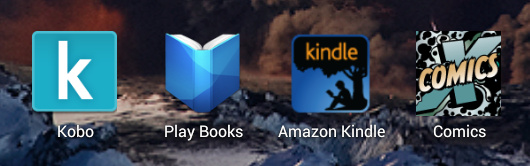
App icons for Kobo, Kindle, Play Books and ComiXology

While reading about Amazon’s purchase of GoodReads, I noticed a link to an article about e-book discovery that points out that a lot of people tend to explore multiple e-book stores. As someone who has done that, I’d like to comment on my experience.

Classic Kindle

I didn’t really start reading ebooks until I had a device I could use. I don’t like reading fiction on a desktop or laptop computer, and I don’t like reading it on a tiny phone. A couple of years back, Katie bought a Kindle 2, which is just about perfect for the base use case of reading a book from start to finish (though it’s a pain for much of anything else — I imagine the touch screen on the Paperwhite line is a huge improvement). My first serious eBook reading was on that dedicated device, which is linked to her account.

Tablet: Branching Out

Since I bought a general-purpose tablet last summer, I’ve branched out a bit. I picked up a few books on Google Play because they gave me some store credit when I bought the Nexus 7. At the time, a local independent bookstore that I like, Mysterious Galaxy, had a deal with Google where they could get a cut of what I spent.

I bought other books on the Kindle store, sometimes because of price or special deals, sometimes because of selection. Sometimes I’d even deliberately choose Amazon because the site where I learned about the book had an affiliate link, and I knew I’d be helping to support them. Mostly, I just like the Kindle reader app better.

At the start of the year, Google Play ended their deal with IndieBound. The new choice for independent bookstores seems to be Kobo. I’ve bought a few books from there after linking my account with Mysterious Galaxy, but I still don’t like the reader app much, and the service just seems…well…pushy. I’ve had to turn off a lot of “features” in the app. I don’t want or need recommendations in my status bar, thank you very much. And I sure as heck don’t need “accomplishments” to encourage me to read more. You know what encourages me to read more? Having time to read.

Fractured Library

The result is that between the two of us, we’ve got a small library of eBooks spread across two Kindle accounts, Google Play and Kobo…on two mutually exclusive devices. (And that’s not counting the reference books I’ve bought from O’Reilly and saved to Dropbox.)

OK, so it’s not a huge deal now, but as we buy more eBooks, it’s going to get harder to remember which book is on which account when trying to look something up or reread. We already have to discuss how to buy books that we’re both interested in reading.

I like having multiple sources to choose from. Selection, price, being able to support a third party, these are all things that you don’t necessarily get with a fully-siloed approach. But with the way eBooks are handled right now, it does add barriers to finding things.

I would prefer the way digital music purchases work: I can buy from anywhere, download a DRM-free file, and then put everything in one place. It doesn’t matter whether I bought the music from iTunes, Amazon, directly from the artist, or imported it from a CD. There’s no question of where to go when I want to listen to it. (Well, until they switch to an all-cloud-storage model, anyway. The cynical part of my brain wonders if this is the real goal behind that trend.)

On the plus side, since the libraries are searchable, and three of them are linked to the same device, it’s actually an improvement over the years we were living in a too-small apartment with 90% of our books in storage, and it was a question of finding which box they were in.

DC Comics has launched a digital comics program, starting with the iPad/iPhone and the Playstation network.

And by launched, I mean launched. As in, you can download the app and buy comics right now.

I’m really looking forward to the day when they expand this to more platforms (desktop PCs, Android and Windows–based tablets, etc) and start reaching into their back catalog. I’ve griped about the lack of Golden Age Flash reprints before, and the Bronze Age is also virtually invisible in reprints (though at least with comics from the 1970s and 1980s, you can usually find the back-issues at a reasonable price).

I haven’t had time to read all the interviews, but I’ll definitely be reading them tonight:

Jim Lee at Microphone at DC Editorial.With Jim Lee so heavily involved in this project, I can’t help but think of a moment at WonderCon this year. Saturday was the day of the iPad launch, and the Apple Store in San Francisco is just a few blocks from the convention center. Jim Lee was conspicuously missing from the DC Editorial panel. He showed up partway through the panel and stood in the Q&A line, where he planted a few questions…and then pulled out the brand-new iPad that he had stood in line for that morning!

Sadly, judging by ComiXology’s new releases, DC hasn’t brought Flash to the iPad just yet. But I’m sure it’s only a matter of time.

Update: Comics Alliance has another article I won’t have time to read just yet, on why this is a big deal.

Cross-posted at Speed Force

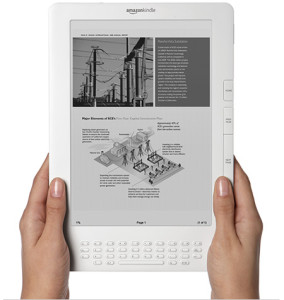
Kindle DXAmazon has announced the Kindle DX, a new version of their e-book reader with a 9.7-inch screen. Unless I’ve got my numbers wrong, that makes it larger than the standard manga page, though not quite as big as the standard American comic book page. And it’s only 1/3 of an inch thick, comparable to a typical trade paperback.

This could be the first e-reader device suitable for simply taking comics formatted for the printed page and transferring them to a tablet. No need to break it down and show one panel at a time like most iPhone or Android comics. No need to zoom and pan. Just transfer the whole page.

Sure, it’s only black and white, but there are plenty of comics produced in B&W, or reformatted for printing in cheap collections like Marvel Essentials or DC’s Showcase Presents series.

Imagine 30 years of Justice League of America or Spider-Man in the space of the latest trade.

The only drawback is the steep price tag: at $489, I’m not picking one up anytime soon.

(Reposted from Speed Force)

Amazon KindleAmazon’s entire home page is currently taken up by the announcement of their new eBook reader, Kindle. At $400 I’m not going to rush out and buy one, but it looks like they’ve solved some of the main e-book problems: it’s small, light and wireless, and they even bring up the reading-in-bed issue in the intro.

The real question is going to be compatibility & openness: It’ll read plain text, HTML, Word, and a few other document formats (and they’re promoting its access to Wikipedia), so it should be possible for other stores to sell books for the device.

And what about the e-book offerings themselves? Will they be loaded down with draconian digital rights management like the Adobe ebooks of a few years ago, or are they following the model of Amazon’s MP3 store?* In a nice change, their music downloads are entirely DRM-free and they use it as a selling point. Edit: Per Andrea’s comments and further research, Kindle ebooks are locked down with DRM. No, thanks!

The name, however, makes me wonder how soon they’ll offer Fahrenheit 451.

* Amazon’s MP3 store is also surprisingly cheap. I replaced my old tapes of the original cast recordings of Les Misérables (Broadway) and Phantom Of The Opera for $9 each—they run upwards of $30 on CD.

»All pages site-wide with this tag