When we visited Oahu two years ago, we noticed that aloha was everywhere, and meant everything. Aside from hello and goodbye, it seemed to represent an easy-going, positive attitude. There were signs all over the place saying things like “Drive with aloha.”

Then there was mahalo, Hawaiian for “thank you,” which is used everywhere in place of the English phrase. Either it’s part of the wave of Hawaiian identity, or it’s mandated by the Hawaii tourist board.

Aloha is all over the big island as well, but not quite to the same extent. We didn’t see a single “drive with aloha” sign this time around, for instance.

What we did see was kapu. Kapu is the Hawaiian form of taboo, a word which has lost much of its meaning both in modern English usage and in modern Hawaiian usage. In traditional polynesian cultures, a taboo was a sacred prohibition, and violation was often punishable by death (generally by way of being chosen for a human sacrifice). These days, kapu mainly shows up on “No Tresspassing” signs—of which there are plenty!

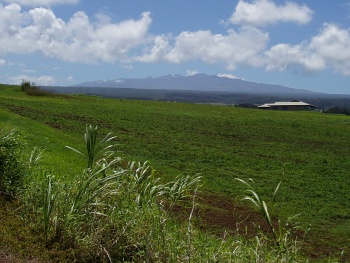
We spent a lot of time exploring the Kona coast, where towns manage to be both beach towns and mountain towns at the same time. It’s simplest to think of the island as one huge mountain (though there are really four mountains on the island, with a fifth, Kilauea, working its way up). The land just climbs up out of the sea and it’s easy to get several thousand feet up without going very far inland.

On our first full day, we just headed south to see what we could find. We randomly turned down Napo‘opo‘o Road, which while acceptable by rental-car standards, was a very winding road with lots of drop-offs. The road leads to Kealakekua Bay, a major kayak launching point, where we stopped and got a view across the bay.

View across Kealakekua Bay

This shot quickly became my new desktop background on the laptop. Way off to the left (not visible in this photo) is the obelisk marking the spot where Captain Cook was killed by Hawaiians in 1779. Right by the road are the remains of the Hikiau Heiau (a heiau is a Hawaiian temple), where Cook read the burial rites for one of his sailors. Continue reading

Driving through the lava fields of North Kona, you’ll see signs like these:

Traffic sign: Donkey Xing Traffic sign: Donkey crossings at dawn and dusk

After coffee companies stopped using donkeys for transportation, they turned them loose, and a herd of wild donkeys roamed the fields. They apparently picked up the nickname “Kona nightingales” from their, uh, “singing.” They’ve since been moved up to greener—and less traveled— pastures on the lower slopes of Mauna Kea, but the signs remain.

One can only assume the Kona nightingales were the inspiration for Surfin’ Ass Coffee Company and the signature island confection:

Surfin' Ass Coffee Company: Donkey Balls Factory Outlet

For the record: 1-inch macadamia nuts dipped in chocolate.

So… a week in Hawaii. I guess the main thing to remember is that it is the “big island.” It can take 2½–3 hours to get from one side of the island to the other, and that’s without stopping to see anything along the way.

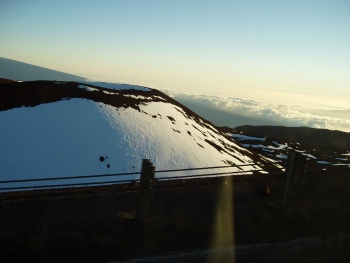
We stayed in Kailua-Kona, and ended up spending most of our time on that side of the island. Part of it was that, since it was basically a long-delayed honeymoon, we figured we’d splurge on a few tours. So one morning was taken up by a submarine tour through the bay outside Kona, an afternoon was taken up by a whale watching cruise on a catamaran, and an entire afternoon and evening was spent on a trip to the Mauna Kea summit.

Highly recommended guidebook: Hawaii: The Big Island Revealed. It’s written by people who actually live on the islands and just explore them constantly, and they have a very engaging style that will have you reading sections about places you aren’t even planning to go.

We did decide that if we were to stay in Kona again, we’d try to stay closer to town. While the Keauhou Beach Resort has a lot on its grounds—a restaurant, tide pools with sea turtles, a beach, some shops, and even a couple of historical sites including some heiau (temple) ruins—it was too far from Kailua proper. Kailua-Kona (the names seem to be interchangable) is a classic beach town—only in Hawaii—and parking is cramped, expensive, and limited, so you want to walk as much as possible without having to get back to the lot and move your car every two hours.

We didn’t get to see much of the Hilo side, partly because of the tours, and partly because we got back so late from Volcano National Park one night that we couldn’t wake up in time to go anywhere the next day. (Tip: Drive to Volcano Village, fill up the tank, and then enter the park. Otherwise you’ll be searching for an open gas station in the middle of the night, and there really isn’t much between Volcano and Kona, unless it’s off the main highway.)

Well, that was faster than I expected. Two months ago, Linux distributors Mandrake and Conectiva merged. Last month they announced the combined product line (basically Mandrake Linux with Conectiva’s own stuff merged in.)

Now they’re changing their name to Mandriva. I know the portmanteau is a logical choice from a purely linguistic perspective, but at least to my English-speaking ears it sounds like something out of a low-budget horror movie. Beware the Mandriva or Mandriva, the Terror from Beyond Source. Or maybe a fictional Central American country, the Republic of Mandriva.

Eh, I’ll probably get used to it. I wasn’t too enamored of Linspire, either. (Come to think of it, I still think that one’s a bit clunky.)

At least this should put to rest their long-running trademark dispute with the owner of Mandrake the Magician. Even if they started out with a penguin in a wizard hat, I still don’t think people are going to get a Linux distribution mixed up with a crimefighting comic book magician.

It looks like SuSE’s the only big-gun Linux company who hasn’t changed their name (if you count the Red Hat/Fedora spinoff), and now that they’re part of Novell, I suspect it’s only a matter of time. It’s probably the lack of corporation that’s kept the Slackware and Debian names intact.

Seven days on “the big island” (a.k.a. Hawai‘i) just aren’t enough. Our flight came in at about 5:30 this morning, and I don’t think either of us got more than a few minutes of sleep, so we’ve been catching up during the day. We’ll both be posting comments and photos over the next couple of days as we get to them.