CNET writes about a new model of the Roomba automatic vacuum cleaner and its application of technology iRobot originally developed for mine sweeping (real mines, not the game), touching briefly on the state of the consumer robotics field. Amazingly it includes the following sentence:

On the other end of the spectrum, the Roomba cleans up the living room and, in all likelihood, could not be used by a mad scientist to take over the Earth.

It sounds like someone’s been reading recent Sluggy Freelance comics!

I’ve seen my share of angry complaints about spam with forged sender addresses, but this is amazing: Aunty Spam’s Slam a Spammer Blog is reporting that Sunnyvale resident Charles Booher called up the “sender” of some spam and threatened him with torture and death.

Of course, (a) death threats are criminal, and (b) the callee was not the actual sender but a third party whose address had been forged. Booher is now facing criminal charges with up to five years of prison and a quarter-million dollars in fines.

“Aunty Spam” didn’t provide any further information, but a quick Google search turned up articles suggesting this isn’t the entire story. Mercury News reports [archive.org] that the person Booher threatened, Douglas Mackay, worked at a call center that handled calls for, among other companies, the one that did send the spam. Metroactive reports on an even closer connection: it seems that the spamming corporation was registered to Mackay’s brother. A DOJ press release is (appropriately) matter-of-fact about the allegations. This all went down last November. In my brief search I haven’t found anything about the current status of the case.

Back on the subject of forgery, the SPF website has gotten a major facelift. SPF, or Sender Policy Framework, is a scheme that lets domain name owners identify which servers they use to send mail, so that receiving servers can pre-screen incoming mail for forgeries. Aside from cutting down on phishing attacks, at least with SPF there’s a better chance you’ll be complaining to the right person!

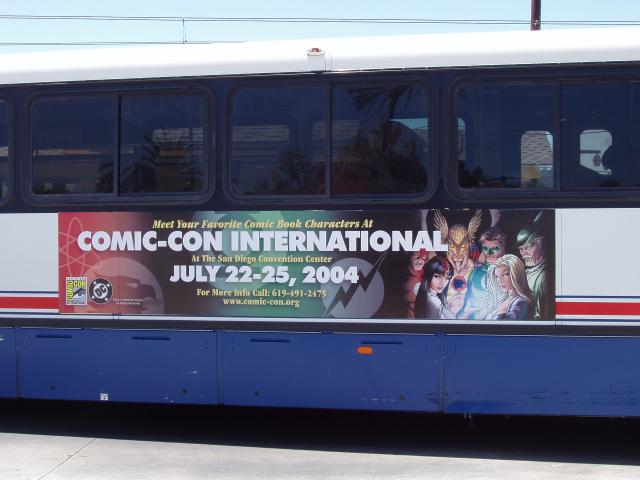
There! Everything’s set for Comic Con. I had been really annoyed with myself last month when I pulled out the pre-reg forms only to discover I had missed the deadline by two days, meaning we’d have to… <reverb>STAND IN LIIIINE!!!!</reverb> *cue scream*

We had to stand in line for on-site registration a few years ago, and let me tell you, it was a near-disaster. We got there before the doors opened. By the time we got through the line, it was time for lunch.

The thing is, we’d been thinking about getting a hotel room in San Diego and going for several days, which would mean we could go through the registration line on a smaller day, with (we hoped) a smaller line. Combined with the fact that we haven’t really taken a honeymoon trip, we came up with this grand plan to take the whole week off, go to San Diego, do the touristy thing for several days and wander in and out of Comic Con at the end of the week. Various things conspired to cut this down, and we ended up planning half a week.

And of course the hotels are all booked.

I went back again tonight, to see what might have opened up and to look farther out. There are places charging $150/night for Wednesday and then $750/night for Thursday through Saturday. There are places charging $200 during the week and $1000 on weekends. The price difference is just insane! I almost wanted to sign up with one of the nice hotels for the first night or two and then head over to someplace else when their rates changed. [Edit: It occurs to me that this price difference probably isn’t an insane markup for weekends/a big convention weekend. More likely it’s the difference between a standard room and a deluxe suite, and while standard rooms are available for Wednesday, they’ve all been snapped up for the weekend, leaving only deluxe rooms open.]

The really cool thing, though, is that when I checked back at the Comic Con website for hotel info, I discovered they had added ONLINE REGISTRATION. *cue choir*

So we’re pre-registered after all (even if the form does arbitrarily choose who the primary contact is when you list more than one person. I filled out myself, then Katie and it tried to use her for the credit card info and email contact. So I started over, filled in her first, then me, and it used me for billing and listed my address for email contact… but it sent her the confirmation email.)

The hotel we ended up with — after a number of false starts that ended in “sorry, no rooms available” — isn’t fantastic, but it at least looks like it isn’t a total fleabag, and it’s reasonably close to the convention center. [Edit: It was the Super 8 in Little Italy.] We could probably walk if we had to, and it looks like we ought to be able to take the trolley, except for the fact that the %^$# trolley map is so abstracted I can’t actually tell whether there’s a stop nearby. (I figure driving on Saturday, at least, won’t save us any time.)

Vacation time? Check.
Registration? Check.
Hotel Reservations? Check.

Whew!

(Originally posted at LiveJournal, and brought over here because the rest of my con posts are here, and it’s an interesting look back at a time when you could get tickets and a hotel for Comic-Con a week and a half before the event!)

Current Mood: accomplished

All the Linux desktop action these days is in KDE and GNOME, but on older hardware, servers, or anything else where you need to squeeze every last ounce of performance from the box, something lighter is needed.

[Screenshot of a WindowMaker desktop] My Linux box at work — a 300 MHz Pentium II — runs WindowMaker. It’s familiar, it stays out of the way, and it doesn’t tie up the memory or CPU that a modern version of KDE or Gnome (or Windows, for that matter) would. But you need to add applets like a clock or a desktop pager. You can find them easily enough — I ended up using the aptly-named wmclock and wmpager – but there’s a significant problem with both. WindowMaker lets you change the size of the dock icons, but when I shrank the dock to get more space I discovered that both applets have a hard-coded size of 64×64 pixels.

[Pair of WM Applets, first at default 64x64 size (they look fine), then at 48x48 (they don't adjust and edges get cut off)] As you can see, a 64×64 applet just doesn’t work in a 48×48 space. It surprised me, though, since these dockapps are designed specifically for WindowMaker, and it’s WindowMaker itself that lets you change the size. You open up Preferences, change the size, and restart WM. Just menus and buttons. No config files, no registry, no third-party add-on. This isn’t an esoteric hack that takes serious effort to find, it’s a basic feature. You might as well design a Mac program that assumes the Dock is on the bottom of the screen. For most people it will be, but it’s not rocket science to move it.

In my ICS classes, they always discouraged us from using “magic numbers” — just throwing a number in the code without identifying or abstracting it. There are two very good reasons for this. The first is that you might forget what this 64 is doing. The second is that you might decide to change it later on, and it’s much easier to change one SIZE=64 definition than to track down every 64 and hope you’ve neither missed any you need to change nor changed any you need to leave alone.

Those dock applets are stuck at 64×64 pixels because the programmers were thinking in terms of the pixel grid, not in terms of actual display size. Continue reading

Time in comics is a strange, fluid thing. When you keep adventure characters in print over the course of decades, you don’t want them to get old. And so characters like Superman, who debuted as twenty- or thirty-somethings 60+ years ago, are roughly the same age today.

This is hardly unique to superhero comic books. The same is true of James Bond movies, the Hardy Boys and Nancy Drew books, and even newspaper comic strips. (How long has Dennis the Menace been five years old?)

Still, it makes for interesting contradictions. If Superman debuted 14 years ago, he can hardly have met JFK, so clearly any stories dealing with him are no longer “canon.” On the other hand, if the story doesn’t depend on JFK having been the President at the time, the nefarious super-villain plot may still be part of Superman’s history. But sixty years of chronicled adventures crammed into fourteen years makes for a pretty busy life! (And how frequently does the US hold Presidential elections in the DC and Marvel universes?)

The time-squishing effect is easiest to see with flashbacks. Continue reading