
Vanity license plates seen recently: “OH NO3S” and “UVULA”, the latter on an old yellow-on-blue CA plate with wide letters.
Category: Entertainment
LOST Commercials Explained
Here’s my theory on LOST’s weird commercials: They figure that anyone still watching the show after this long doesn’t need to be convinced to watch the next episode, just told when it’s on. So they might as well have fun with it.
Hello chkdsk, my old friend…
Hello chkdsk, my old friend
I’ve got to run you once again
Cause my Windows box is acting weird
And the disk drive must need something cleared
And the error that was printed on my screen
Made me scream
And put aside my work
For chkdsk
WonderCon 2010 Experience
 Last weekend, we made our third trip to San Francisco’s WonderCon in as many years. While it was fun, it wasn’t as enjoyable as the last two years.
We only really planned on going Saturday, but I was half-hoping we’d get there in time to catch some of Friday afternoon. That…didn’t work out so well.
Saturday morning around 11:30, we walked down to the Moscone Center in surprisingly clear weather (it was supposedly 50°F, but the sun was warm enough that a T-shirt was just fine), followed a series of people giving directions, and breezed through the line to pick up our badges. I think we were on the main floor within 10 minutes of entering the building.
Main Floor and Costumes
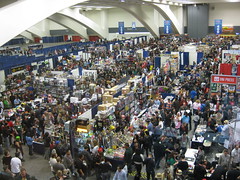 The convention seemed more crowded than I remember last year — despite the move to Easter weekend. There were places on the main floor where traffic just stopped. The mezzanine balcony, which I remember being a relatively empty traffic corridor last year, had somehow become a popular hang-out spot and photo-op location. Several panels proved to be too popular for the rooms they’d been placed in. People were even lining up three hours ahead for Geoff Johns.
It’s not a San Diego-level crowd yet, but it’s getting denser. Fortunately they still have room to expand. They’re only using two-thirds of the main floor space.
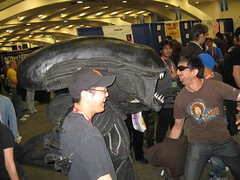 Still, they could really use some more seating out in the lower lobby with the food services. In three years, I don’t think I’ve ever sat at a table for lunch at this con.
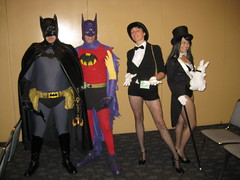
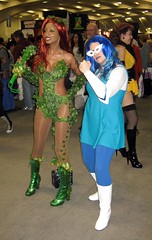
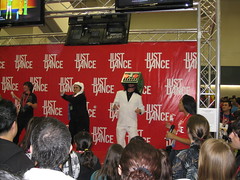
Neither of us noticed any obvious costume theme. Two years ago the place was full of GI Joe costumes. Last year it was Watchmen. This year nothing really stood out. I don’t think I even saw as many steampunks as usual. Admittedly, I no longer really notice people in Stormtrooper, Mandalorian, or Jedi outfits, so they could have had the entire 501st Legion wandering around and I wouldn’t have noticed.
You can see all of my photos of the con on Flickr.
Panels
 Since I’d missed the DC and Geoff Johns panels on Friday, I went to the DC Editorial panel (covered at Speed Force). Instead of being an actual presentation like last year, it was an hour and a half of question-and-answer. Unfortunately, the timing blocked several other things I’d considered attending, and I’m not sure it was worth it.
Never Give Up. Never Surrender
The best panel either of us caught was the mock Galaxy Quest “23rd Anniversary Celebration” that Katie attended. The panelists made a point that it was actually the 30th anniversary, as we were all there to celebrate our love for the original show and not “that movie,” and the original airdate was several years earlier than non-Questarians reckoned. And it went from there. The audience members who came up with the best answers to “trivia” questions about the original show were rewarded with t-shirts for the upcoming “Next Generation” show (it was apparently picked up for a full season!). There was a lot of speculation about how the new version might go too far in being Darker and Edgier, or that someone had heard there might be a movie with all younger-and-hotter actors and more lens flares than plot. Essentially, a free-for-all to both lament and celebrate the current state of SF media productions.
Missing In Action
Several panels were canceled when presenters couldn’t make it. The Comics Arts Conference session on “Urban and Political Mysteries” had to replace two of its three presenters. The reexamination of Batman: The Long Halloween went on as scheduled, looking at the evidence without taking the confessions at face value. Rounding out the timeslot were an examination of different narrative ways to make the shift from Silver Age to modern storytelling, and the comparison of Wonder Woman to Canadian heroine Nelvana of the Northern Lights.
Another casualty was the Real Archaeology of Indiana Jones, which I caught last year, but Katie missed because it was opposite a special-effects makeup demo. She was hoping to catch it this year, and I was kind of curious as to whether he’d be covering anything different this time.
Goals (or Lack Thereof)
 I think part of the problem I had with the con this year was that I didn’t really have any goals in mind. I wasn’t looking for any books. I didn’t have a huge stack of items to get autographed (partly because I didn’t want to carry around Comic Book Tattoo, and partly because I didn’t get around to looking through the guest list or my recent acquisitions). My to-do list consisted of one panel and a couple of artists, and was basically done by 2:00. Usually I make at least one full pass through the main floor, but this time I just kind of wandered aimlessly.
Around 4:00, Katie called me to tell me that her costume shoes had practically killed her feet (she had a really nasty blister, too), and she was ready to go back to the hotel — but couldn’t imagine walking even the short distance. I picked up her sneakers, and then we both went back for takeout and Lord of the Rings. (Thank you, TBS, for your conveniently-timed marathon!)
Hotel: Staying at the Marriott
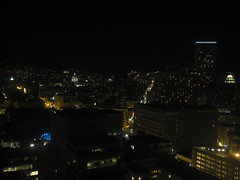 I think this is the first time I’ve stayed at an actual headquarters hotel for a convention. For the most part, we didn’t notice…except for the Power Girl/Terra photoshoot we saw in the atrium Sunday morning.
The Marriott Marquis is just a short block away from Moscone South, and across the street from the Mosser, where we stayed last year. The rooms are a more typical size, though, and of course the building is more modern. Oddly enough, the Mosser is a better choice for Internet access. The Marriott has free wifi in the lobby, but the rooms are wired only — and they want $13/night for it! (We mostly went without, and just ran down to the lobby for uploads and downloads.)
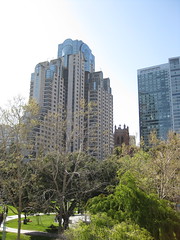 Restaurants: We were disappointed to find that Mission Steak is gone — or, rather, has been converted to “Mission Grille,” which had a decent enough brunch, but isn’t open for dinner anymore. Despite what the outdated ads in the elevators said. The concierge assured us that the other bar-restaurants in the hotel were open for dinner hours and would serve full meals, but neglected to mention that the 4th Street Bar and Deli had just been closed for renovations the day before. The menu at The View lounge didn’t seem much bigger than a typical bar menu either, the $19 Kobe cheeseburger notwithstanding. The view from our table was a wide city panorama, rain-soaked in typical San Francisco fashion, and we got to watch the fog slowly thicken until the Bay Bridge towers were just hints in the mist. (The picture window with its radial supports reminded me of the Gotham Clock Tower, but apparently it’s become known as the Death Star Bar.) We didn’t visit Bin 55, as neither of us is a wine drinker and their food menu is half the size of their wine list.
How to Get a Hotel for Comic-Con
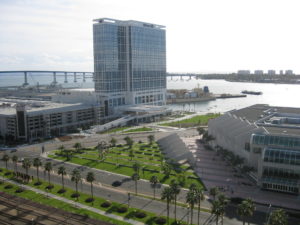 Planning to go to Comic-Con International, but couldn’t get a hotel room during the reservation lottery? There’s no magic bullet or secret code, but here are some things you can do to find a place to stay during the con:
ADDED: Call customer service if you placed a request but haven’t heard back from them. There may have been a problem with the email (at their end, at your ISP, or anywhere in between), or there may have been an issue with the reservation that prevented them from processing it or sending the confirmation. But do it soon, so you don’t miss the deadline to secure it with a deposit.
Some rooms may open up when the deposit deadline passes. Maybe. This is probably only an option if you submitted a reservation request but didn’t get a room, and it assumes that (a) not everyone will manage to make a deposit in time and (b) Travel Planners will move on to the wait list with the rooms that free up. I wouldn’t rely on this one.
Book directly, but be prepared to spend more. And be prepared to try a lot of hotels before you find one with available rooms, or else go through a travel site like Expedia, Travelocity, Priceline or Hotwire.
Look into short-term condo rentals. Hotels aren’t the only way to rent a room. You could make your trip into a week-long vacation!
Find roommates to share the cost of that directly-booked room. Or find roommates who already have a room. A lot of the downtown hotels actually have suites, so you might even have some privacy. (One thing to watch out for, though: hotels will often charge more for extra people.) If you don’t personally know anyone to share a room with, try asking in your online communities.
Stay with friends or relatives in the area. Obviously not an option for everyone, but again, you can check with online friends.
Stay farther out and commute. If all you need is a place to sleep and shower, you don’t have to stay downtown. Mission Valley and Old Town have trolley service straight to the con, and you can get a 4-day trolley pass for $15.
Try again after cancellation deadlines hit. Some rooms will open up after the last day for a full refund, and more open up after the last day for a partial refund. Check the convention website for this year’s dates and how to get in for the resale.
Good luck!
Once you’ve got your lodging situation settled, check out the rest of my Tips for Comic-Con.
Comic-Con Hotel Experience: 2010
 It took more than 8 hours, but I finally got my hotel confirmation for Comic-Con. It wasn’t one of the 12 I’d requested this morning, but it’s in my price range, relatively close, and was actually #14 on the list we put together last night.
All this despite the fact that I put the request in within 5 minutes of the system going online. That part was smooth, and judging by the comments on Twitter and at The Beat, it went smoothly for most people.
Then came the waiting.
On one hand, it was better because I could actually do things — like, y’know, work — instead of sitting there hitting refresh on the browser and redial on the phone for two hours. On the other hand, instead of two hours of active frustration, it was eight hours of wondering whether they had lost my info, or whether I had mistyped my email address, or whether they had actually run out of rooms in the first five minutes and hadn’t gotten around to telling me. A confirmation number for the request itself would have gone a long way toward making me confident that I was in the system.
Later posts on Twitter, and later comments at The Beat, reflected the growing sense of frustration among congoers — and anger as they were assigned hotels that weren’t even on their list.
Order
It seems that not everyone’s requests were handled in the order received. I saw people who had received confirmation hours before I did, but who had submitted their requests a few minutes later. My guess is that Travel Planners was taking two passes through the queue: one pass to handle the requests that they could fill based on people’s actual choices, then one pass to handle the requests where all the preferred hotels were full. Even that doesn’t quite track, though, so I’m not sure what was really going on.
Edit: Katie suggested that they might also be prioritizing based on how many nights you tried to reserve. I was only reserving three nights, so it sort of makes sense that they might give more weight to someone trying to reserve four or five.
Lessons to be Learned
As with the convention’s struggle with crowding, every year they solve one problem only to discover another lurking behind it. A lot of people have compared this year’s process to a lottery, but really, it actually shifted the advantage from luck to typing speed.
Think about it: For the last few years, everyone has had to try to get through, repeatedly, over a period of several hours. Those lucky enough to make a solid connection would then make a reservation and leave. You could start at 9:00 and get through at 9:05 or 11:00, but there really wasn’t any sort of strategy you could apply other than trying multiple avenues at the same time.
Now? Everyone logs in at 9:00, fills out a form immediately, and submits it. Whether you submit your request at 9:05, 9:10 or 9:15 has nothing to do with luck. Instead, it has to do with whether you made up a list beforehand, how long it takes to enter your information, and how much time you spend verifying it before clicking that button.
In that way, it’s actually less of a lottery than it used to be!
Update: I’ve posted some ideas on what to do if you couldn’t get a room.
Comic-Con Hotels 2010: Reviewing the Reservation Form
It was fast. Anticlimactic, really. It took a few reloads to get the Comic-Con International home page up, but once I could click on the reservation link, everything went smoothly. I was done by 9:05.
The reservation page was actually optimized!
- Just one image: a banner across the top.
- Everything was on one page, including the list of hotels, the personal info, and the hotel choices.
- Hotel selection was done by client-side scripting, so there was no wait for processing between selections (and no risk of typos confusing their processing system later today).
This is a huge deal, especially compared to Travel Planners’ horribly overdesigned 2008 forms — yes, forms, plural — that kept bogging down. (I never even saw last year’s, though I tried for an hour and a half to get in.)
On the downside, that one page does load a half-dozen script files, but that doesn’t seem to have slowed it down much.
In case none of your 12 choices were available, they asked for a maximum price you’d be willing to pay for another hotel that’s not on your list. I vaguely recall this being a feature of the old fax forms, but I don’t remember being asked this on the phone last year.
I was surprised to find that they didn’t want credit card info immediately, but that’s good from a streamlining perspective as well. The hotel choices, room type, and contact info are critical in order to make the reservation in the first place. Payment can be done later, so in a rushed situation like this, it’s better to handle it later. Plus, not asking for credit card information means that they could run the site without encryption, speeding things up a bit more.
I would have liked to have gotten a confirmation number for the request, or an email, just so that I could be sure that I was in their queue. And to be sure that I entered the right email address. And the right start and end dates. And…well, you get the idea. I’m a little paranoid about the process at the moment.
Here’s hoping that the back end of the process, and sending out confirmations, goes as smoothly as the front end did.
Update: Short answer: it didn’t. Long answer: I’ve written up what went wrong, at least from the guests’ point of view.