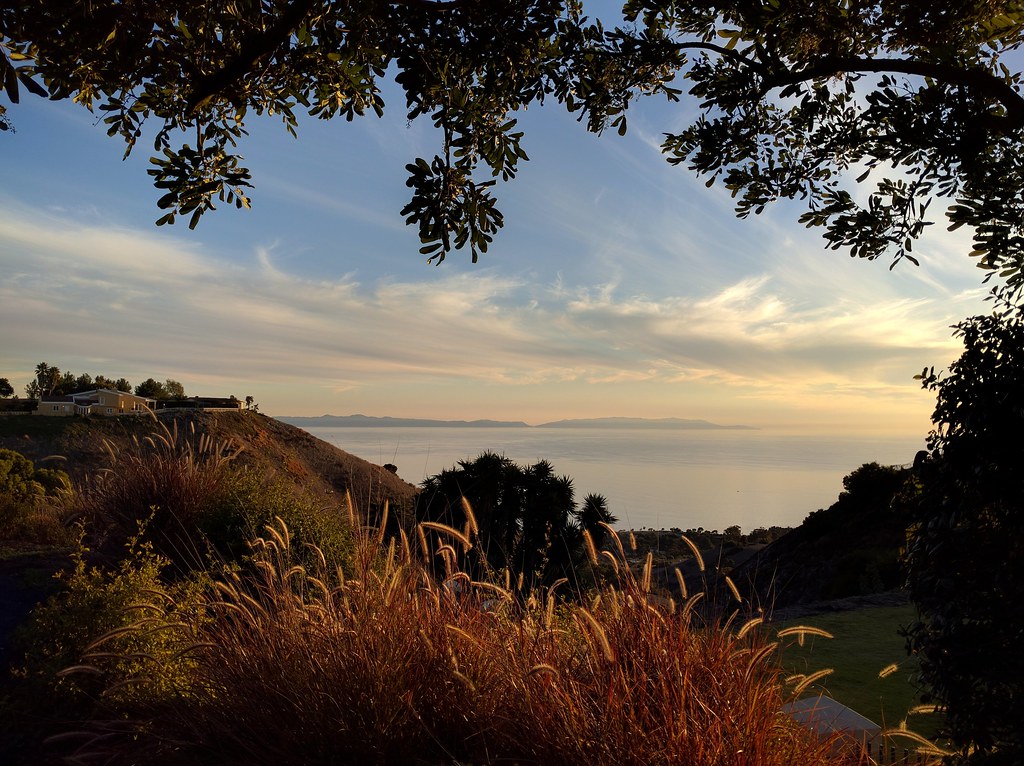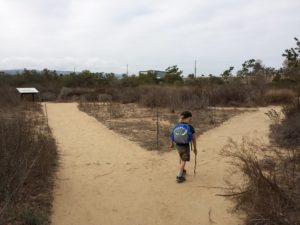
Del Cerro Park sits atop a hillside overlooking the Pacific Ocean and, in the distance, Catalina Island off the coast of California. Suburbs surround it on the inland side, but the hills rolling down to the sea remain mostly open space (though to be fair that’s in part because the land isn’t stable enough to build on).

Normally I can put the car right in the lot when I go there. On the afternoon of January 1, I had to park all the way on the other side of the gorge that separates the outcropping from the rest of the neighborhood. I can’t complain, because I got to see this view on the way over…and on the way back, after sunset. Continue reading

It’s been a relief to have (relatively) cold weather this winter. Last year I think I wore a sweater once. While the rest of the country was caught in the frozen grip of a meandering polar vortex, California was so warm people were going to the beach to cool off. Not that December heat waves are unheard of, but it’s usually only a few days. Last winter the state barely got any snow, which meant we’ve been really relying on reservoirs and groundwater this year.

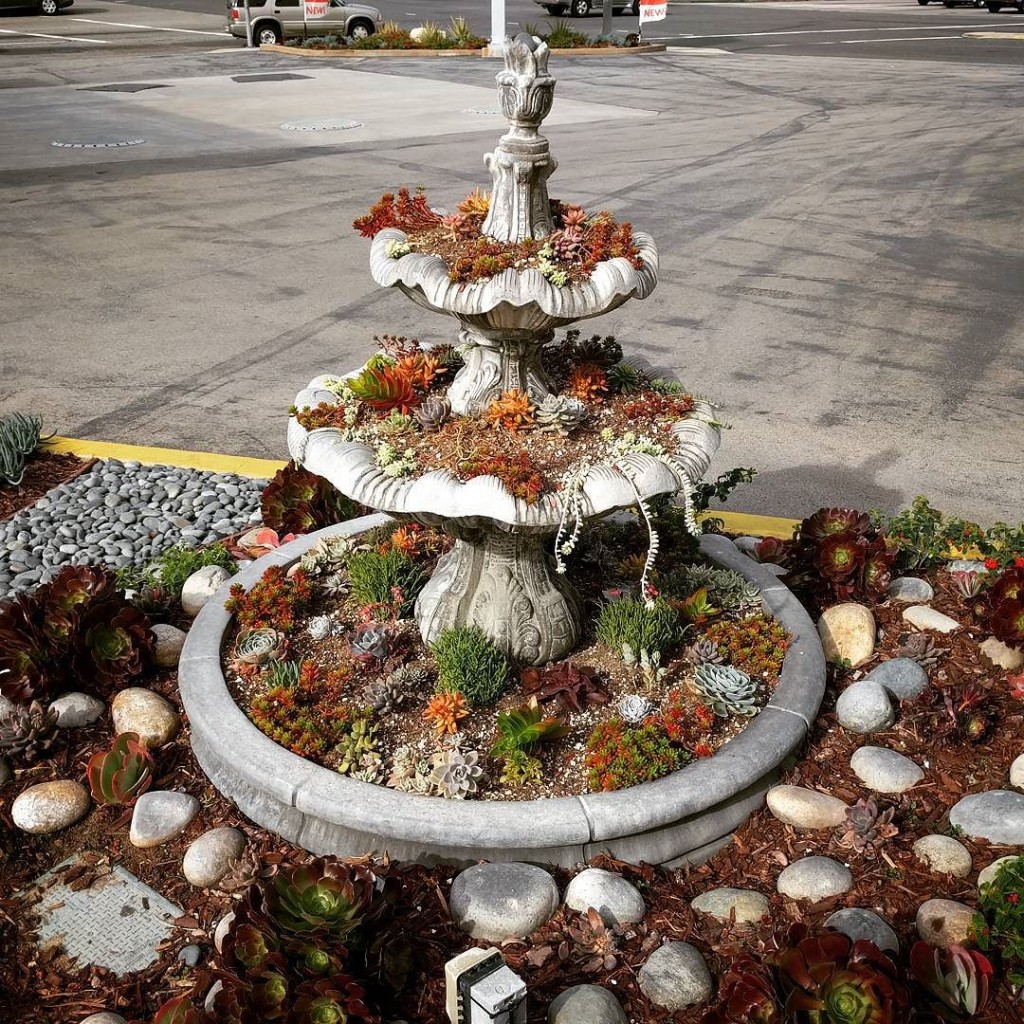
Even if it holds, and we get a wet winter in the lowlands and (enough) snow in the mountains, it’ll take a while to climb out of the current drought. So I’m always happy to see new water-saving measures put in place, like this fountain at a gas station that’s been re-purposed as a drought-friendly planter.

Fountain Re-Purposed as a Planter

Over the past year I’ve found myself using my camera less and less, and my phone more and more. I used to carry both and try to take “good” photos with the camera, and quick shots intended for faster sharing with the phone, but several things have combined to change that:

  • In bright daylight, the phone’s quality is comparable to the camera’s. (I used to tag phone pics with “cameraphone.” I stopped when I got the Galaxy S4.)
  • Half the time, I find that I composed a better shot on the phone than on the camera.
  • It’s one less device to carry around.
  • I can edit or post online immediately, without taking time to transfer photos from a card.
  • Dust got into the camera, and when I finally tried to get rid of it with compressed air, I made it worse.
  • The two photos I’ve had featured in Flickr Explore were both phone shots.

For the first time I used only my phone at this year’s Long Beach Comic Con, and on a trip to Boston. And for a while I didn’t miss the camera, but…

Have you tried taking pictures of a four-year-old indoors with a slow shutter speed and flash? Good luck!

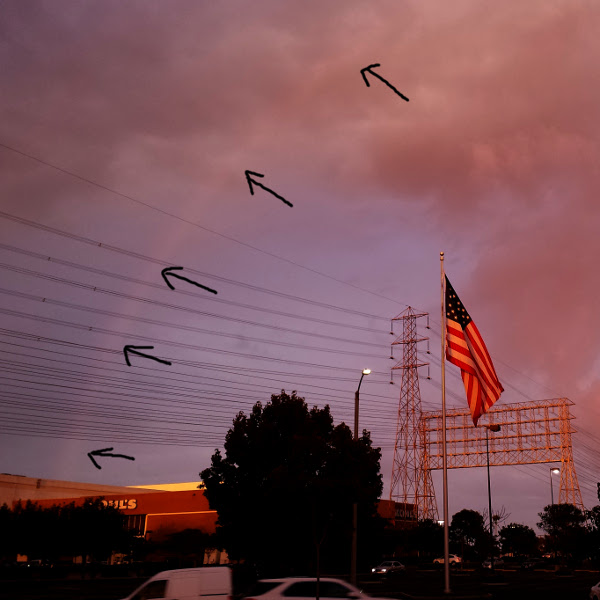
I’ve also found myself severely limited in what pictures I can take at sunset, or standing near a drop-off.  On two occasions I’ve spotted rainbows at sunset, and they’ve been too dim for the phone to pick up any color.  That’s right, there’s a faint white arc in the picture instead of a spectrum.

Faint Sunset Rainbow

And forget the photos I tried to take at a wedding! I’ve thought about running a watercolor filter on them so the blurriness will look intentional.

It’s time to admit that I have to do something about the camera.

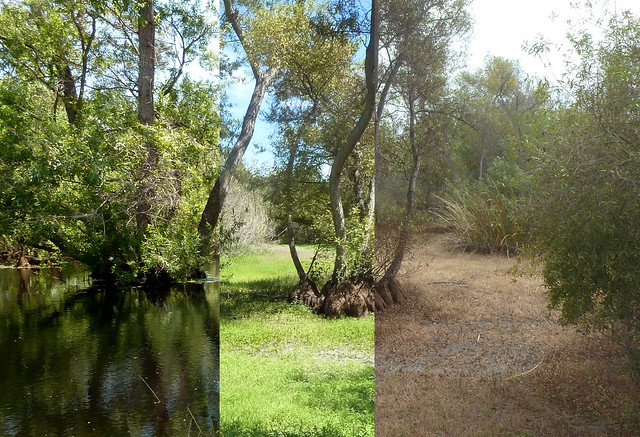
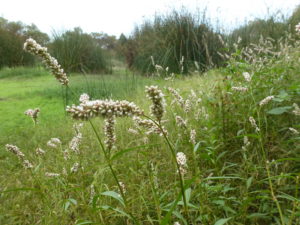
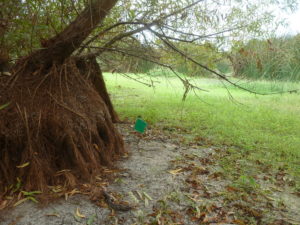
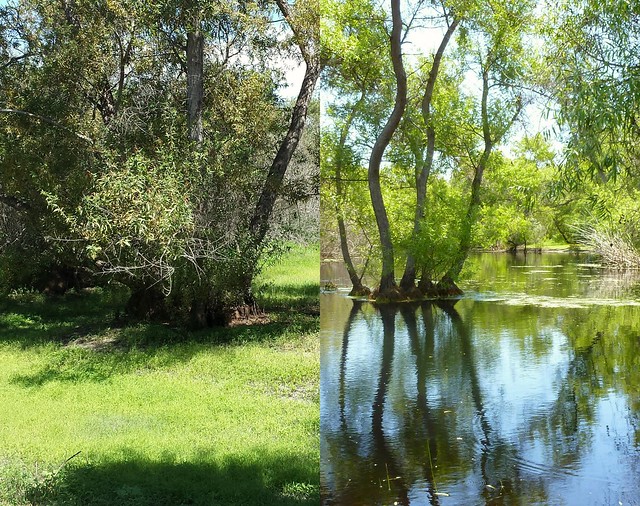
Last weekend I returned to the Madrona Marsh Preserve to see what our late summer/autumn heat wave had done to the place. The fields of sunflowers I saw in August have gone to seed and dried up, and the pools have continued to retreat. I managed to get a third shot in the same grove as before, where trees grew out of a pool in spring, towered over low ground cover in summer, and now stand alone, waiting for winter rains to flood the grounds again.

The image above is a combination of spring, summer and fall (specifically May, August, and October) views at the same spot.

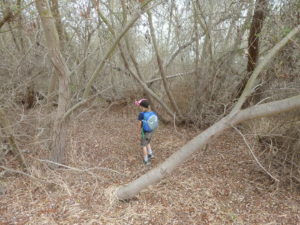
The higher parts of the preserve are covered with dry scrub, though volunteers have cleared a lot of it out. The broken tree limb I had to walk around in August has been cleared away as well. Deep into the wooded area we did find mud flats teeming with reeds, smaller plants, dragonflies, songbirds and insects. I don’t know if any standing water remains, since we turned back at that point. (Kids have boundless energy, but limited stamina.)

Over on Flickr I have about a dozen photos of the hike, showing the preserve’s current range from dry scrub to muddy grass.

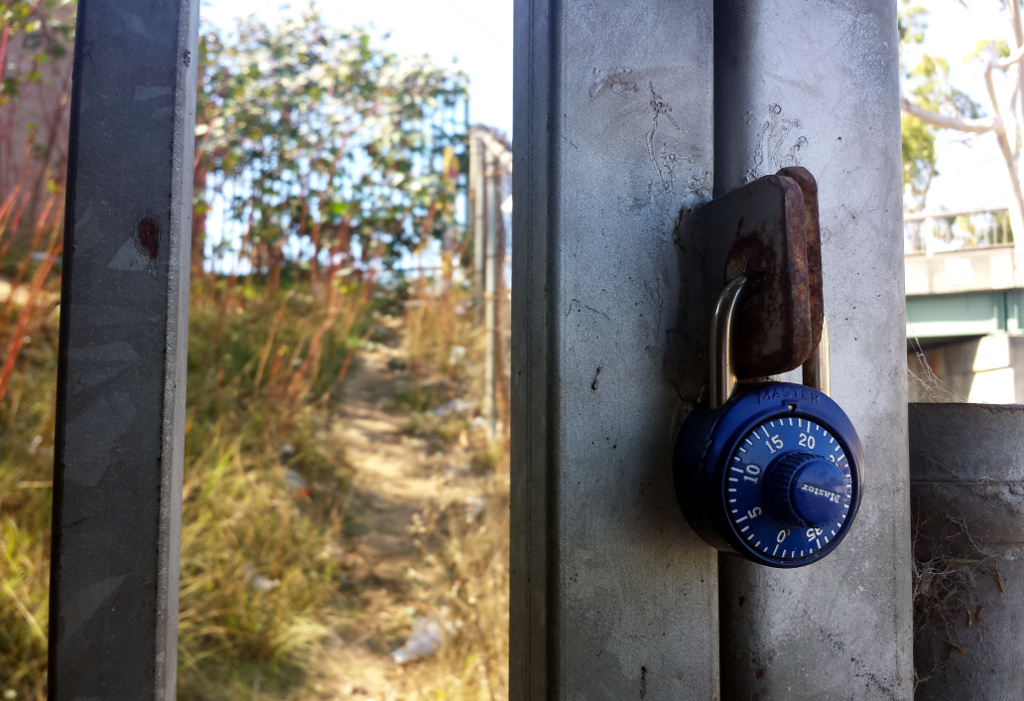
Close-up: looking between bars of a metal fence. 2 bars are locked together with a combination lock. Behind the gate we can see a blurry path uphill and scraggly bushes, with another fence at the top of the path.

Behind this gate, a path leads up a narrow access way to a railroad bridge.  Clearly people do get in there from time to time based on the trash – or maybe they just throw it over the fence from the sidewalk. Once I saw two people up on the bridge doing a photo shoot. They probably didn’t get there through here — a block south, there’s an at-grade crossing without any gates, and anyone could easily walk along next to the tracks as long as they keep alert for trains.

It got me thinking about how some boundaries are there to block access, and some are there purely for organizational purposes — consider the property line between two neighbors, defining responsibility for upkeep on each side — and while some of the obstacles we put up are intended to keep people out, sometimes they’re only meant to slow people down or send them down another path.

And then there are the boundaries like the tracks themselves: Structures that aren’t intended to separate regions, but nonetheless just by existing define a near and a far side. Railroads, highways, even natural features like rivers and mountains split communities, climate zones, ecosystems, and nations.

But people are also good at getting past obstacles. We build bridges and tunnels. We find places to ford streams. We find mountain passes, and blast them out to make them easier to cross.

And sometimes? We just go around.

Photo challenge (WordPress): Boundaries

Spring: trees growing out of a pond. Summer: trees with a lot more branches growing out of dry ground with lots of grass.

Finally put together a before-and-after shot!

On the right: May in Madrona Marsh, after winter and spring rains filled up the low-lying areas of the preserve.

On the left: Late August in the same spot, after summer had dried up the pools. Despite the drought, and helped along by a couple of freak summer storms, the ground is still holding onto enough moisture that the floor of the vernal pool is covered with low greenery instead of dry grass.

I know, it’s always better to put “before” on the left, and I tried it with that layout, but it ended up looking better this way.

»All pages site-wide with this tag