Well, I tried again at lunch to see if I could spot Comet McNaughton during the day, just in case it was still bright enough. No luck, but I set my camera on max zoom and took a set of pictures in roughly the right area, just to see if I could spot something.

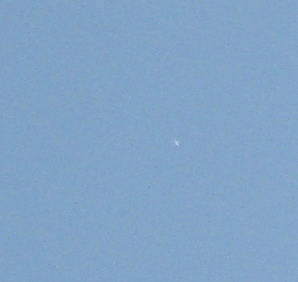
And, well, I did. I’m just not sure what. This was 1:28 pm (33.66 N, 117.75 W), looking roughly southwest, with the sun placed behind a wall to the right. The sun is to the right and above the frame. I don’t have a good sense of distance in the sky, but this is in the right direction to be either Venus or the comet.

Or it could be a passing high-altitude airplane that I didn’t notice.

If it is the comet, the tail is completely invisible, as it should be stretching down to the lower left (away from the sun) and I can’t make anything like that appear with any of the image enhancement tools I’ve tried.

Small bright object in the daytime sky.

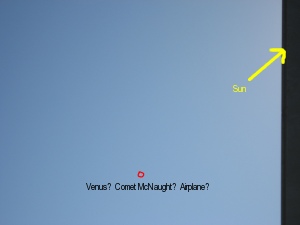
This is unprocessed. All I did was load it from the camera and crop it. And here’s a copy of the whole photo (this was at full ~3x zoom on a Canon PowerShot SD600) with the position of the object and the rough position of the sun pointed out.

Position of the unidentified object

The skies were surprisingly clear today. Four of us at work walked outside after sunset to a bridge near the office, and saw Comet McNaught. It was visible from ~5:10/5:15 to 5:28, at which point it slipped below the line of hills to the west.

We saw it against the red sky, slowly dropping through the (fortunately sparse) clouds. It was easily visible to the naked eye as a fuzzy white spot, with a hint of a tail pointing straight up that was a lot clearer in binoculars. The tail looked like a U or a V, fanning out at what looked like (but probably wasn’t) a 45° angle.

Well, my fingers are finally warming up. (I made the mistake of not grabbing my jacket, and went out just in my sweater.) Time to wrap stuff up.

Update January 13: I managed to catch another glimpse of it tonight. Unfortunately I was just arriving at the shop to pick up my car, and it was just closing, so I didn’t have a chance to watch it set (or see much more than a fuzzy white dot.) My watch said 5:02. By the time I got out, it had set beneath the building across the street, and there just wasn’t anywhere nearby enough with a clearer view of the western horizon.

On the plus side, I did manage to spot Venus while the sky was still light, and get a picture. It’s not quite as exciting as spotting it at one in the afternoon, but by adding more blue, you get an idea of what that looked like:
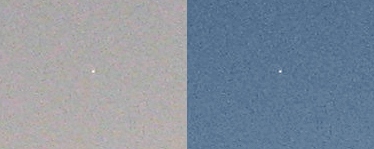
Venus in a light sky: actual on the left, colorized on the right

Update January 14:

I was looking over the photos I took last night (Saturday) and discovered I could actually find it by messing around with levels. On the left is the original photo, with a little bit of color correction to match what the sky looked like. The background’s still too bright to see the comet, though it was visible to the eye. On the right, I’ve adjusted the heck out of the image, and there’s a very slight bright spot right where it should be (I framed the shot so that the comet would be near the light pole, making it easier to find). Actually, now that I look at it again, it’s just barely visible in the less-processed photo on the left.
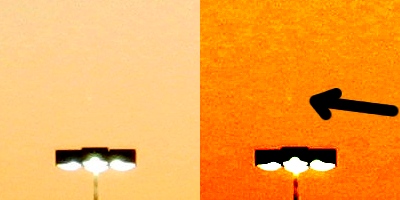
Comet McNaught - original photo on the left, processed on the right.

Also, this is cool: the comet has gotten bright enough to be spotted in daylight. (via Slashdot) I didn’t have any luck looking for it this afternoon, but I chalk that up to lower altitude and city haze.

Update January 15: I spotted something today, but I’m not sure what…

I set up a slide-show screen saver on one of my computers at work. To start, I dropped in some of my wallpapers, including several from the Astronomy Picture of the Day, then snagged some photos from my website to add a little variety.

Of course, 800×600 (or smaller) images don’t look so great blown up to 1400×1050, so last weekend I grabbed some higher-res copies from home.

What surprised me was how blurry the older photos were. Most of the digital photos I have older than 2003 are scanned in from 3½×5″ or 4×6″ prints. And half of those were done with a point and shoot camera. Even the photos that I scanned at a higher resolution tended to be much blurrier than the 5-megapixel images I’ve been taking since we went digital.

It also pointed up a problem with the point-and-shoot camera and lighting. Compare the following photos from my American Southwest page:

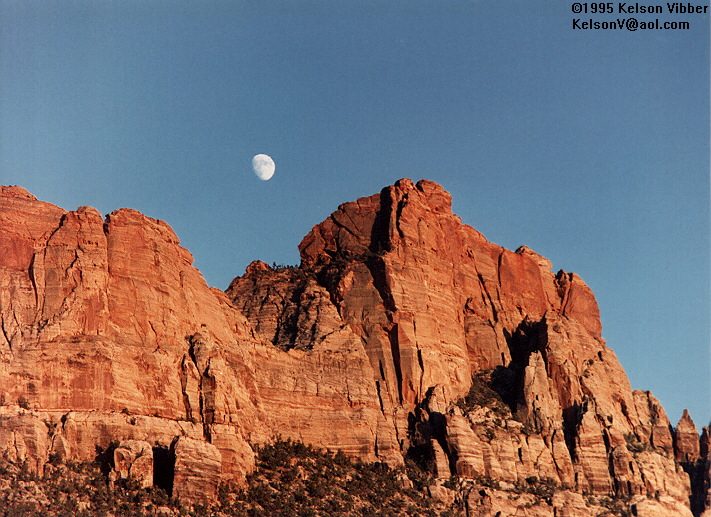
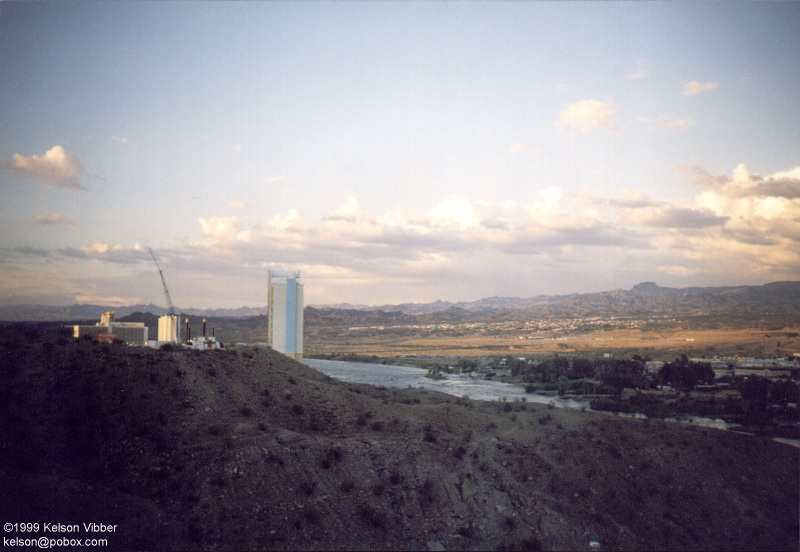
Moon over Springdale, Utah (SLR) Looking Back at Laughlin

The one on the left (of the moon above a rock ridge) was taken with an old SLR camera that my grandfather gave me when I was maybe 12 or so. It was entirely manual except for a built-in light meter. I loved the control and the photo quality I could get out of it, but it was big and bulky, and eventually I stopped carrying it.

The second photo (with the one tall building sticking up out of nowhere) was taken with the point-and-shoot camera I picked up during high school and used right up through that first Hawaii trip. Notice the difference in the sky? The sky does vary in color—you only need to walk outside on a clear day to see that—but something about that camera just collected less light from the corners of the image. The Laughlin picture is a good example because you can see the circle continue across the lower half of the frame as well.

The ones from the 2003 Hawaii trip are actually not too bad, even though they were done on the cheap camera, because they were scanned straight from the negatives by Kodak. I suspect they have a slightly better scanner than I do! 😀

Here are a couple of photos, one just before sunset, the other just after, over the past month.

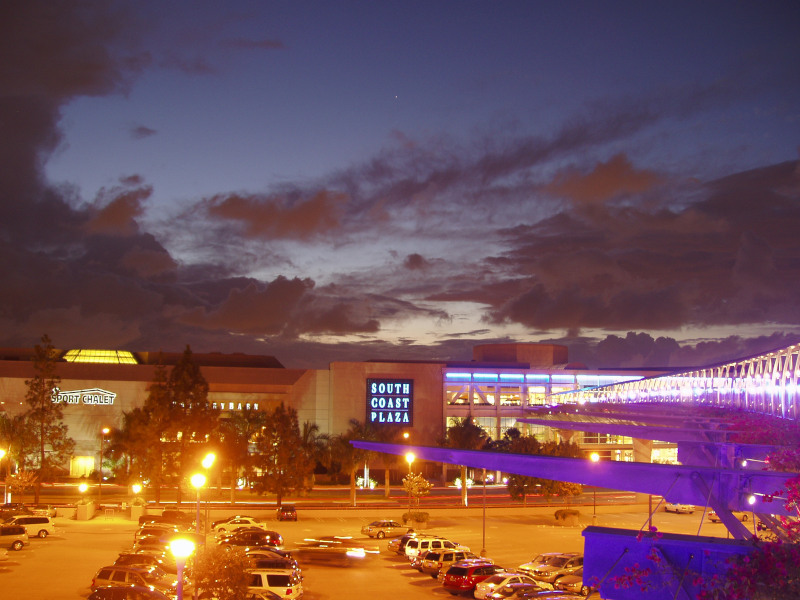
First up is a twilight view of South Coast Plaza. On Friday the 13th, we went to the nearest Borders to pick up The End of Lemony Snicket’s Series of Unfortunate Events and Neil Gaiman’s new short story collection, Fragile Things. We ended up crossing the bridge over to the main section of the mall, turned around, and saw an amazing twilight display with clouds silhouetted against the blue.

We stopped to take pictures. We weren’t the only ones.

Looking across a yellow-lit parking lot toward a long, low building, and above it a blue sky (fading to yellow closer to the horizon) with clusters of clouds, some dark gray, some lit from below.

Perhaps an hour later, the rainstorm arrived.

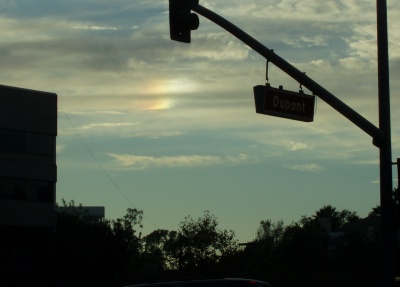
Next up is from this past Monday, October 23. I was driving up the 405 after work and noticed that there were some feathery clouds in the right area, so I started looking for sundogs. Normally I don’t find anything. It’s Southern California, after all, so the right conditions are relatively rare. (Though occasionally I see something spectacular like the full halo I caught in February.)

To my surprise, I saw a faint bright spot in the clouds, level with and to the right of the sun. It got brighter over the course of my drive, with hints of red, orange and yellow creeping in on the sunward side: a classic sundog. Once I got onto city streets, I had a chance to stop and take a picture.

The long boom of a traffic signal and street sign are silhouetted against a blue-gray sky banded with clouds. There is a bright spot in the clouds, white fading to yellow and red toward the left.

I mentioned that on Saturday, we left Comic-Con for a few hours to check out the ships at the Maritime Museum of San Diego. We saw five:

  • The Star of India, billed as “the world’s oldest active ship”
  • The HMS Surprise, a replica of an 18th century British ship.
  • The Berkeley, an 1898 steam ferry
  • The Medea, a 1904 yacht
  • A B-39 Soviet submarine.

The big attractions, of course, were the Star of India and the HMS Surprise. Naturally, the Star of India was closed when we got there.

Star of India as seen from a porthole in the Surprise
The Star of India seen from the Surprise

The Surprise was fun, though. It turns out it was built in the 1970s as a replica of an 18th century British Royal Navy vessel, the HMS Rose. It was sold to 20th Century Fox in 2001 and used to film Master and Commander: The Far Side of the World. After filming was complete, the museum bought the ship and renamed it the HMS Surprise in honor of the fictional vessel.

Continue reading

»All pages site-wide with this tag