
Do tire stores ever hold blowout sales?
Category: Strange World
Ticked off by Meat Allergy
Allergies to nuts, grains, vegetables, seafood and milk are common. Allergies to meat? Much less so. But that’s starting to change.
A few months ago I read about adults (author John Grisham in particular) developing an allergy to red meat after being bitten by ticks.* And not just a low-level allergy like your face turning red — we’re talking full-on hives and anaphylactic** shock, the kind of thing that requires you to carry an Epi-Pen to make sure you keep breathing long enough to reach the emergency room.
Researchers have determined that the lone star tick’s bite can cause the body to produce an IgE antibody for a sugar called alpha-gal, which is found in mammal meat.
The result: from then on, you’re allergic to meat.
CNN calls it mysterious. Allergic Living calls it baffling. It’s certainly weird compared to “usual” allergies, and the fact that the reaction is usually delayed by a few hours makes it hard to diagnose, but we’re ahead of the game in understanding it: Unlike most allergies, we know what causes this one.
With most allergies, we know the process, but we don’t know what gets the ball rolling to begin with. We know that in people who are allergic to a food, exposure to it causes an IgE antibody reaction that triggers a massive release of histamines that sends the body into some level of shock, but we don’t know why some people have that reaction and others don’t.
There are a lot of ideas being investigated, with varying amounts of supporting evidence, but there’s still nothing we can point to and say: “This caused you to be allergic to nuts” or “That caused you to be allergic to milk.” Advice to parents concerned about keeping their child from developing allergies is all over the map.
2025 Update
When I posted this back in 2012, I segued into a call for fundraising for research. The particular fundraiser has since been discontinued, but research has dramatically improved both medical understanding and practical actions around allergies.
First: it’s been clearly demonstrated that early introduction of a food lowers the risk of a child developing an allergy to it. It’s not a guarantee, but at least there’s clear advice to parents now!
Plus, immunotherapy and IgE-targeting treatments can reduce sensitivity and severity (though they can’t always eliminate reactions entirely) for those of us who already have severe allergies, those who develop allergies as adults, and the (much smaller!) percentage of children who still develop food allergies even with early exposure.
Unfortunately there’s still no clear explanation for why that ~3% of children who do have early exposure still go on to develop allergies — or why some people bitten by the lone star tick develop what is now called alpha-gal syndrome and others don’t.
Advice these days is basically: Try not to get bitten by ticks, and if you do develop the allergy, stop eating red meat.
Notes
*Naturally, this was a few days after I hiked a severely overgrown trail without taking precautions against ticks, so I freaked out a bit, but I also hadn’t found any ticks when I got home from the hike.
**Fun fact: Chrome’s spell-checker doesn’t know “anaphylactic,” and suggested such helpful alternatives as “intergalactic” and “anticlimactic.” Not sure about the former, but I get the impression a lot of viewers suffered “anticlimactic shock” when watching the Lost finale.
Spinning the Recall
I subscribe to allergy alerts through FAAN. Normally I skim the notices to see if (a) the problem is something I’m allergic to and (b) the product is something I’m likely to buy or eat, or have already bought. A couple of amusing phrases jumped out in this one:
FISH ALLERGY ALERT
April 17, 2012
Nestlé Prepared Foods Company announced today that it is voluntarily recalling two hour codes of STOUFFER’S® Satisfying Servings Lasagna Italiano because the package may contain STOUFFER’S Stuffed Peppers. While the Stuffed Peppers are wholesome, the recipe includes Worcestershire Sauce—which contains anchovy as an ingredient–and there is no Anchovy allergen statement on the Lasagna Italiano package. Consumers who are allergic to fish should not consume this product.
These products were manufactured in December 2011 and, given their popularity, Nestlé believes there may not be much inventory left on supermarket shelves. However, Nestlé is asking consumers to check their freezers for STOUFFER’S Satisfying Servings Lasagna Italiano in the 19 1/8 oz. package, with UPC code 13800-44709. The possibly affected production codes include 1349595513R or 1349595513S. This information can be found on the “proof of purchase” panel, located on the right end flap of the package, below the ingredient statement.
If you find the codes on your product, please call Nestlé at 1-800-392-4057, or email nestlefrozenfoods@casupport.com for further instructions. Nestlé will provide a replacement coupon to those affected consumers.
(Emphasis added.)
There’s just something funny about the way they went out of their way to talk up the product even in the middle of the recall notice!
Bored?
I’ve got a handheld connection to a worldwide network of information, communication and entertainment, and the signal’s solid. If I’m bored waiting in line, it’s my own fault.
The Phantom City
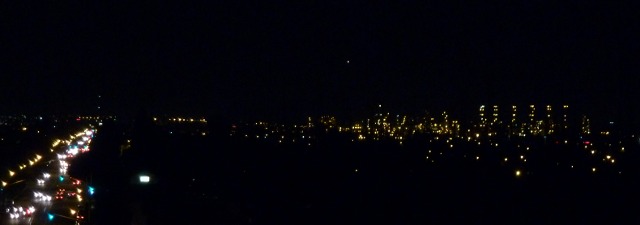
Years ago, when I’d drive along the 405 freeway late at night, I’d catch glimpses in the distance of what looked like a cluster of tall buildings in a city center. Not knowing the area well, I’d wonder whether I was seeing glimpses of Long Beach, or some other city in the area that I didn’t know. And then the freeway would curve, and I’d never quite figure out where those buildings were, and I’d mean to look it up on a map, but by the time I got home I’d be so tired I’d go straight to bed, and I’d forget all about it in the morning.
It always made me think of the kind of fantasy story inspired by mirages, where someone sees something from a distance, but when they get close it turns out not to be there, or to be far less grand than expected.
Somewhere along the line I realized that those lights I was seeing in the distance weren’t a city far off from the freeway. They were the lights on the oil refinery right next to the freeway a few miles down in Carson. I’d just catch glimpses of it between trees and closer buildings. With no reference points and no sense of scale, it wasn’t clear that I was looking at a compact cluster of small towers, not a larger cluster of taller buildings. By the time I got close enough to see the actual refinery towers, they looked different enough that my sleepy and driving-focused brain didn’t make the connection to those distant lights.
The South Bay is dotted with oil refineries, built here in the days when it was a major oil producing region, and I assume kept here because it’s so close to the Port of Los Angeles. [Edit: Actually, the area still produces quite a bit of oil, but the remaining wells are much better hidden.] Every once in a while I’ll be driving or walking over a hill and catch a glimpse of a too-regular “skyline” where all the lights are yellow, and I’ll think back to the time when I wondered about a vanishing city.
Photo: Exxon/Mobil Torrance Refinery, seen from a hill up on 190th St.
It’s beginning to look a lot like…medieval weaponry?
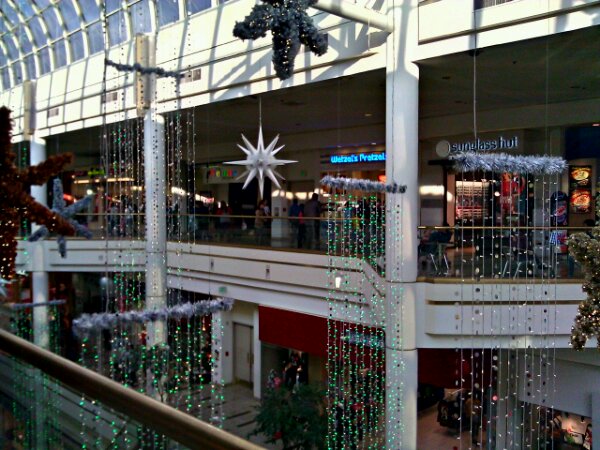
I’ve seen dangerous-looking Christmas decorations at the mall before, but at least those looked like…well, Christmas decorations. This spiked ball looks like something you’d find at the end of a mace, or maybe on the end of a chain for some knight to swing around.
Maybe the order called for a “morning star” and someone got confused?
Sequencing the Black Death
A few years back, while I was reading Eifelheim, I found myself curious about the timeline of the pandemic and read up on the Black Death. There was an idea floating around at the time that, based on descriptions of the symptoms and spread of the disease, the black death might have been caused by a viral hemorrhagic fever like Marburg, not by the bacteria that causes the bubonic plague that’s still endemic in some parts of the world. Since then, researchers have managed to extract bacterial DNA from the bones of Londoners who died when the plague reached the city in 1348, confirming that they were infected with a relative of the modern plague…and have reconstructed its genome. It’s virtually identical to the modern form.
Wow.