
Favorite techie license plate spotted lately:
GREP IT
Favorite techie license plate spotted lately:
GREP IT
Wow: A researcher studying the way people use computers found that most people don’t know how to search for a word on the current page!
Crazy: 90 Percent of People Don’t Know How to Use CTRL+F
Google’s resident search anthropologist, Dan Russell, dropped this incredible statistic on us. And no, he couldn’t believe it either.
To someone used to using computers, it seems so basic, but I guess if no one shows you it’s there, it’s the kind of thing that’s not easy to discover on your own. (via Slashdot)
The article doesn’t actually say which side of the 90/10 split people using toolbar buttons or menu items to search fall on, but it does mention people paging through an entire document to look for something by eye.
Cool idea: Google is designing a “Web intents” system for web apps similar to intents in Android. For those who haven’t used Android, “intents” allow apps to register actions they can take — such as “I can share (or edit) images!” — and other apps to hand data over to them. That way your camera app doesn’t need to know about every possible image-sharing or editing app you can put on your phone.
Now they’re extending the idea to web applications. There’s a JavaScript-based proof of concept, and they’re planning to add native support to Chrome.
Originally posted on Google+
Update: While it would have been cool, Web Intents never got off the ground. Paul Kinlan describes what happened.
I spotted something interesting while walking to lunch, took a photo with my camera, and then took a photo with my phone so that I could post it to Twitter immediately.
Then I thought: why?
And on the flip side:
I decided that in this case, it was self-explanatory, and neither the timing nor the quality made much difference. But since I had the better photo, I might as well wait until I could upload it. (Sometimes the photo quality really matters, though: my phone’s photos of that rainbow cloud just weren’t worth the effort, so it’s a good thing I rushed back to the office for a better camera.)
There was a time when if I wanted to post a photo online, I had to finish a roll of film, send it to a photo lab, wait for them to develop it, and then scan the print. I really like not being limited by that, whether it’s because I’m posting about a current event like Comic-Con or an election, or just because I think something’s fantastic (or hilarious) and really want to share it.
Sometimes it’s really useful to be able to post photos online instantly. Other times, it’s worth asking: Is now better?
A bit of craziness: I wrote this post in June 2010, about this sign. Then I decided it needed a bit of work before I posted it…and forgot about it. Interestingly enough, the post is still just as valid as it would have been a year ago, and it demonstrates that sometimes, now isn’t better, even if it’s not worse.
Of course, it also demonstrates an advantage of posting immediately. There’s no chance of forgetting about it that way!
I got hit by the mysterious overnight battery drain that’s been affecting G2 owners over the past week or so. Without using it at all, it had dropped to 58% battery. No, I haven’t received the OTA update to Gingerbread yet. Reports have been that it might be related to a Google Maps update that came out last week. Seeing as how I checked the battery usage and it showed 91% was Maps, and I hadn’t used Maps since several hours before I plugged it in last night, that seems highly likely.
I figure there are two reasons it hit now and not earlier.
My guess: Maps isn’t shutting down properly, and if GPS is enabled, it’s calling out and using up power.
The other weird thing: Before I realized I’d left GPS on, I uninstalled updates to Google Maps. Then I went back to the battery usage report, and instead of 91% Maps and tiny percentages of others, it showed the more typical 30% Cell standby, 30% Wi-Fi, etc. I suspect uninstalling the updates may have removed it from the battery usage report, and I was seeing the remaining 9% blown up to 100%.
Update (Wed): I reinstalled the Maps update and made a point of turning off both GPS and Wi-Fi when I charged the phone that evening. No battery drain during the 8 hours between the time I unplugged it last night and the time I picked it up this morning. Tonight I’m going to try it with just Wi-Fi and no GPS and see what happens.
Update (Fri): Well, that was unexpected. I turned GPS off and left Wi-Fi on last night, and the phone was down to 55% battery when I woke up this morning. Even though I know it had a stable signal since it was sitting 4 feet away from the access point. I would have thought GPS was a more likely culprit, but this suggests otherwise. Tonight I’ll have to try it the other way around.
Update (Sat): Last night I turned off Wi-Fi and turned on GPS before unplugging it from the charger. This morning I forgot to check the battery level, but I looked at it just after noon — and it’s still at 90% after at least 12 hours.
To make matters more interesting, Katie has long had problems with her Vibrant losing battery quickly, but since she turned off Wi-Fi, she’s been able to go several days between charges.
I think we’ve found the culprit. The question remains, though: why now? What is the phone doing over wifi that it wasn’t before?
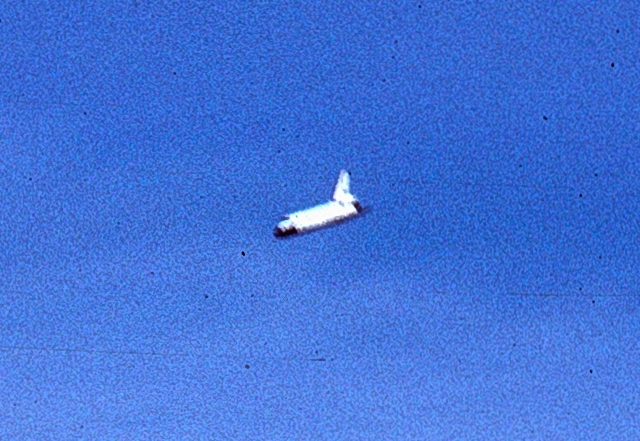
When I was twelve, my family went to see the Space Shuttle land at Edwards Air Force Base. It was the first mission after the Challenger disaster, and the orbiter was Discovery.
I took a roll of slides using a manual SLR camera and (for the landing itself) a telephoto lens. With the last shuttle mission ending tomorrow, I decided to track down the slides and scan them. Continue reading
I saw a license plate today that read,
I ♥ SPAM
I was a little surprised, but then I saw the “Made in Hawaii” plate holder and realized they were talking about the lunch meat.
*whew!*