White LightningA question over at the Comic Bloc Forums reminded me that I hadn’t gotten around to writing a full profile of the Impulse villain, White Lightning. Fortunately I had a full list of appearances already, so I was able to look up the answer to the question, but it felt like being caught totally unprepared. So yesterday I re-read all her appearances, and tonight I wrote up a profile of White Lightning.

Just for fun, I did some searches for her name. Mostly I came up with cars, horses, wax and, of course, booze. And an alpaca. Back to the booze, there was one point at which the character was mistakenly identified as as Moonshine (later explained away as an in-world mix-up, which would have made more sense if she hadn’t been the one calling herself the wrong name!)

Fedora LogoNow the funny thing: the “…in pop culture” section in Wikipedia’s article on Moonshine reminded me that Fedora 7, which just came out last week and which I installed at work a few days ago, is codenamed Moonshine.

The only way the timing could have been more appropriate would be if I’d written the character bio the same day as the Linux release.

I recently stumbled across an archived mailing list post of mine from the days before spammers started targeting WordPress. Someone had remarked that their spam problem had disappeared when they switched from Movable Type to WordPress, and I responded:

Oh, they hit us WordPress users too, just not as often as MT. Having it automatically moderate comments with certain keywords or more than X number of links helps cut it down, and the ability to (a) see all the latest comments and (b) mass-delete comments reduces the pain of cleanup. But they do target WP blogs from time to time.

I tend to get a pair of comments sent to the moderation queue every few weeks (presumably they figure if the first two didn’t show up, they won’t waste their time with more), but just this morning I had to delete a spam comment that came in last night and didn’t trip the moderation rules. (One of those with the generic “I like your site” messages and the author’s URL being the spamvertized site.)

That was September 2004. How things have changed! All WordPress blogs come with Akismet as an anti-spam measure, but I still prefer to use Bad Behavior, which has blocked ~2900 hits to this site in the past week alone, and Spam Karma, which has collected over 17,000 comment spams.

And with all those counter-measures in place, I get a couple of comments landing in the moderation queue each week. And just this morning I had to delete a spam comment that came in last night and didn’t trip either layer of defense (it was a generic piece targeting keywords found in a post). The filters are just barely keeping pace with the increased volume.

Project Honeypot recently started tracking comment spammers as well as email harvesting bots. Oddly enough, even though they have data going back to March 22, and even though Bad Behavior and Spam Karma have blocked an incredible number of spam comments on this site (Bad Behavior has blocked 3807 connections in the past week alone)…none of the honeypots I manage have trapped a single comment spam.

And no, the honeypot on this site isn’t protected by those plugins.

Flock. One of the problems with the ubiquitous Get Firefox! Get Opera! etc. web buttons is that while they might encourage someone unfamiliar with the product to check it out, they’re kind of pointless to someone who already uses your preferred browser. Sure, there’s a sense of, “Hey, this author uses Opera too!” but that’s about all it can do.

To make these a little more useful, on my Flash site, I use JavaScript to switch the button if someone’s using Firefox, and instead promote the Spread Firefox site. I’ve written up a similar method for Opera, though it’s less clear where to send people.

I recently discovered that Flock has taken another approach to solving this problem. As you may recall, Flock is a browser based on Firefox, focusing on social networking. It integrates with blogging sites, photo-sharing sites, bookmark-sharing sites and so on.

The Flockstars Extension expands on this by converting the button into a mini-profile. You fill in information like an avatar, usernames at Flickr, YouTube, etc., and links to your website(s). It generates button code that acts like an ordinary Flock button, but contains all this extra information.

The extension reads this information. Visitors to your site who are using Flock and the extension will see an icon in the toolbar, which will pop up a short profile and a menu of all the facets of your online presence.

It’s a cool idea, and seems to fit perfectly with Flock’s target audience. But it only solves half the problem. The browser promo badge is still there, still taking up space. The fact that the profile data is in the button code doesn’t make a difference; it might as well be stored in a set of META tags in the page head.

Opera BrowserThe Opera Web Browser is in the news today. First, they’ve just released version 9.20. In addition to the usual security, stability, and compatibility fixes, they’re promoting a new feature called Speed Dial, to make it easier to reach your most-frequently-visited websites.

Meanwhile, a recent survey by NetApplications and Surveyware found that while Firefox is widely considered the best browser, Opera’s users are more satisfied than users of any other browser. NetApplications’ current marketshare shows 79% IE, 15% Firefox, 4.5% Safari and 0.8% Opera for March 2007. (via OperaWatch)

While Opera is an excellent browser, this high level of satisfaction may be in part because of the size of its userbase. Often, when something is only followed by a small fraction of the potential audience, it’s mainly the hard-core fans. The only way to grow past that size is to bring in the casual users, who are less invested in it. Only time (and increased marketshare) will tell.

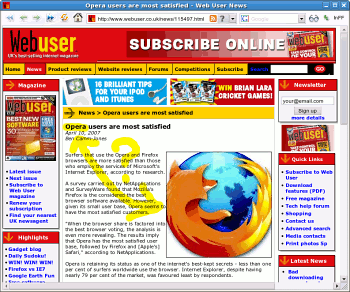
Webuser decided to lead with the Opera findings, which is great news for what they call “one of the internet’s best-kept secrets.” But they made an odd choice on the image to run with the article:

Screenshot of WebUser Article: Opera headline, Firefox Logo

Maybe they figured the Firefox logo was more recognizable, and would get more people to stop and read?

ยปAll pages site-wide with this tag