
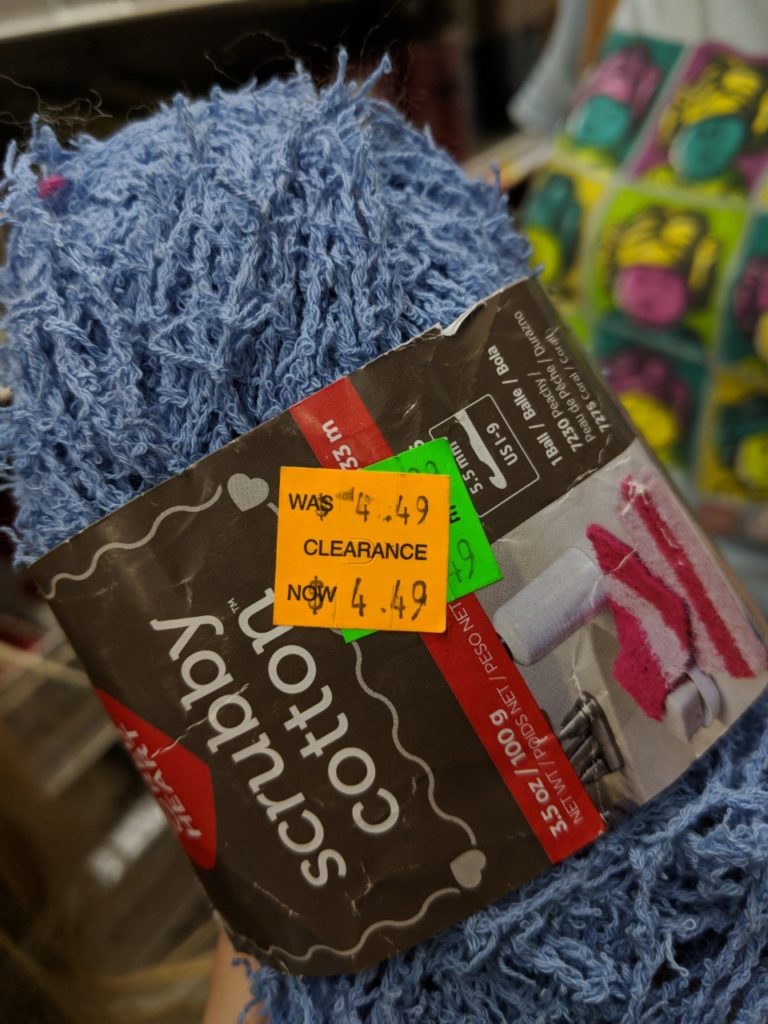
Gee, serious discount there…🙄
Gee, serious discount there…🙄
If you have environmental allergies to pollen, dust, animals, etc. you’ve long had the option of taking shots to desensitize yourself to the allergen. That hasn’t been the case for food allergies. But a pollen allergy is a lot less likely to kill you than a nut allergy. Some sort of treatment beyond “try not to eat it, and use epinephrine if you do” has been sought after for a long time.
Various forms of oral immunotherapy (OIT, SLIT) for desensitization have been under study for a few years…along with an injected medication that takes a different approach.
Around 10-15 years ago, my allergist at the time brought up the possibility of Xolair (omalizumab) for my asthma, suggesting it might also help with my food allergies. It’s an IgE inhibitor, which means it blocks the pathway through which food allergies operate. In theory, it would reduce my chances (or reduce the intensity) of a severe reaction to an accidental exposure.
It was an unproven, off-label use. Xolair had only been studied and approved for treating asthma, primarily asthma that other medication couldn’t control. And it would mean regular shots. And staying in the office after each one to make sure I didn’t have a reaction to the shot itself.
Ultimately I decided not to take her up on it. It seemed like more trouble than I wanted to go to for an uncertain gain. My experience wouldn’t have even helped clarify that gain. Any close calls I missed would have just been another anecdote, the medication’s impact unproven.
A decade and a bunch of clinical trials later (some alone, some in combination with OIT), the FDA has given Xolair a “breakthrough therapy designation” for treating food allergies. That means fast-tracking further reviews and development as a treatment. (more detailed article.)
There’s still risk/benefit analysis to do (in general and on a case by case basis), but things are starting to finally look up in terms of being able to treat the condition instead of trying to detour around it!
On Thursday I took the day off from work and we went to the Orange County Fair. It was a particularly bizarre visit because Costa Mesa was beneath the smoke plume from the Holy Fire (so named because it started in Holy Jim Canyon) burning in the Santa Ana mountains.
The sky, except for clear blue patches to the west and south, was a yellowish brown. The sunlight was dim and yellow.
![[Looking up at a log ride against clouds of brownish smoke.]](https://journal.kvibber.com/wp-content/uploads/2018/08/log-ride-apocalypse.jpg)
When we arrived, the entire ticket sales system was down. All the booths. All the self-serve kiosks. You couldn’t buy tickets for any of the rides, unless you could find one of the wandering cash-only ticket sellers, roaming the fair like quest-giver NPCs.
![[Looking up at a Ferris Wheel against clouds of yellowish-brown smoke.]](https://journal.kvibber.com/wp-content/uploads/2018/08/ferris-wheel-smoke.jpg)
We did eventually find someone who could sell us tickets. At that point, the sun emerged briefly through a break in the smoke. The deep red-orange disc was dim enough to look at comfortably, and lit up the fissures in the cloud a lurid red.
![[Crowds at the fair, and rides, with smoke above and some blue sky in the distance.]](https://journal.kvibber.com/wp-content/uploads/2018/08/fair-and-smoke.jpg)
Fair food keeps getting more and more outrageous. Deep fried Twinkie dogs and Zucchini Weenies have been joined by triple-decker donut burgers, chicken-in-a-waffle-on-a-stick, and the donut chicken and ice cream sandwich. But for sheer “because we can” ridiculousness: deep-fried filet mignon. What a waste.
![[Food stand selling fried...everything.]](https://journal.kvibber.com/wp-content/uploads/2018/08/fried-everything.jpg)
It was early evening by the time we left, and as we walked to the gate closest to where we’d parked, we saw a bright orange line in the distance. Was it the glow of the flames behind the mountain? Or the flames themselves on top of the ridge? We were too far away to tell. But that line shimmered, and we watched a deeper orange glow appear and fade behind another part of the ridge. It’s hard to be sure, but I think it might be burning in the valley between the two peaks of Saddleback.
![[Night view: Mostly black, with an orange line silhouetting the edge of a mountain.]](https://journal.kvibber.com/wp-content/uploads/2018/08/fire-on-the-mountain.jpg)
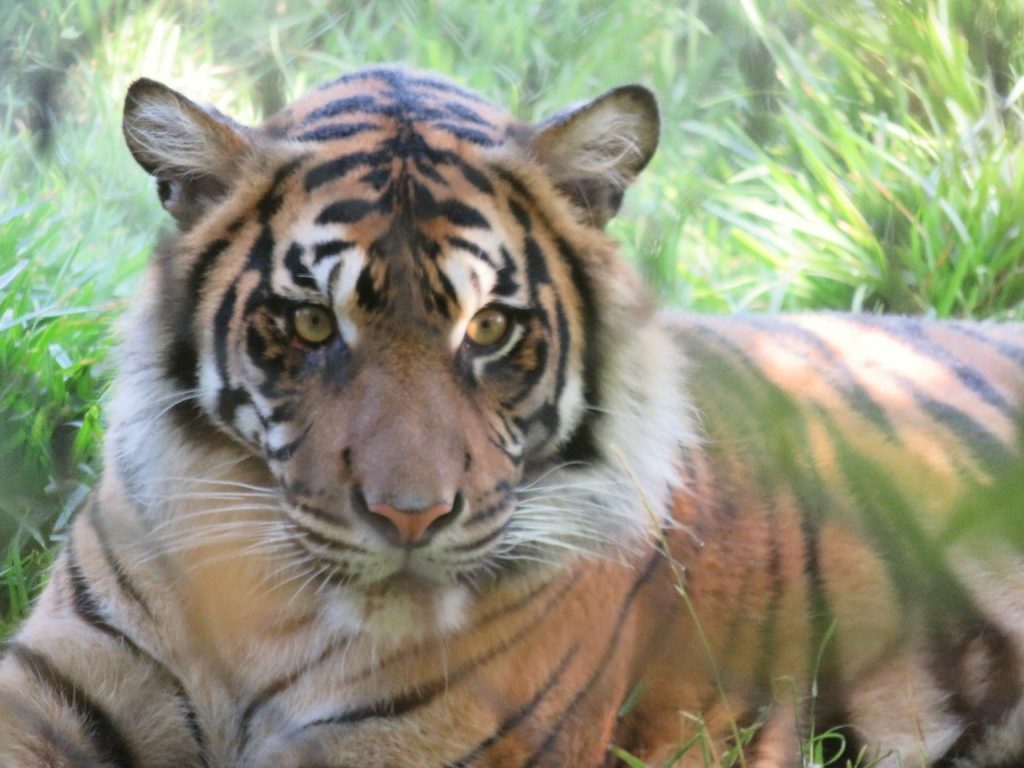
The tiger was a lot closer to the fence than I expected, watching us tourists with a disdainful look as it lounged in the afternoon heat. The fence mostly blurred out of view, but I didn’t notice a dry leaf in front of its face to the left of its mouth, leaving a brown splotch in the camera’s view. The tigers at the San Diego Zoo’s Safari Park have quite a bit of space, and this isn’t the only shade, which makes me think they were people watching. It’s an intriguing thought. And a disturbing one!
Looking at the photo reminded me: Tigers and other large cats have round pupils, unlike housecats. I read an article a while back on a study that linked pupil shape to ecological niche: Horizontal pupils mainly appear in prey animals (sheep and goats, for instance), and vertical pupils appear primarily in ambush predators who are active in both day and night, and whose heads are low to the ground (like snakes and smaller cats). Horizontal pupils handle glare better and offer a wider visual field. Vertical pupils adjust to a greater range of light levels and, by narrowing the depth of field, offer better distance cues…but that effect is stronger when your eyes are close to the ground. Higher off the ground, the vertical slits don’t help as much, so bigger cats like lions kept round pupils.
Expanded from a post at Photog.social. More photos from trips to the Safari Park in this Flickr album.
I have mixed feelings on Facebook closing down automated posts to personal* profiles. It might cut down on spam, and it will lead to better descriptions on link posts, but it also locks you further into their silo.
You can still write elsewhere and link back to it on Facebook, but you can’t use WordPress Publicize or IFTTT to post it, or Buffer to schedule it. You have to do it manually, which adds more friction, and you can’t time-shift it. I used to spread out look-at-this-cool-link posts using Buffer, and queue them up from Pocket while offline, but I can’t do that anymore.
If you want your Facebook audience to see your words or photos, it nudges you to maybe just post on Facebook to begin with (never mind that you want its main home to be somewhere you have more control). And it’s another way for them to get you back onto the site so they can try to keep you there for another 15 minutes, see some more ads, and generate more value content for Facebook.
Then again, I can’t help looking at it in terms of the debate over cross-posting from Twitter to Mastodon. There’s an argument that if you’re not actually on the platform, you’re not contributing to it. And while that debate tends to focus on auto-posts from a specific mismatched (and hostile) community, I think it’s fair to consider the broader context that if you’re not at least following up, you’re not really participating. (I’m especially guilty of that with my cross-posts to Tumblr.)
Though I suppose it matters more to a smaller community like the Fediverse than to something as massive as Facebook.
*Pages and groups can still accept automatic posts through the API, but those supposedly represent a business, or an organization, or a public persona rather than a “real” person.
Expanded from a Mastodon post on Wandering.Shop.
You can broadly categorize social networks, or really any communication software, based on four criteria:
More than whether the content is likely to be short text, long text, a photo, a video, or a link, these questions define the types of connections and types of interactions that people are going to have.
I need to generate a GIF of Gillian and George the Giant Giraffes gingerly eating ginseng gelato on a gyroscope while drinking gin.