I’ve been thinking a lot about Robert J. Sawyer’s Quantum Night the last few months. It links human cruelty, psychopathy, and mob behavior to the nature of consciousness, mostly focusing on the main characters but playing out against a global crisis brought on by a rising tide of xenophobia.

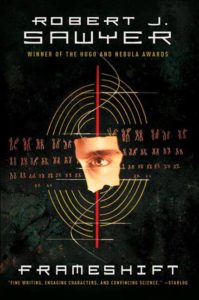
More recently, I’ve been thinking about Frameshift. His 1997 novel deals with (among other things) eugenics, Neanderthals, Nazis, and health insurance companies doing everything they can to avoid covering people with pre-existing conditions.

I can’t imagine why that keeps coming to mind….

I liked Rogue One: A Star Wars Story quite a bit. Despite having a very different tone from either the original trilogy or the prequels, it’s still recognizable as a Star Wars film, and successfully weaves in and out of the events leading up to A New Hope.

There’s a somewhat odd setup for where they actually find the Death Star plans, though. SPOILERS after the cut:

Continue reading

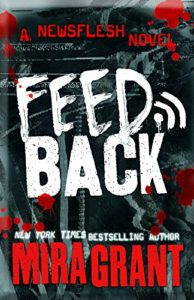
Feedback, by Mira Grant

While reading Feedback, it occurred to me that Mira Grant’s Newsflesh series features the worst-case scenario of zombie design, and yet humanity survives with civilization mostly intact. That’s impressively optimistic.

I mean, look at the parameters of how zombies work in this setting:

Everyone who dies becomes a zombie, regardless of whether they’ve ever been near a zombie. This is fairly common, but there are settings where you can keep zombies out with a quarantine. Not this one.

Direct contact with a zombie is extremely contagious. Bites and scratches, sure, but imagine a zombie with late-stage Ebola. (A modified Marburg is one of the component viruses). Zombie drool landing on an open wound can convert you. The blood spatter from the zombie you’re shooting can get in your eye and convert you. The body of the zombie you just killed, lying on the ground motionless, is still a high-level biohazard that can convert you.

Anyone who goes out in the field must go through decontamination when they return. Showers include a standard bleach cycle and won’t let you out until it’s done. Outbreak sites have to be hosed down with bleach, burned, or simply condemned.

Any blood that’s been outside the body long enough will trigger conversion on exposure, even if the person isn’t a zombie. Even your own blood.

Sometimes people spontaneously convert. It’s not common, but it’s been known to happen.

The newly-infected can be as fast as a normal person before their body starts decaying. (Yep, fast zombies and slow zombies in the same ‘verse.)

Any large mammal can become a zombie. Dogs. Raccoons. Horses. Bears. Cows. Red meat is now a biohazard.

Mobs of zombies can plan ambushes. Enough zombies together exhibit just enough rudimentary intelligence to set a trap. Even across species.

There’s a really scary twist in the virus’ transmissibility late in the second novel that I won’t spoil.

The only factor that isn’t maxed-out is their indestructibility. A zombie in the middle of the desert or at the bottom of the ocean will eventually starve.

Eventually.

And yet humanity survives the Rising and is able to rebuild civilization in many — not all, but many — parts of the world.

That’s…well, that’s kind of inspiring.

With Jessica Jones and Star Wars: The Force Awakens both out, it’s hard not to compare Kilgrave’s power to Jedis’ ability to influence minds. But while we admire “You don’t need to see our identification” and laugh at “Republic credits will be fine,” Kilgrave is terrifying.

It’s not just that Jedi are compassionate and Kilgrave is a total sociopath with no regard for human life who would casually make someone kill or maim themselves just because he was having a bad day. Darth Vader is just as ruthless, but doesn’t bother with the technique (in the films, at least).

It’s that the “Jedi mind trick” is explicitly shown to be limited. It’s used rarely, and only for specific commands. The first time we see it used in A New Hope, Obi-Wan Kenobi describes it as “influence” rather than control and specifically says it only works on “the weak-minded.” Willpower is sufficient to guard against it. In Return of the Jedi, Jabba the Hutt even laughs it off when Luke tries to use it on him. The only time we see any sort of long-term suggestion it’s to “go home and rethink your life.” Presumably the dealer in Attack of the Clones will be in full command of his own faculties by then, having simply been prompted to start the soul-searching.

Kilgrave, however? His commands are absolute. No matter how hard you prepare mentally, no matter how strong your will, no matter whether your actions would go against your principles, or hurt you, or hurt someone else — even someone you care about — you do it. Immediately. None of the usual trying to stop your hand from moving that you see in a lot of movies where a mind-controlling character shows up. No apparent strain on his part to keep controlling you. Implanted commands can last for hours, and he can renew his control over and over as long as he wants to.

That’s scary enough right there. Putting that level of power in the hands (well, voice) of someone who sees other people as merely tools and playthings, and whose only behavioral boundaries consist in covering his own tracks? That’s nightmare-level stuff.

Think about it this way: Emperor Palpatine spent decades manipulating key people across a galaxy into putting him in a position of absolute control over thousands of worlds. Put him in a room with Kilgrave and he wouldn’t stand a chance.

Do Not Taunt the OctopusMira Grant has been writing yearly novellas set in the world of her Newsflesh trilogy. A generation after the zombie apocalypse, humanity has survived, adapted, and rebuilt civilization. While the trilogy focuses an a core group of characters, journalism, social media and American politics, the novellas have opened up more of the world.

“Countdown” reveals the early stages of the Rising, including a look at what two messed-up background characters were like before everything went to hell. “The Last Stand of the California Browncoats” looks at what would happen if an actual zombie plague wiped out Comic-Con. “How Green This Land, How Blue This Sea” jumps across the world to Australia, where the people take a very different approach toward managing the zombie virus. “The Day the Dead Came to Show and Tell” explores the implications of life with zombies on the school system, and it’s really freaking disturbing. The newest one refers back to it (not in any detail — it goes out of its way to not describe what actually happened), and it hit me again. That story sticks with you.

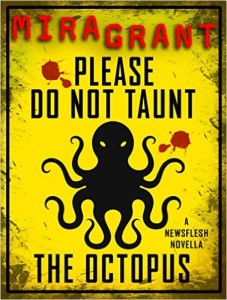
“Please Do Not Taunt the Octopus” is the latest, and picks up the tale of Dr. Abbey, who runs an underground virology research lab where they’re trying to cure the zombie virus without the politics constraining mainstream organizations like the CDC (which has its own issues), as they deal with industrial espionage, hackers, and some…surprise visitors. She grudgingly accepts the label of “mad scientist,” though she insists that while she is angry, she’s not crazy.

It’s a surprisingly upbeat story considering the setting, as is “How Green This Land…”

One interesting observation: It’s now 2015. In the Newsflesh world, the Rising took place in 2014. We’ve now branched into alternate universe territory, but there are references to historic events and pop culture that happened after the first novel came out in 2010.

Another observation: I followed this up by finally reading Unlocked, a novella detailing the background of John Scalzi’s novel Lock-In. It’s an interesting parallel, in that both Newsflesh and Lock-In pick up a generation after a devastating virus has swept the globe, killing and transforming people — in one case taking over the bodies as the mind dies, in the other leaving the mind intact but cut off from the body — and the technological, social and political changes made to deal with the new normal.

Let’s face it: This is the first live-action Star Wars movie in ten years, and it reunites the original cast on screen for the first time in thirty. Nobody really cares what it’s called: it could be “Star Wars VII: The Search for More Money” and those of us who grew up on the original trilogy would still go out and see it opening weekend.

Just not at a midnight showing. We’re getting too old for that sort of thing.

ยปAll pages site-wide with this tag