
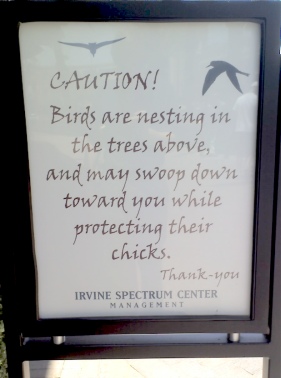
Well, that’s encouraging. I mean, nothing makes lunchtime better than worrying you might be about to star in a Hitchcock remake.
Author Archives: Kelson

Announcing SpeedForce.org!
 I’ve just launched SpeedForce.org, a companion blog to the website, Flash: Those Who Ride the Lightning.
Since I started adding news items to the front page of Ride the Lightning, it’s started to get a bit crowded. I thought about converting it to a Delicious feed, but then I realized it really ought to be a blog. There hasn’t been a major Flash-focused blog out there since Crimson Lightning shut down, so I figured I’d step in and fill the gap. And I could use the domain I picked up last year!
I’ll be posting Flash-related news there, including a weekly round-up of Flash comics, as well as articles that might not fit into the existing site structure, and (eventually) reviews as well. Some stuff that I would have posted here will end up on the new site. Certainly Flash news, but I may start shifting more comics-related commentary over there as well.
I’ll be refining the look and features over the next couple of weeks, and cross-linking it more into Ride the Lightning. I might keep the current theme with a few tweaks, or I might try to match Ride the Lightning, or I might build something else entirely.
So please, check it out and let me know what you think! I’m open to suggestions as to content, design, etc. And of course bug reports.
TV Shows that Should be on DVD
One nice thing about the DVD market is that it seems like just about every TV show imaginable has gotten released on DVD over the past few years (to the point where, in some cases, it feels like studios are scraping the bottom of the barrel). But if you look at the full list at TV Shows On DVD, the percentage of shows available is actually quite small.
Once the trend had been established, I waited years for first Babylon 5, then Animaniacs, and then The Flash to make the list. I’m still waiting for VR.5, a show from the mid-1990s that, like Firefly and Drive, got half a season on Fox and didn’t even see every episode aired. (Okay, the premise was total fantasy wrapped in a sci-fi buzzword, but the concept, characters, and storyline were interesting.)
So, what TV shows of days past are you hoping to see again? I’m mainly curious about shows that have been off the air for at least 5 years.
Smilers in Concert
Went to see Aimee Mann on Friday at the House of Blues. She’s promoting her new album, @#%&*! Smilers (and yes, it’s pronounced as you might expect, though she also gave an alternate pronunciation of “Effing Smilers”), which just came out last week. Of course, this meant that most of the audience either hadn’t heard the new songs, or had only heard them a few days before. Old favorites like “Save Me” tended to get cheers as soon as people recognized the intro music. With the new stuff, people were quieter, as if they were waiting to hear the song for the first time. But they all got applause in the end.
In the past, when we’ve gone to the Anaheim House of Blues, we’ve tried to eat at Downtown Disney. It always proves problematical, with restaurants either not taking reservations for parties of two or not having any reservations left. This time we just ate near home and drove up after dinner. We got there after the doors opened, but before most of the audience arrived, and managed to claim a spot dead center in the main floor, much closer than we’d ever been to this stage.
The opening act was Rebecca Pigeon. She was quite good, and a good match stylistically. (Too often, you only get one — or neither. We still joke about “Corn Mo” who opened for TMBG a few years ago.) She started with “Tough on Crime,” which Katie figures has to have a Heroes video in it somewhere. Interesting fact: it turns out she’s married to David Mamet.
By the end of the opening act, the house had filled up considerably, and was respectably packed by the time Aimee Mann took the stage. Continue reading
The Accidental Beekeeper
On Monday, Katie found a bee flying around the kitchen, and a disturbing buzzing sound coming from the stove vent. Outside, bees were swarming around the outlet. We clearly had bees in the ceiling. Worse, they were getting into the kitchen. By Monday evening, we’d found at least 8 bees in the kitchen, two of them at once.
Maintenance came out that afternoon, realized there were too many bees to handle, and called in the professionals to come out on Tuesday. By Tuesday evening, there were only a handful of bees outside, and we found a half dozen dead on the floor near the window. And, disturbingly, one dying bee stuck in a pool of unidentified goo in a skillet that had been left to dry on the stove.
And that was the end of it, until Katie opened up the cabinet above the stove today, and was greeted by the sight of dozens of dead bees:
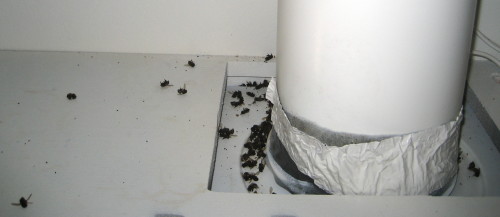
They weren’t just in the vent, or the ceiling: if we’d opened that cabinet on Monday, we’d have had a full-on swarm in the kitchen.
The Flash Companion Arrives in July
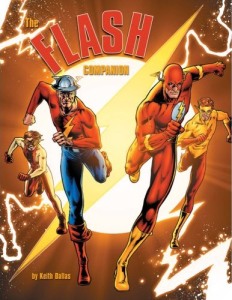 A couple of bits of news on TwoMorrows’ upcoming book, The Flash Companion by Keith Dallas. This is the book for which I wrote several articles last fall.
First, the book has been scheduled for July 23, which brings it out just in time for San Diego Comic-Con.
Second, I noticed this week that Amazon is offering 26% off on pre-orders, bringing it to $19.81.
I’ll let the official summary speak for itself (with a bit of reformatting):
The Flash Companion details the publication histories of the four heroes who have individually earned the right to be declared DC Comics’ “Fastest Man Alive”: Jay Garrick, Barry Allen, Wally West, and Bart Allen.
With articles about legendary creators Shelly Mayer, Gardner Fox, E.E. Hibbard, Julius Schwartz, Robert Kanigher, John Broome, Ross Andru, Irv Novick and all new interviews of Harry Lampert, Carmine Infantino, Cary Bates, Alex Saviuk, Mike W. Barr, Marv Wolfman, Mike Baron, Jackson Guice, Mark Waid, Scott Kolins, among others, The Flash Companion recounts the scarlet speedster’s evolution from the Golden Age to the 21st century.
Also featured are “lost covers,” never before published commission pieces by Flash artists throughout the decades, a Rogues Gallery detailing The Flash’s most famous foes (including 3 profiles by the author of this website) a tribute to late artist Mike Wieringo by Mark Waid, a look at the speedster’s 1990s TV show, and “Flash facts” detailing pivotal moments in Flash history. Written by Keith Dallas, with a cover by Don Kramer (Detective Comics, JSA) with colors by Moose Baumann (Green Lantern).
I’ve contributed three articles to the Rogues Gallery section, and a convention photo. I’ve had a chance to read some of the other articles and interviews, and this is going to be a great read for Flash fans!
Edit: One more item: This is small press, and I’m not the main author on the book, so I’m not getting paid for the articles I contributed. But I do have an Amazon Affiliate account, so if you order through this link, I’ll actually get paid a little in a roundabout way.
Quick Thoughts on Gas Mileage
Yesterday the Los Angeles Times ran an article about the fact that, in response to soaring gas prices, smaller cars are outselling light trucks (which include SUVs, pickups, and minivans) in the US for the first time since 1996. Last night I was going through old magazines that we’d just tossed in a bag before moving. I found the September 2006 issue of Westways (the California Auto Club’s magazine), with a cover story about the new breed of small cars, wondering when the market would shift in response to the high prices. Now there’s timing.
On a related note, 9 months of driving a Prius has given me a somewhat different perspective on “good” and “bad” mileage. When I see averages of 38–48 MPG over the course of a tank of gas, and can get up to 60 MPG on straight, flat stretches of freeway, advertisements touting 25–30 MPG just don’t sound that enticing.