CNET has posted a write-up of AOL’s new Netscape prototype based on Firefox, as well as a screenshot. It seems to be a combination of Firefox + theme + bundled extensions… plus a mode that embeds Internet Explorer for compatibility.

There are some nice ideas: adapting Firefox’s RSS capabilities to create a headline ticker, for instance, and the Firefox team has been talking about bundling extensions since it was called Phoenix. As for the embedded IE mode… on one hand it provides a convenient solution to the biggest criticism laid on all non-IE browsers: they don’t render pages exactly the way IE does. But it comes at the cost of all the security risks inherent in IE itself. It does remind me of the “View with Gecko” option Konqueror used to have (and probably still does on some systems).

But the clutter… The sheer number of buttons, icons, widgets etc. in that screenshot is staggering. Even after installing the web developer extension I don’t think I have that many buttons on Firefox. 3+ buttons on the tab bar, 3 icons on each tab…. I hope that CNET was just enabling every feature they could find to get them all in one screenshot, but if AOL is trying to bill it as “easier” than Firefox (which was created with a simple user interface as a design goal), they’ve got to try another approach.

Update (via WaSP): It seems BetaNews has more information on the dual-engine setup. Apparently they do have security settings to mitigate the IE issues… but then so does IE, and we all know how well that’s worked. Also, another screenshot, which looks even more cluttered than CNET’s. I think this will be a browser that requires you to run it maximized at 2000×1500. (Also of note: Firefox developer Blake Ross’ Open Letter to Netscape and Henrik Gemal’s collection of screenshots.)

Further Update: MozillaZine has posted a more thorough review.

After updating some links, the following dialogue occurred to me:

Sallah: Indy, why does the web… move?
Indiana: Give me the URL.
(The location looks like a Python script)
Indiana: Snakes. Why did it have to be snakes?
Sallah. ASP. Very dangerous. You go first.

(Actually, I have to credit Katie for the Python reference. The first and last lines just popped into my head, though.)

Mozilla developer Ben Goodger writes about losing his inbox to the latest virus… despite not using any vulnerable software. Apparently he’s been getting over 10,000 virus-laced messages every day, and with the four-day weekend they built up to the point that Thunderbird wasn’t able to handle the influx. (Imagine having to filter out 770 megabytes of junk every day, and having that build up over several days.)

Sure, the the pre-release Thunderbird still has problems dealing with very large folders, but 770 MB/day? Even Gmail only gives you 1 GB of total storage. I can’t think of any reasonable expectation that any mail client should have to deal with that at today’s level of data richness. Maybe in the future when we’re sending full-motion video on a regular basis, but not when most email is text with maybe some formatting and a couple of small images.

It’s just staggering that, even though the main email worms depend on Microsoft Outlook, Outlook Express, and Internet Explorer to spread themselves and infect new hosts, they can still damage systems that don’t use those programs!

While working on my Flash site last night, I noticed something interesting: several of the Flash’s classic Rogues Gallery have children.

The Trickster was the first: he discovered he had a 12-year-old son by an ex-girlfriend. (Neither Billy nor his mother has appeared since this story, which was part of 1998’s “New Year’s Evil” event.)

The Weather Wizard was next. Early in his run on the book, Geoff Johns introduced an ex-girlfriend of Wally’s who had an infant son with lightning-based powers. He turned out to be the result of a rebound one-night stand with the Weather Wizard (in his civilian ID, of course) just after she and Wally had broken up.

And now, with Identity Crisis, Captain Boomerang has a long-lost adult or teenaged son… who looks like he’ll be taking over the “family business.” Who his mother is remains to be revealed, though the next issue of either IC or The Flash seems likely.

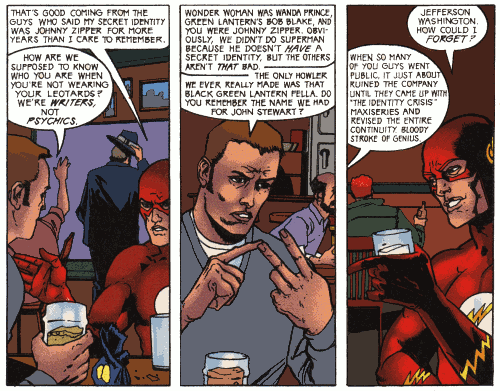
With the Top‘s history featuring prominently in the current Flash tie-in to Identity Crisis, I realized it’s possible to narrow down just when the flashbacks in IC take place. I’m not very familiar with the satellite-era Justice League, but I have tracked down, read and, yes, catalogued the entire Barry Allen run of The Flash.

In Identity Crisis #2, Green Arrow states that it was a few months after Iris died. Iris died in Flash vol.1 #275, and the storyline wasn’t really resolved until #284, when Barry trapped her killer on the wrong side of a time machine. In Flash vol.2 #215, Barry writes about an event that took place a week after the Top’s ghost was excorcised from Barry’s father. That storyline ran from #297 (the car crash in which Henry Allen’s heart stopped) to #303 (getting rid of the Top). Since this was clearly after the *ahem* incident, we can narrow it down to taking place between Flash #284 and Flash #297.

(This has got to have been the most fanboyish post I’ve made here…)

The current tenuous situation with Fallen Angel reminds me of one of those curiosities of the comic book market: the relationship between episodes in magazine form and longer stories in book form.

Most comics in the US/Canadian market are released as individual issues, with maybe 22 pages of story and a bunch of ads. Longer works are often released as trade paperbacks (TPBs), but often don’t sell as well because, let’s face it, $19.95 is a much bigger chunk of change than $2.50. However, many series are collected into TPBs once the publisher figures the original issues have mostly been tapped out, often adding additional material like sketches, character designs, or occasionally an entire epilogue. (Kingdom Come and Death: The High Cost of Living both used that trick.) Advantages: they fit on a shelf, they’re often better paper and more durable, you can get an entire 6-part story in one chunk… and most importantly, they can fit on bookstores’ shelves, bringing them to an entirely new audience.

During the 1990s, only the most popular storylines would get the TPB treatment, but as the graphic novel market has grown, the trend has been toward collecting every issue of a series, so that whether you get the original issues or the collections, you still get everything. This has led to two controversial phenomena: writing for the trade and waiting for the trade. Continue reading