
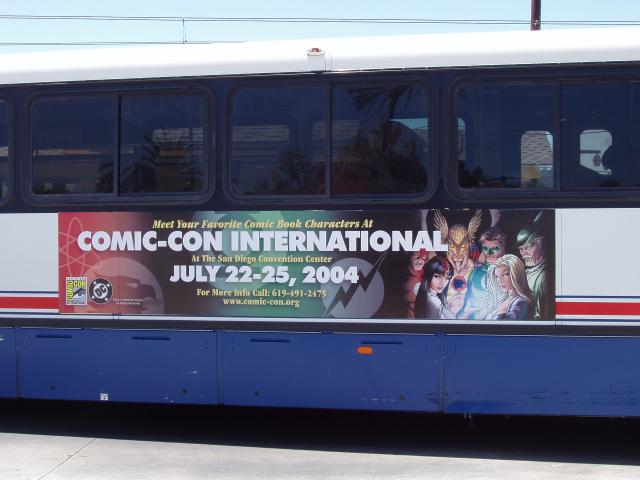
We accidentally went to Comic Con on Thursday. The plan was just to pick up our badges that afternoon, but there was a panel on balancing action and character development with some really big-name authors – Robert Jordan, Peter David, Raymond Feist, etc. (The basic lessons: let combat grow out of the characters’ actions instead of tossing it in, and be aware that combat is confusing. Focus on individual characters as much as possible, rather than trying to present a long view. Quotes here.) So we stayed, I got massively dehydrated, and we spent the next hour slowly drinking water and recovering. We ended up running into a group from the UCI RPG club and just stayed around and talked for a while before we headed off to dinner.

Neither of us had ever been to Comic Con on a day other than Saturday, and my experience with conventions tends to be that Thursdays are very light. Not so! Continue reading

Support The Comic Book Legal Defense Fund: 1-800-99-CBLDFYou might think nothing of going down to the store and picking up a comic book, but there are people out there who want to limit your choices to books aimed at 10-year-olds. (Admittedly, there aren’t enough books aimed at 10-year-olds right now, but that’s another rant). Imagine if all movies were G-rated. Because, after all, everyone knows, movies are just for kids, right?

There was a time when all comics had to be approved by the Comics Code Authority, because in the 1950s, comics were the trendy scapegoat for juvenile delinquency (much as video games are often blamed today). While writers and artists of the day managed to produce classics within those constraints, one can only imagine what the world missed out on that it wouldn’t see until publishers began to risk non-code books in the 1980s. The now-classic Alan Moore run on Swamp Thing, for instance, or Neil Gaiman’s Sandman, could never have been produced under the limits of the Comics Code, even under its current incarnation. (Back to movies briefly: did you know that It’s a Wonderful Life broke the rules of the motion picture code? Mr. Potter may have failed to take over the Savings and Loan, but he was never punished for his misdeeds — a requirement under the film codes of the time!)

Even now, there are people who want to keep everything “safe” and innocuous — for everyone, adults as well as kids. The Comic Book Legal Defense Fund is dedicated to protecting freedom of expression in comics from this sort of attack. They’ve defended writers, artists, even retailers over the past 15 years.

So if you like books like Fables or Powers, or books like 100 Bullets or Y, The Last Man — check out the CBLDF. Read what they do, and why. Consider joining, or making a donation, or just buying a T-shirt. And if you’re going to San Diego for Comic-Con International this weekend, drop by their booth and see what’s going on.

Time in comics is a strange, fluid thing. When you keep adventure characters in print over the course of decades, you don’t want them to get old. And so characters like Superman, who debuted as twenty- or thirty-somethings 60+ years ago, are roughly the same age today.

This is hardly unique to superhero comic books. The same is true of James Bond movies, the Hardy Boys and Nancy Drew books, and even newspaper comic strips. (How long has Dennis the Menace been five years old?)

Still, it makes for interesting contradictions. If Superman debuted 14 years ago, he can hardly have met JFK, so clearly any stories dealing with him are no longer “canon.” On the other hand, if the story doesn’t depend on JFK having been the President at the time, the nefarious super-villain plot may still be part of Superman’s history. But sixty years of chronicled adventures crammed into fourteen years makes for a pretty busy life! (And how frequently does the US hold Presidential elections in the DC and Marvel universes?)

The time-squishing effect is easiest to see with flashbacks. Continue reading

A few weeks ago I was looking at the website error logs and noticed some attempts to access images with names like /flash/images/%20%20%20%20%20%20%20ans3.jpg. I got around to looking at it today, and all of them are the same name, all of them from browsers looking at my profile of the Teen Titans, which includes an image called teentitans3.jpg.

I finally realized what’s going on. Some moronic filter has broken up the name not as “teen titans” but as “teen tit ans,” decided it must be porn, and replaced the “offending” words with spaces (%20 is the code for a space in a URL).

It really makes me wonder how badly mangled the page looks to these people, especially if it turns out that every instance of the team’s name gets pointlessly erased.

Further reading: The Censorware Project, Peacefire, Electronic Frontier Foundation.

ยปAll pages site-wide with this tag