
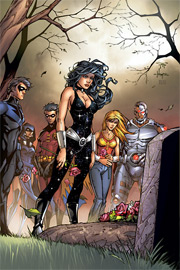
 With current and former Teen Titans dying by the handful in DC’s big events, Infinite Crisis, World War III and Countdown, I’ve decided it’s time to take a look at the comics’ body count. Going back to the beginning of the team, which members have died? Which have come back? Here’s a list of all the dead Titans I could think of:
Category: Entertainment
Comics and the World War II Home Front
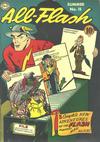 Two months ago I picked up a copy of the comic book All-Flash #15 (Summer 1944), published during the thick of World War II. In the bottom margin of each page is a slogan, in rhymed couplet form, on how children could help with the war effort:
- Bottom Lines on Following Pages Tell What to Do While Battle Rages
- Tin Cans in the Garbage Pile Are Just a Way of Saying “Heil!”
- Waste Fats in Good Condition Help to Make Fine Ammunition
- Boys and Girls, Every Day, Can Give War Aid in Many a Way—
- Every Time You Buy a Stamp, You Feed the Flame in Freedom’s Lamp
- If You Have an Extra Quarter, Buy a Stamp to Make War Shorter
- However far soldiers roam, the want to have some mail from home
- Collect Old Paper, Turn It In—Help Your Uncle Sam to Win
- You Can Walk to School and Store! Saving Gas Helps Win the War!
- Boys Are Smart, Girls Are Wise, Black Markets Not to Patronize
- IF YOU STILL HAVE METAL SCRAP, TURN IT IN TO BEAT THE JAP
- Turn Out Lights Not in Use —War Production Needs the “Juice”
Case and punctuation are preserved as closely as possible. Continue reading
Victimized Hero
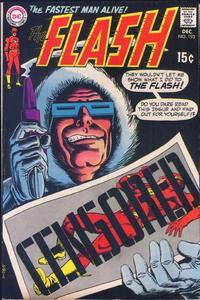 I didn’t think I had anything to add to the discussion on the infamous Heroes For Hire #13 cover. (Some of those links possibly NSFW.) Something stuck in my mind, though. Typolad suggested that “you would never, ever see Marvel or DC make a cover like this with a male protagonist. Yes, a male hero may be shown in peril, but his face will be defiant. He won’t be shown as submissive.” Lea Hernandez’ remix of the cover alters the expressions to do just that.
Now, I agree—that cover was way past the line, and I can’t imagine DC or Marvel doing the same thing with male characters, especially when you take into account the sleaze factor. But phrases like “never, ever” tend to read like a challenge. Looking just at the defiant/passive stance, I knew I’d seen at least one cover with the Flash beaten to within an inch of his life, unable to put up a fight or even a glare, so I took a trip through the Grand Comics Database’s cover gallery. Continue reading
Lost Finale
That makes two very good season finales this week. Lost was more plot-focused, while Heroes was more character-focused.
And we learned some very interesting things about the fate of the islanders.
Spoilers follow. Continue reading
Thoughts on Heroes: “How to Stop an Exploding Man”
The Heroes season finale was excellent. They did a good job of resolving the main story arc established at the beginning of the season (the bomb threatening New York City), balanced action and characterization, answered some questions while still leaving things open—and set up a really interesting situation for season 2.
It’s also nice to see that they’re keeping the weekly online comics going between seasons—and that they mentioned it during the broadcast. I think that’s a good move for keeping fan interest going until fall. I’m still hoping they’ll collect them in print, though. They could probably put everything concurrent with season 1 into a ~200-page trade paperback and sell it in bookstores. It would be a great companion item to go with the DVD set.
Now for more detailed thoughts on the episode. Spoilers follow: Continue reading
Showcasing the Flash
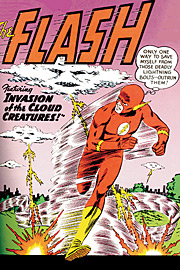 The first volume of Showcase Presents: The Flash came out today, reprinting ~500 pages of Silver-Age Flash stories in black-and-white for cheap. If you’re familiar with Marvel’s Essential line, it’s the same concept.
I took a look at it to see what stories were included. (DC’s solicits didn’t say.) As expected, it features the first several years of Barry Allen’s run as the Flash, from the original Showcase appearances starting in 1956 through the beginning of his series in 1959–1961. That includes the first appearances of the Elongated Man (who got his own Showcase Presents book last year) and Wally West as Kid Flash.
There was one surprise: “The Rival Flash,” from Flash Comics #104 (1949). That was the final issue of the Golden-Age series, and the last solo Jay Garrick adventure printed for years. I’d heard that the Showcase Presents books were making use of restoration done for DC’s Archives series, and this tracks: That same story also appeared in The Flash Archives Volume #1.
It also appears as a backup in The Flash #211 (1971), and is listed in the contents for the upcoming Flash: The Greatest Stories Ever Told, tying the origin story in Flash Comics #1 for the most-reprinted Golden-Age Flash story yet.
Full contents:
- Flash Comics #104 (1949)
- Showcase #4, 8, 13, 14 (1956–1958)
- The Flash #105–119 (1959–1961)
Mohindiana

 Ever notice the similarities between Mohinder Suresh on Heroes and Indiana Jones?
No, seriously. His first arc is straight out of Indiana Jones and the Last Crusade.
Both are teaching professors (Mohinder: biology; Indy: archaeology)
Their fathers are both academicians as well (Dr. Chandra Suresh: biology; Dr. Henry Jones, Sr.: medieval studies).
Both are estranged from their fathers, in part due to the death of a female relative (Indy’s mother, Mohinder’s sister) and in part due to the fathers’ obsessions with their own personal quests (Suresh: evolved humans; Jones: the Holy Grail).
Nonetheless, each pursued his father half-way across the world when that quest got him into trouble.
They both found their fathers’ notes, which had been missed when their homes were ransacked.
Each encountered a female associate of his father, close to his own age, who later turned out to be a spy. Moreover, both women’s first names were four letters long and started with an E (Dr. Elsa Schneider, Eden McCain).
Each shares his name with a family pet. (Indiana Jones took his nickname from the dog. The elder Dr. Suresh named a lizard after his son.)