I’ve been working my way through the classic Universal Frankenstein movies, some of which I’m sure I’ve seen before, and some of which I’m sure I haven’t. Of course, they get filtered through having read the book at least three times and having watched Young Frankenstein many times.
Last weekend I watched Bride of Frankenstein. It’s a good movie, but the framing sequence bugs me. In it, Lord Byron is telling Mary Shelley how much he enjoyed her tale of horror, and proceeds to revisit the high points in the 1935 version of “Previously, in Frankenstein…” Unfortunately, just about everything he mentions wasn’t in her book! (Neither the 1818 or 1831 versions.) He then bemoans that it should have ended so abruptly, at which point she says something like, “Ended? That wasn’t the end at all!” and proceeds to tell Percy Shelley and Lord Byron the tale of, well, the next movie.
All this, despite the fact that the movies clearly take place in the 20th century, though they at least went to the effort to dress Byron and the Shelleys in period costumes.
On one hand, it’s a nifty conceit, made somehow more appropriate by casting the same actress, Elsa Lanchester, as both Mary Shelley and the Bride.
On the other hand, it’s emblematic of Hollywood’s mixed demand and contempt for original source material and its authors. This is the industry that brought us both Bram Stoker’s Dracula and Mary Shelley’s Frankenstein, trading on the author’s name as a claim of authenticity while still taking things in their own direction. (To be fair, both movies made efforts to include aspects of the original stories that are usually left out. And MSF followed quite well until about 5 minutes before the end, at which point it took a 90° turn and flew off into another movie entirely.)
Neil Gaiman says it best in his short story, “The Goldfish Pool and Other Stories” (in Smoke and Mirrors):
She managed a pitying look, of the kind that only people who know that books are, at best, properties on which films can be loosely based, can bestow on the rest of us.

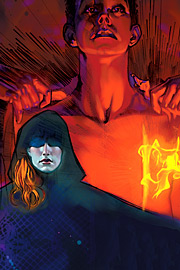 All right! DC has announced that they will be releasing a second collection of Peter David and David Lopez’ Fallen Angel!