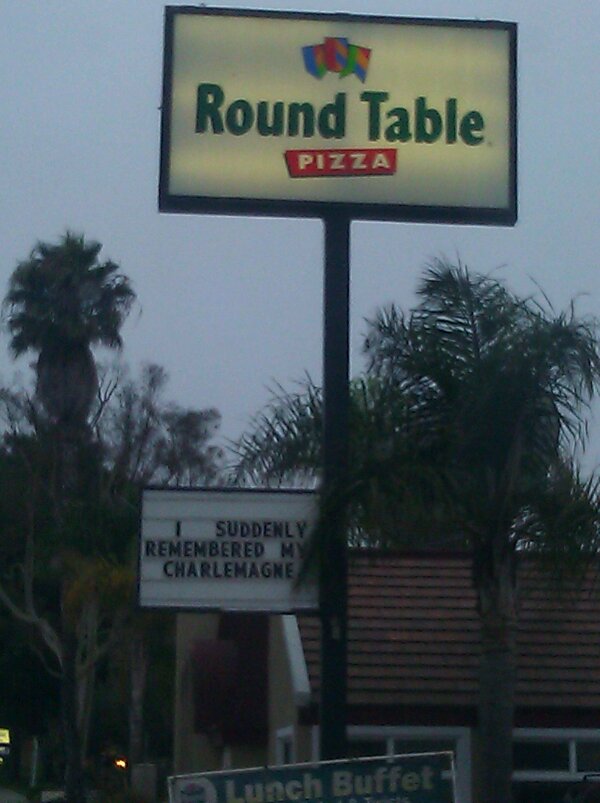
If a professor of medieval studies and Grail scholar wanted to run a pizza parlor franchise, Round Table would be the one to go with.

If a professor of medieval studies and Grail scholar wanted to run a pizza parlor franchise, Round Table would be the one to go with.
We attended Planetfest in Pasadena yesterday. It’s still going on now, a two-day event by the Planetary Society timed to match tonight’s landing of NASA’s Curiosity space probe on Mars.
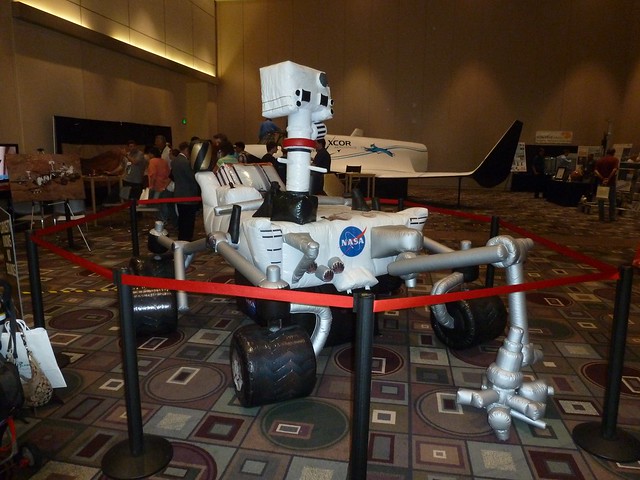
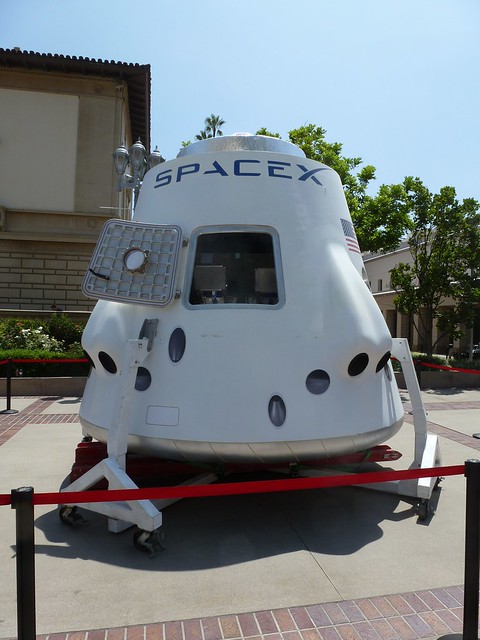
I wasn’t really sure what to expect, but it was basically a bunch of space enthusiasts and people in the industry. SpaceX has a mock-up of their crew capsule, and other sponsors had exhibits with things like space plane mock-ups or geological drills. There was a life-size inflatable model of the Curiosity rover. There was a single track of programming with speakers on topics from the actual science of Martian exploration to the question of just why we explore space in the first place. Katie caught the Sally Ride tribute while I walked J around the exhibits, and we both watched Bill Nye’s talk about “Our Place in Space,” which he finished up with a fun science demonstration featuring liquid nitrogen marshmallows, gas toruses, a candle, and Robert Picardo.
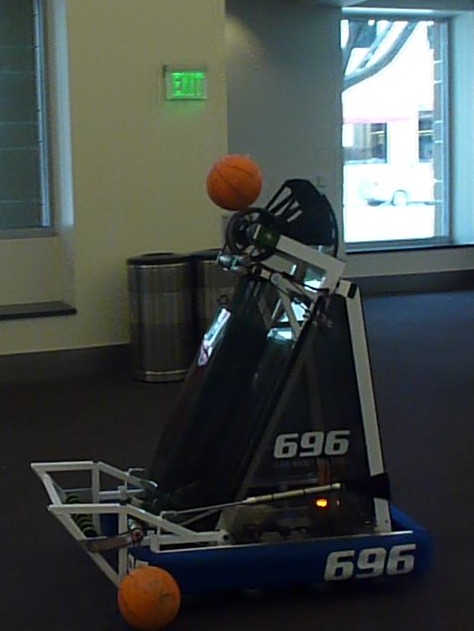
The exhibits for “kids of all ages” turned out to be for kids from 4 on up. J wasn’t really interested in the Martian soil uplift demo, or the dirty snowball CO2 comet demo, but he liked watching the Xbox Mars Lander game, and he was fascinated by the robot that picked up and tossed basketballs. He had fun hanging out with grandma and grandpa, at least, and playing with a magnetic meteorite. (The tiny fragment of verified Martian meteorite was carefully mounted on a slab with plastic wrap to protect it from skin oils, but they had a couple of non-valuable rocks that you could pick up and hold.)
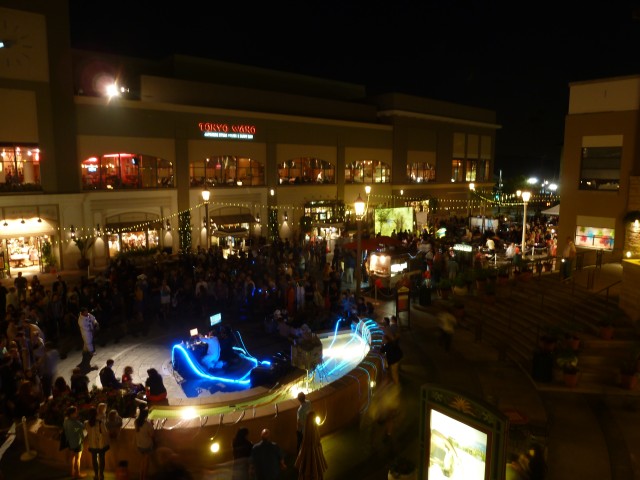
A family friend invited us to the after party at the mall across the street. It was divided into two main areas: the sci-fi-themed dance floor out on the plaza, and a set of tables on the terrace above for the sit-and-talk crowd, where the main event was a participatory art project: A group had set up one blank postcard for each day of Curiosity’s journey from Earth to Mars, and was asking attendees to draw what they imagined the probe would write home about.


Gee, I hope not!
Comic-Con International was a lot more fun and a lot less overwhelming than usual this year.
Maybe it’s because we skipped the busiest day to go the San Diego Zoo. Maybe it’s because we picked our battles on what we tried to do. Maybe it’s because last year we crammed the whole experience into a single day, and having three days felt like a luxury in comparison. Or the fact that the logistics of getting to and from the con were so ridiculously complicated (more about that later) that they made the convention seem relaxing.
Whatever the reason, the floor did seem a bit less crowded this year. Both of us remarked on the fact that we never felt trapped as we usually feel on the busiest days.
(Skip to the photos if that’s what you want.)
Thursday was the day I spent mostly on the floor, exploring. I hit the usual haunts: DC Comics, Sideshow Collectibles, Studio Foglio. DC was really plugging their upcoming fighting game, Injustice: Gods Among Us.
Sideshow seems to be displaying more figurines (and a wider variety) every year. Their Lord of the Rings figurines are absolutely incredible. Though I’m not sure what the target audience is for the life-sized Han Solo in Carbonite or Boba Fett. I can’t see putting one of those in my living room. They also had a very cheesecaky Poison Ivy statue. I overheard someone saying they couldn’t see themselves buying it because it would be like having that lamp in A Christmas Story. At another booth I discovered that you actually can buy that lamp.

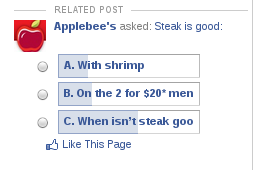
I think someone’s confused about the concept of step-by-step directions. (Not to mention the definition of “above.”)
(Originally posted on Facebook and Google+)
So, NPR ran a post by an intern who doesn’t get the whole paying-for-music thing — or, rather, realizes now that she ought to, but doesn’t want to pay for physical media of specific songs or albums.
The Trichordist responded with an open letter about the ethics of file sharing, which is a great read from the artist side of the fence, but also mixes up several issues. In particular, it misrepresents a large part of the “other side.” He starts off saying that Emily White seems to have succumbed to “false choices” presented by “Free Culture,” then goes on to present his own false choices, somehow managing to characterize rampant piracy, Creative Commons*, and the tech industry as if they’re all the same thing.
The issue is not simply “pay for everything” vs “take what you want because you can.”
Among other things it’s about recognizing that distribution channels have changed, so business models must as well. It’s about trying to come up with a system that doesn’t put unnecessary roadblocks in place. It’s about enabling those who do want to share their art in different ways to be able to do so easily.
Edit: It’s also about, and here’s where the tech industry comes in, recognizing that technology does change the legal landscape. Remember the debate over whether Google should pay up for thumbnails in image search results? (Kind of like requiring card catalogs to pay to use the title of the books they refer to.) Or Congress trying to decide whether copying a media file or program from disk to RAM constituted a legal “copy” subject to copyright restrictions?
Edit 2: And then there’s the matter of opening up the gray areas, or rather the areas that most of us intuitively see as gray, but that current copyright law treats as black and white, such as fan art and fan fiction. Technically, a six-year-old’s scrawled Mickey Mouse is illegal. Technically, software companies can tell you how many backups you’re allowed to make. Enforcement is spotty (fortunately), but that means if someone wants to get you in trouble for something else, all they have to do is report you.
If you want to make music and I want to listen to it, I’m happy to pay you for it. I have a lot of music on my iPod, and yes, I’ve paid for it. My last MP3 purchase was a week ago. Heck, I’ve bought music from Jonathan Coulton, who gives it away for free (under a Creative Commons licence, I might add).
So yeah, I’m willing to pay for music. But I don’t want to have to pay separately to listen to the same music on my home sound system, on my computer, on my phone, and in my car because your publisher has decided to put DRM in place that makes it difficult for me to move that music around. If you live on the other side of the planet from me, I want to be able to give you money directly and download the song over the internet instead of having to wait for publisher A to make a deal with publisher B and ship physical media around.
Technology has presented us with new ways of distributing art. Something like Pandora or Spotify would have been impossible before broadband internet. So let’s find ways to make it work for everyone instead of characterizing everything that isn’t pay-per-song as no better than looting.
It doesn’t help to complain about one set of false choices and then present your own.
*He cites the Creative Commons’ tax return to indicate the backers of the Free Culture movement, so it seems clear he looks at them as the same thing.