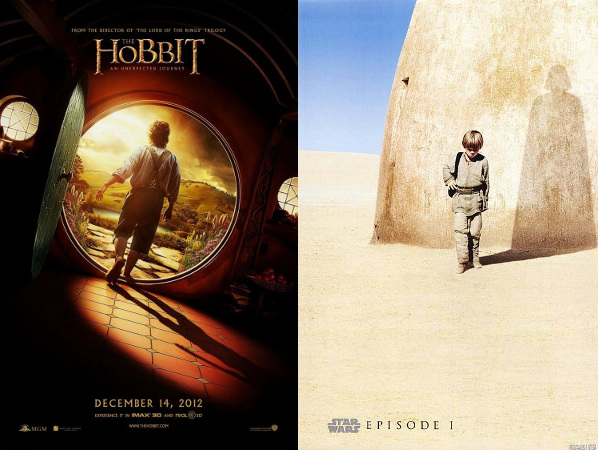
Posters for The Hobbit: An Unexpected Journey and Star Wars Episode I: The Phantom Menace

As the release date approaches for the first movie in The Hobbit triogy, I find myself comparing the circumstances to the Star Wars prequels. Why? In both cases you have…

  • A visionary director returning to…
  • A high-profile trilogy set in a fantastical world…
  • After years away…
  • To tell a prequel set a generation earlier…
  • Including significant events that set up the other story (Vader’s turn to the dark side and the rise of the Empire, Bilbo finding the One Ring and the Necromancer of Mirkwood).
  • Some cast are returning as younger versions of the same characters (Palpatine, C-3PO, Gandalf, Elrond)
  • Other characters have been recast (Obi-Wan, Bilbo).

But of course, Star Wars isn’t Lord of the Rings, and Peter Jackson isn’t George Lucas. Let’s look at four big differences.

1. Time

The Phantom Menace came out 22 years after Star Wars: A New Hope and 14 years after Return of the Jedi. An entire generation of children grew up with the original trilogy and were adults by the time the prequels started. And with 14 years of no Star Wars films, the prequels had to justify the wait.

With Lord of the Rings, it’s only been 10 years since Fellowship of the Ring, and 8 since Return of the King. We’ve spent half the time away from Middle Earth as we did from that galaxy far, far away. Children have become teenagers, and teenagers have become adults, but there isn’t quite the same level of “My childhood is back!” nostalgia that could make or break the films for a large section of the audience.

2. Directorial Experience

According to IMDB, George Lucas stopped directing after the first Star Wars film in 1977. He kept writing and producing, of course, but he hadn’t directed a film in two decades when he picked up The Phantom Menace

Peter Jackson may have slowed down a bit, but between wrapping up the extended edition of Return of the King in 2004 and picking up The Hobbit in 2010, he’s directed King Kong and The Lovely Bones.

3. Source Material

This is a big one. The Star Wars saga was an original story by George Lucas. When he wrote Episodes I-III, he was free to do anything he wanted as long as it didn’t contradict Episodes IV-VI. The Hobbit films are based on Tolkien’s novel, the appendices from Lord of the Rings, and his published notes. The core of the story is a lot more well-established.

4. Executive Meddling Potential

Zillionaire George Lucas wrote, directed and produced the Star Wars prequels, financing them himself. Nobody was in a position to tell him no. On one hand, this is good, because there weren’t any suits with more money than talent to tell him to add an extra car chase here, or add a love triangle there, and does Revenge of the Sith *really* need to be PG-13, can’t we dial down the violence a bit? On the other hand, it also meant no one could say, “George, don’t you think Jar-Jar is a little over the top?” or “This fireplace scene just isn’t working.”

Peter Jackson lucked out with the Lord of the Rings trilogy in being able to mostly do his own thing. But the legal battles and rights-wrangling that have caused The Hobbit to take so long to reach the screen indicate that the studios might be trying to exert their influence to “protect” their investment (which usually seems to involve killing the goose that lays the golden eggs). Certainly the decision to stretch the story out to three movies sounds like the studio trying to multiply their ticket sales, though I can also see Jackson and Weta deciding that this is their last chance to explore Middle Earth, so they might as well make the most of it.

Well, it’s just one week until The Hobbit: An Unexpected Journey opens and we all get to see how it turned out. One thing that’s definitely changed for me: Unlike Episode I, there’s not a chance that I’ll be standing in line for hours to see a midnight (or 2AM) showing. I can wait until Saturday afternoon.

I spent the first Saturday of November in Long Beach for the fourth annual Long Beach Comic and Horror Con. Despite the name change last year, the show remains focused on comics, and horror feels like an afterthought tacked on to fit with the Halloween timing of the show. (It makes me wonder whether they’ll return to the original name next year, when it’s held at the end of November.)

Venue & Layout

There were four or five Star Wars-decorated cars outside the lobby and one Teenage Mutant Ninja Turtles van. I was way too amused by a convertible, tricked out to look like it had starfighter engines and gun emplacements, on display with a Yoda statue in the passenger seat. (I figure Jedi don’t ride shotgun, they ride lightsaber.)

Yoda Is My Co-Pilot

On the main floor, Artist’s Alley continues to be the centerpiece, both literally and figuratively. SDCC has been shoving the artist’s tables off to one end of the insanely-long hall, Wizard tends to put them in the back, and I hear NYCC put them in a different hall entirely (not quite behind a door labeled “beware of the leopard”), but Long Beach has always made a point of putting them right in the center. Publishers at the front, fan groups at the back, dealers to the sides, all wrapped around the artists.

Way in the back, past the fan groups, there was a laser tag arena and a roller derby course (marked on the floor in tape. The derby replaced the wrestling ring they had the first couple of years. For some reason Chevrolet was plugging the Volt (so to speak) in one corner. The roller derby makes sense in the same way as the wrestling does (garish costumes, code names, and violence), but I couldn’t figure out the Volt. Continue reading

Chicon 7Our family vacation this summer was a trip to Chicago, partly to sightsee, partly to catch up with my sibling and sister-in-law, and partly to attend this year’s Worldcon, a.k.a. Chicon 7.

What’s a Worldcon?

I grew up going to sci-fi/fantasy conventions, but over the last decade I’ve mostly been going to comic cons of one sort or another. The World Science Fiction Convention is a more literary and, in some ways, academic con than the glitzier media cons like Comic-Con International, or the celebrity-oriented cons like Wizard World. The guest list is more focused on writers than on actors or media personalities, and panels tend toward discussions rather than announcements.

Worldcon itself travels around from year to year, essentially a convention franchise where members of one year’s convention vote on who gets to put on the con two years from now. Last year it was in Reno. Next year it’ll be in San Antonio, Texas, and in 2014 it’ll be in London. Certain elements remain constant — there’s always a masquerade, an art show, a Regency Dance, and of course the Hugo Awards — but the tenor of the con can change wildly from one year to the next.

Chicago River at Night

Lead-Up to the Con

We flew into Chicago the weekend before the con, met up with family (who were also attending the con), and spent the next few days sightseeing before the convention started on Thursday. We explored the nearby area, took day trips out to the Lincoln Park Zoo, Museum of Science and Industry, had some real Chicago pizza (this is important, after all), and made a point of getting up to one of the tallest buildings’ observation decks. (We picked the John Hancock building over Sears Tower, mainly because it was closer when we decided to do it.)

There was an allergy close call the first night there, which put us on alert for the rest of the week. And we all picked up a cold: I got it first, on Tuesday, then J on Thursday, then Katie on Friday, then Marti. You’re supposed to get the con crud after the convention, right? Continue reading

ยปAll pages site-wide with this tag