Walking around the house last night, setting all the clocks to Daylight Saving Time before bed, I found myself thinking: Why do we have so many clocks, anyway? They used to share one clock for a whole town!

OK, that’s not feasible these days, but every time we switch into and out of DST I miss some clocks because we have so many in the apartment, even though there are only three people.

  • Analog wall clocks in the dining room and each bedroom (bought when the kid was small so he’d be familiar with clock faces).
  • A waterproof clock in the bathroom for shower timing.
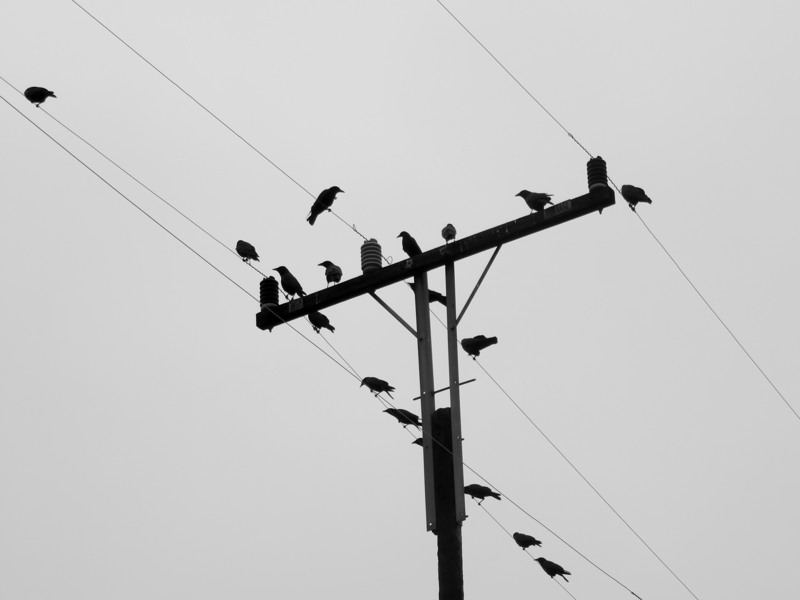
  • The cameras we use when we want to take higher-quality photos than a phone can (or when I just want to be able to take pictures of birds with a zoom lens so they don’t fly off before I get close enough to catch more than a vague silhouette in the photo). Related: How I fix the timestamp on photos when I forget to switch the camera’s time.
  • Alarm clocks we don’t use for alarms anymore since phones have nicer alarm tones, but they have glowing displays so we can see what time it is when we wake up in the middle of the night.
  • Watches we don’t wear anymore but the batteries last for years, so they’re still going.
  • The microwave has a clock.
  • The stove has a clock.
  • The coffee maker has a clock. (The display’s messed up, though, so we stopped bothering to set it.)
  • The stereo has a clock.
  • The car has a clock.

And that’s not counting the devices that automatically pull from a canonical time source over the internet. Every phone, computer, tablet or ebook reader tracks time, but at least they adjust themselves automatically!

Some of these we placed intentionally, like the wall clocks. Some need to track current time internally to function properly or to keep track of when things happened, like the phones and cameras. But some are just kind of extras.

The microwave doesn’t need a clock. It needs a countdown timer, yes, but the clock is just kind of there as something for the display to show when you’re not using it. I guess since they’re already building the timer circuitry into it, tracking current time doesn’t add much complexity. Same with the oven timer (countdown again) and the stereo (track/album length). Anything that has a display that might show hours/minutes/seconds for some purpose seems to get a clock as its default display. Whether you need it there or not.

Anyway, the upshot is, we have a ridiculous number of clocks for the number of rooms and people here. We always have the time, even though we never seem to have time.

Now I want to write a story about how time goes faster as you get older because you keep adding more clocks, and they use it up.

The other day I grabbed a coffee and muffin while out walking, and found an out-of-the-way outdoor place where I could unmask and eat without being near anyone else.

It was weird! It felt like I was getting away with something. This sort of thing used to be normal, but now it isn’t… and that’s weird too!

I haven’t eaten at a restaurant in nearly a year. Not even outside on a patio when health orders have allowed it. (Though I have bought take-out.) This was only the second time since last March that I’ve eaten anything away from home except the occasional travel mug of coffee in the car. Not that I bother with that very often, since I rarely drive farther than the grocery store. I’ve even stopped carrying my Epi-Pen everywhere. I know I’m not going to eat until I get back.

I think the last time I ate at a restaurant was when I went out to lunch with some co-workers the first week of March, and we were talking about whether we wanted to switch to working remotely early, before the order came down. We knew it was coming sooner or later.

As it turned out, all of us who were there ended up spending just one more day onsite. The other two both started working remotely the next week, and I came down with the flu that weekend (at least I think it was the flu) and didn’t recover until the office closed.

I’m still at the same job, but that office? Gone. They’re moving to a new location for when onsite office work is a thing again. I haven’t been to the new office either, because it’s not ready yet, and everything’s in storage for now, presumably including the clutter I would have taken care of if I hadn’t been sick when the work-from-home order came down.

I hope I rinsed out my coffee mug.

And didn’t leave any food at my desk.

But hey, at least I know I didn’t need all of those hand-written notes!

Surprising no-one, WonderCon will be online-only again this year. Last year’s event was canceled just as we all started to realize that Covid-19 was spreading in California. And while the winter surge in cases is finally slowing down, the coronavirus is still more prevalent out there now than it was last March.

They’re still hoping to do San Diego in July, but even with multiple vaccines, there are still too many variables (vaccine distribution, mutation speed, mask and distancing practice, etc.) to know whether it’ll be possible to hold a convention by then. I guess we’ll see.

Well, other people will see. Much as I miss going to comic cons, SDCC feels unsafely crowded in normal years. Even in the best-case scenario, my anxiety would go through the roof.

Besides, I’ve already read The Last Stand of the California Browncoats.

No Fair(e)

Anyway, the local Renaissance Faire canceled this season again, too. On one hand, it’s all outdoors, which helps a lot — and you know the Faire folk would be serious about safety — but on the other hand, it’s still a big gathering, and April isn’t that far off.

I could maaaaybe see doing a smaller convention in fall, if things improve by then. Long Beach Comic-Con’s and LA Comic Con still show their September dates. For now. (I was worried about LBCC for a bit since their website was offline when I checked a few days ago, but it’s back now.) But again, way too many variables in the war between public health and the virus to predict whether it’ll even be possible for them to hold it. Though I’m pretty sure LBCC will be more responsible than LA Comic-Con.

Of course, even if someone can hold a convention safely by then…would it actually be fun? Or would it be a day of white-knuckled agoraphobia as we plunge into a crowd after a year and a half of semi-isolation?

Maybe we’re probably better off not trying to hit a convention until next spring anyway. We’ll need time first to re-acclimate to being around people!

National Geographic reports on a new(ish) theory on the Dyatlov Pass incident [edit: moved from archived original]: a small avalanche with a large chunk of snow could have caused the blunt-force injuries, leading to them evacuating the tent, without leaving the expected (but missing) signs of a full avalanche.

The bizarre deaths of hikers at Russia’s Dyatlov Pass have inspired countless conspiracy theories, but the answer may lie in an elegant computer model based on surprising sources.

An avalanche could explain why they cut their way out of their tent and were found scattered around the campsite, but there was no snowfall and no signs of an avalanche when the bodies were found, and it doesn’t explain the various injuries.

Car crash test data combined with snow simulations developed for Frozen — and the fact that some of the hikers put their bedrolls on top of their skis makes the injuries fit if a slab of snow landed on the tent.

And the team diary recorded strong winds, which most likely would have been blowing downslope, which could have moved enough snow around to trigger a small avalanche.

Not conclusive, of course, but within the realm of possibility.

Of course, a mini avalanche isn’t as exciting as, say, an attack by Yeti or running into an experimental Soviet weapons test!

November 23: Helicopter pilot finds “strange” monolith in remote part of Utah.

November 25: Using Google Earth to look for the Utah monolith site. One candidate that matches the landscape seems to have something vertical that appeared between the 2015 and 2016 images.

No coordinates in the article. Attempt no landings there.

December 7: After the Utah Monolith was found, everyone was making comments about 2001: A Space Odyssey. But as more have popped up, I’m starting to think about The Chronoliths. It’s a novel by Robert Charles Wilson in which obelisks appear out of nowhere, commemorating future military victories by someone no one has heard of – yet.

The monolith in Atascadero, California, was installed by a group of local artists who, on hearing about the one in Romania, figured, someone’s going to make a third one, so why not us?

It was meant to be something fun, a change of pace from the kind of conversations 2020 has been plagued with

After a group traveled five hours to tear it down on video, the town rallied around rebuilding the obelisk and putting it back up on the mountain.

December 27: I…what????? Gingerbread monolith appears — then collapses — on San Francisco hilltop

In true pop-up-art fashion, a nearly 7-foot-tall monolith made of gingerbread mysteriously appeared on a San Francisco hilltop on Christmas Day and collapsed the next day.

A tower made of gingerbread squares on a patch of dirt on a hill. Boulders and hikers visible in the background.

Whatever you think of the electoral system, the fact that we have to wait for people to copy down those electoral votes is no longer helpful, and the fact that they can choose (or be pressured) to vote for someone else is a vulnerability in our democracy that should be patched.

You want to keep using electoral votes instead of the national popular vote? We can argue about that later. But we don’t need electors any more. Once each state certifies its election’s results, assigning its electoral votes should be automatic. It’s just math.

»All pages site-wide with this tag