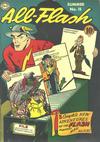
 Two months ago I picked up a copy of the comic book All-Flash #15 (Summer 1944), published during the thick of World War II. In the bottom margin of each page is a slogan, in rhymed couplet form, on how children could help with the war effort:
- Bottom Lines on Following Pages Tell What to Do While Battle Rages
- Tin Cans in the Garbage Pile Are Just a Way of Saying “Heil!”
- Waste Fats in Good Condition Help to Make Fine Ammunition
- Boys and Girls, Every Day, Can Give War Aid in Many a Way—
- Every Time You Buy a Stamp, You Feed the Flame in Freedom’s Lamp
- If You Have an Extra Quarter, Buy a Stamp to Make War Shorter
- However far soldiers roam, the want to have some mail from home
- Collect Old Paper, Turn It In—Help Your Uncle Sam to Win
- You Can Walk to School and Store! Saving Gas Helps Win the War!
- Boys Are Smart, Girls Are Wise, Black Markets Not to Patronize
- IF YOU STILL HAVE METAL SCRAP, TURN IT IN TO BEAT THE JAP
- Turn Out Lights Not in Use —War Production Needs the “Juice”
Case and punctuation are preserved as closely as possible. Continue reading
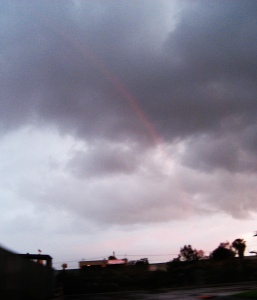 At sunset, there were clouds above us, rain in the east, and clear skies to the west, showing a bright orange sun. We looked to the east, and saw a huge rainbow. It was extremely high—it looked like it ought to be an entire circle, even though I knew it couldn’t be more than a semicircle. That doesn’t come through in the one photo that came out, since it’s a matter of perception: neither of us had ever seen a rainbow centered at the horizon before. It was also faint (I had to increase the contrast on this photo), and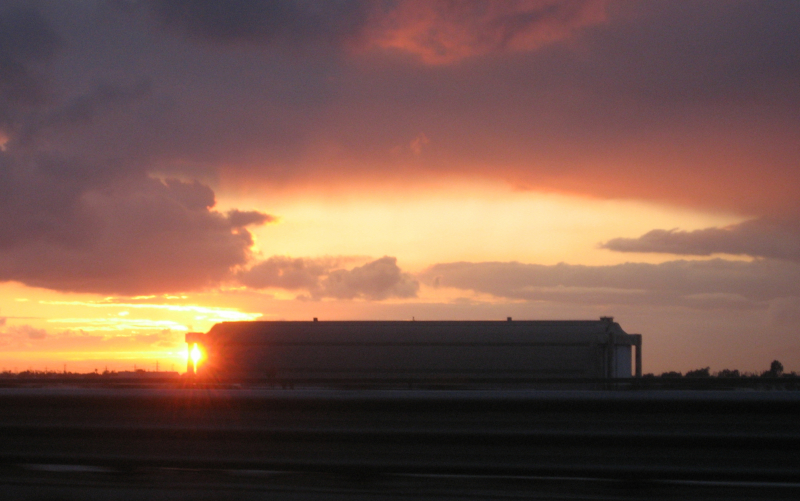
 Let’s start with the drive out. Somewhere between the Cajon Pass and Victorville, we saw a warehouse with this banner. We had to wonder what “really living” furniture was. Trees grown into the shape of chairs, perhaps? A topiary table? We didn’t get the camera out in time to snap a picture, but we caught it on the drive back.
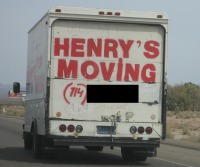 Then there was the moving truck. Somewhere around Barstow we got caught behind this veeerrrryyyy sssslllooooowwwwwlllly moving truck, with the company name and phone number spray-painted on the back. We joked that it was “Henry’s Moving… slowly.” (About 45 MPH on a 65 or 75 MPH highway.) What was really odd was that, two hours out, we’d run into a car from our own area code. Once we could get out of the lane, we passed them and left them way behind. Perhaps 45-60 minutes later, we made a stop in Baker. Bathroom break, new drinks, top off the gas tank, and stop at