I literally found out yesterday about today’s partial solar eclipse. Unlike the last one visible from Southern California in 2012, which was conveniently on a weekend, this ended up being right in the middle of the work day. Add in a lot of other stuff going on, and I didn’t have time to do anything like go out to a prime viewing spot or make a giant pinhole camera.

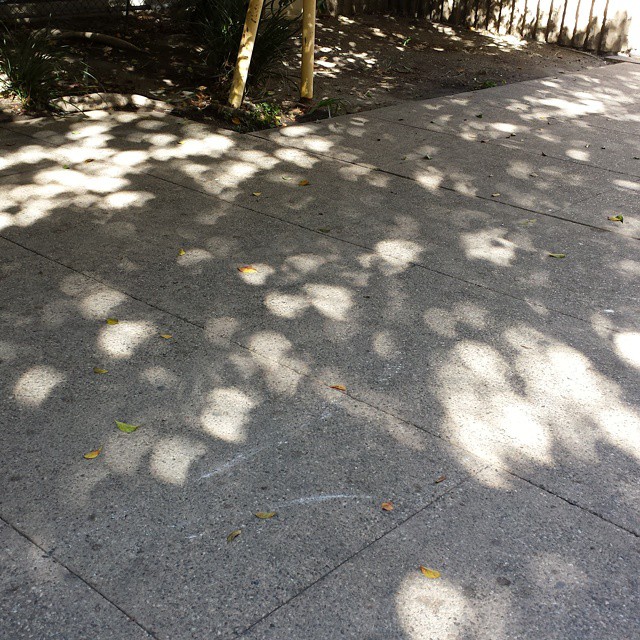
My original plan was to take a late lunch, see what I could see, then try to head back outside at the point of greatest eclipse. I sat on a bench in the courtyard, surrounded by trees, checking a tiny pinhole camera I’d made from a tea box at the last minute and also looking for a good spot with images projected through the tree leaves.

After about half an hour I started to wonder why I wasn’t seeing any signs of eclipse, and looked up the times again. Apparently the calculator I used didn’t account for daylight saving time. The good thing about that: I was early, not late. The bad thing: Greatest eclipse was actually going to be during/shortly after a production switchover at work that I needed to be on hand for.

So I headed back outside around 2:50 to look at the clusters of eclipsed suns projected by the leaves in the shady courtyard.

Continue reading

It was a late-summer heat wave, and while the picnic itself was spread out in the shade beneath some trees, it was over 100 degrees. Still, a preschooler can’t be terribly interested in his parents’ old school friends catching up, and my son kept trying to wander off to play in the hot, hot sun.

Finally, after lunch, I decided instead of bringing him back I’d go with him. On the other side of the hill we found a small concrete-lined channel, amazingly with water in it, then followed it upstream to where it opened up into a stream running through the grass.

Exploring the Creek: Running through the grass.

Further up we found a wooden foot bridge, and then trees closed in around it. The shade was very welcome!

Exploring the Creek: In the Shade.

This second photo is looking back downstream toward the open area. Just behind me there’s a chain link fence that marks the edge of the park, and a hill leading up to the road. The stream is fed from a drainage pipe, and judging from the erosion patterns, it picks up a lot of runoff during the rainy season.

I took both shots with my phone in HDR mode to get both the light and shade areas clear. Unfortunately on the second shot it ended up blurring the leaves, since they moved just enough in the breeze between bracketed shots. It looks great on a small screen, though!

Researchers simulated a 70-year mega-drought and came up with ways that California could survive without the economy collapsing, emptying out the state, or even abandoning agriculture. We’d have to change the way we store and distribute water, recycle more wastewater, do groundwater replenishment, prioritize different (and less thirsty) crops, and of course cut down on our water use. It would hurt, and smaller, rural towns would be worse hit than cities (which is already happening — there are places out in Tulare county, for instance, where wells are drying up and homes no longer have running water). But the simulation suggests it could be done — and it’s a good idea to plan for this, just in case, rather than relying on the drought to end in a year or two. Geologic evidence suggests that decades-long droughts used to be the norm, and of course who knows what “normal” is going to be over the next century.

Another article details how Southern Californians have been changing water use this summer: letting lawns die, using more reclaimed water, draining fountains and converting commercial landscaping. The average Los Angeles resident has cut back to 89 gallons per day.

I can’t say I’ve seen much change in my area since I started noticing the occasional lawn replaced with native plants back at the start of the year. Maybe a few more native gardens or scraggly lawns, but not a sea change. Katie does a lot more walking, though, and she’s noticed that a lot of houses just have dirt. Apartments mostly still have lawns, but at least that’s more people per square foot of grass. Unfortunately nobody wants to wash the smears of dog poop off of the sidewalk.

Swimming Pool Under Construction.Meanwhile, the office building to hotel conversion next door to my workplace has embarked on what they’re replacing that giant lawn with: a swimming pool. A sign out front proclaims an early 2015 opening. Someone’s optimistic about water for next year.

On a related note, the Irvine Company is planning to donate what’s left of the Irvine Ranch to the county as open space. Good!

I’ve lamented the loss of both open space and local farmland over the past twenty years or so as more and more of Orange County has been paved over with houses and shopping malls. Since moving to the South Bay, I’ve seen the potential endgame. “Open space” out here consists of the occasional empty block that’s been set aside, or a hillside that’s too steep to build on conveniently. Palos Verdes has a bit more, but it’s filling in. At least the Portuguese Bend area is likely to stay clear, since the ground isn’t stable enough to build on.

Final pieces of Irvine Ranch complete ‘open-space puzzle’ in O.C. – LA Times

This spot in eastern Orange is now part of a proposed 2,500-acre gift from the Irvine Co. to Orange County — 1,400 acres here and an additional 1,100 in Anaheim Hills.

Well, good. I’ve lamented the loss of both open space and local farmland as more and more of Orange County has been paved over with houses and shopping malls. Since moving to the South Bay area, I’ve seen the potential endgame. “Open space” out here consists of the occasional empty block that’s been set aside, or hillside that’s too steep to build on conveniently. Palos Verdes has a bit more, but it’s filling in. At least the Portuguese Bend area is likely to stay clear, since the ground isn’t stable enough to build on.

FARE Walk along Long Beach

This year’s route for the Walk for Food Allergy was a lot longer than last year’s, when we walked out along a jetty and back. That was a comfortable 1½-mile round trip surrounded by ocean. This was 1½ miles each way on a path along the beach, surrounded by reflective white sand, in the hot sun, with no shade. (Hey, at least it wasn’t last weekend, when it hit 99°F.) In fact, since the signs ran out about halfway there, a lot of us started to wonder if maybe we’d missed the turnaround.

Some families turned around early. We almost did, but spotted a sign on a table full of water bottles not far ahead, and we decided to go at least as far as the water. We asked the woman staffing it where the turnaround point was, and she told us that was it.

Wait, Why Were You Walking?

15 Million Reasons to WalkEvery year, FARE sponsors events around the country to raise money for research and education, and to increase awareness of food allergies. 15 million people in the US alone have food allergies — and for a lot of us, it’s severe enough to be life-threatening. FARE sponsors research into treatments and prevention, provides educational resources, and advocates for allergy-friendly policies and laws.

You can still donate through December 31 if you want to help!

We’ve been walking in the Los Angeles event for four years now. Our first year was in Santa Monica. It moved to Long Beach in 2012. That year the planned route was blocked by construction and it took about ten minutes to walk. Last year was the jetty, and this year we walked from the western end of Marina Green Park, across from Rainbow Lagoon, along the beach to the Long Beach Art Museum.

Obstacles

The registration area always has tables for the event sponsors: food companies with allergy-friendly samples, pharmaceutical companies that make epinephrine injectors (since that’s basically the only reliable treatment for an anaphylactic reaction once it starts), and local medical and support groups.

Bouncy SlideLately they’ve also had a bouncy obstacle course and slide for the kids. Last year, J (almost three at the time) desperately wanted to go through it, and we wouldn’t let him because we thought the walk was about to start any minute. Then one person after another went up on stage to talk, and we realized he would have had plenty of time, but then the walk did start. We told him he could go on it when we got back…but we returned to see it being deflated.

This year, we made an effort to get there early, and we didn’t bother pulling him out until everyone had left the stage and they were calling us all to the starting line. He went through the course more times than I could count. We didn’t drag him away until they ran out of people onstage and told everyone to head for the starting line. (Of course this year they kept it inflated afterward, but we were too tired and hungry for it to matter.)

Wrapping it up

We finished up the afternoon with lunch at The Potholder Cafe Too, which reminded us of Broken Yolk Cafe in San Diego. They specialize in all-day breakfast — many, many varieties of all-day breakfast — but have sandwiches and burgers as well. I think I know where I’m going to grab dinner when I go to Long Beach Comic Con next weekend!

Last Tuesday I stayed late at the office. As I was leaving the parking structure, I looked to the left for oncoming cars and saw this. I was stunned. Instead of getting on the road immediately, I parked on the side of the street to look and take a couple of photos.

It didn’t look exactly like this, of course. The photo came out too yellow, so I tried adjusting it to bring out the orange tones, until finally I just started trying all of Snapseed’s filters until I hit on this one. I was surprised by the level of detail it brought out in the upper cloud layer, and how far the crepuscular rays actually extended.

I also took a photo with my camera, which was adjusted for sunset tones. It came out a lot darker than the actual scene, but the color balance is closer. Continue reading

»All pages site-wide with this tag