Despite growing up in Orange County, I never managed to go to Medieval Times. It’s a dinner show with knights on horseback staging a medieval tournament. Last month in Las Vegas, Katie talked me into going to the Tournament of Kings at Excalibur, which is the same type of show.
![[Knight from Excalibur'sTournament of Kings]](https://journal.kvibber.com/wp-content/uploads/2006/05/knight.jpg) When you purchase your tickets, you’re assigned a country. (We got Hungary, which seemed appropriate for a dinner show.) This determines two things: your seating area, and which knight you’ll cheer for. People got really into it, cheering on their own knights, booing others, all from a random assignment. About halfway through the show, I realized it was a Drazi scarf situation.
When you purchase your tickets, you’re assigned a country. (We got Hungary, which seemed appropriate for a dinner show.) This determines two things: your seating area, and which knight you’ll cheer for. People got really into it, cheering on their own knights, booing others, all from a random assignment. About halfway through the show, I realized it was a Drazi scarf situation.
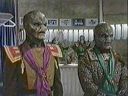 To explain: The Babylon 5 episode, “The Geometry of Shadows” features a conflict among an alien race called the Drazi. Two factions have been fighting each other on the station, and the crew wants them to stop. The Drazi ambassador explains that every few years, they put a bunch of green and purple scarves in a barrel. Each Drazi reaches into the barrel and pulls out a scarf. Green Drazi form one faction, Purple Drazi form the other, and they fight until one side wins, becoming the dominant political force for the next few years.
The episode was clearly meant as commentary on politics, but here in the dinner tournament was an actual case where nothing but random chance determined allegiance. It wasn’t even a random draw for a team, this was just the cheering section! For a scripted show!
![[Pirate]](https://journal.kvibber.com/wp-content/uploads/2006/05/pirate.jpg) Last weekend we went to the Pirate’s Dinner Adventure for Katie’s birthday. It’s a similar setup, only with pirates instead of knights, a smaller arena so that you can actually see the actor/stuntmen’s faces, and a more interactive setup. (There are contests where they get willing audience members to participate, kids get to be sworn in as members of the pirate crew, etc.) Again, you’re assigned a color when you get your ticket, and that color corresponds to one of the pirates. And everyone gets a colored headband. Not too different from those Drazi scarves.
Last weekend we went to the Pirate’s Dinner Adventure for Katie’s birthday. It’s a similar setup, only with pirates instead of knights, a smaller arena so that you can actually see the actor/stuntmen’s faces, and a more interactive setup. (There are contests where they get willing audience members to participate, kids get to be sworn in as members of the pirate crew, etc.) Again, you’re assigned a color when you get your ticket, and that color corresponds to one of the pirates. And everyone gets a colored headband. Not too different from those Drazi scarves.
