 Some random thoughts and anecdotes about Comic-Con that didn’t make it into other posts:
It’s amazing that out of (reportedly) 140,000 people, you’re virtually guaranteed to run into people you know. For instance, I knew in person 8 people besides the two of us who were definitely going to the convention. Without planning, I ran into 6 of them, as well as 2 people who I didn’t know were attending. Katie and I even accidentally ran into each other once. I’m sure I ran into people I’ve met online, but just didn’t recognize them on sight.
Overheard near a coffee shop one morning in San Diego:
20ish man #1: I’m so wasted. I can’t work like this.
20ish man #2: Dude, you make coffee!
Nothing as drastic as Aeire’s story of nearly getting trampled, but I sustained a number of minor injuries over the course of the event:
- Left knee, bruised while walking into a traffic barrier concealed by the flow of people (Wednesday).
- Right forearm, bruised twice catching a backpack strap (Thursday).
- Left hand, bruised (unknown).
- Also, Katie: Left thumbnail pulled back and bleeding, catching a backpack strap (Friday).
Conclusion: Backpacks are dangerous 😉
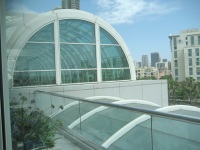 I walked out onto this balcony Friday afternoon and took some pictures looking out across the street. At the time, there were some teenage girls sitting on that ledge off to the left. It’s maybe 4 feet deep, and some of them had scooted out past the balcony, one of them standing up. When I came back later to get a picture of the ledge (how creepy would I have looked taking a picture of a group of teenage girls?), the door to the balcony was locked. I’m guessing security wasn’t happy.
When eating out at a restaurant, ask about the portion sizes before you order. The food at Bandar was very good, but we were each served enough food for three people. With no refrigerator or microwave in our hotel room, we couldn’t save the leftovers. The waste was saddening.
Panels I attended:
Thursday: TwoMorrows, Paramount Pictures, Lost.
Friday: Spider-Man cartoon (2nd half) and Neil Gaiman Spotlight. Babylon 5: The Lost Tales.
Saturday: Quick Draw, Buffy 10th Anniversary Screening. (edit: fixed link)
Sunday: My Dad Makes Comics (2nd half), Fables.
Panels Katie attended:
Thursday: Making Fiends, Paramount Pictures, Lost.
Friday: The Mist/Halloween, Jim Henson, Babylon 5: The Lost Tales.
Saturday: Pushing Daisies, tried to get into Heroes but got locked out, Battlestar Galactica, Buffy screening.
Sunday: Cages Talk Comics, Right at Your Door/Dragon Wars, Pathology.
*whew!* Almost done. I just need to post quotes and oddities. Well, and finish labeling the photo gallery.






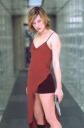 Mystery solved? The Resident Evil panel featured 17 Milla Jovovich doubles wearing her iconic red dress. This looks like more than 17, and the dresses don’t seem to be ripped in the right place, but this could be them.