An NPR story about an archaeological site in Peru mentioned that the ancient Andean calendars used a 10-day week, and I started wondering what other measurements various societies have used. The seven-day week is (almost?) universal these days, developed independently in both the Middle East (spreading to the West) and in the Far East, but past societies have used anywhere from three days to ten.

Unlike the day, year, or lunar month, there’s no natural unit of time corresponding to the week. So it’s hardly surprising that different societies have chosen different lengths. Ten is one obvious choice (there’s a reason we refer to number places as digits, after all). But aside from the obvious Biblical origins, why seven?

Well, seven days roughly corresponds to a phase of the moon. But humans have long had a fascination with the number seven, no doubt influenced by the seven heavenly bodies: the sun, the moon, and the five visible planets. Sunday, Monday (moon day) and Saturday (Saturn day) are obvious in English, but Tuesday through Friday are a little less clear: you have to work out which Norse god the name comes from—Tyr, Wotan, Thor, Frigg—and convert to the corresponding Roman god—Mars, Mercury, Jupiter, Venus. It’s much clearer in Romance languages, as I discovered when I studied Spanish a few years ago. Wikipedia also has a nice table of weekday names in various languages.

On a related note, if February were a full month, today would be February 30. It turns out there’ve been a few of those in relatively modern times, including an extra-long leap year in Sweden in 1712, and two in 1930-1931, when the Soviet Union tried to use a “revolutionary calendar.” (Funny how those never seem to catch on.)

They say that the Southern California car culture is isolating. It’s hard to argue with that, when everyone’s shut up in their own little boxes. But today, on my way to work (delayed a bit on account of dentist), I was listening to KCRW’s Morning Becomes Eclectic and stopped at a traffic signal. They were playing a live version of Elvis Costello’s “Allison.” I looked in my rear view mirror, and realized that the driver behind me was singing along to the same song. Even though it only went one way—she had no way of knowing I was listening to the same music—it was still a moment of connection through shared experience.

For various reasons, braved the crowds at South Coast Plaza yesterday. Oddly, it’s the easiest mall I’ve parked at all weekend. Getting to the Marketplace was a disaster, but that’s just because the streets are wholly inadequate to get cars in and out of the parking lot, and the Village (formerly the Mall of Orange) was just plain full.

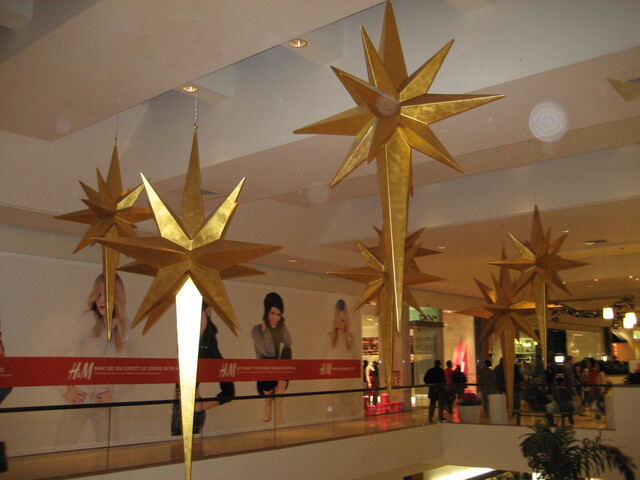
At South Coast, as part of their Christmas decorations, they had these giant, shiny, 14-pointed stars hanging from the ceiling in several places.

Stars of Doom!

Classic Christmas, but when you go down to the first floor and look up, there are all these giant, gleaming spikes hanging over your head.

Death (star) from above!

It’s a little disconcerting. “Death from above!” is not something I want my holiday decorations to invoke.

I’d known that artist Roy Lichtenstein‘s most famous works were done in the style of gigantic comic book panels. Something I didn’t know was that many of those paintings weren’t just in the style of comic panels, but were blown-up copies of specific panels from actual comic books (done, of course, by other artists).

An art teacher named David Barsalou has been tracking down the originals. He has a website, Deconstructing Lichtenstein, which displays dozens of actual comic panels side by side with the corresponding Lichtenstein paintings.

Some are nearly exact. Some depart a bit more, but many of those actually keep the same dialogue or narration. And yet, somehow Lichtenstein’s work has been hailed for decades as “original.”

(via A Distant Soil)

Received the replacement battery for the PowerBook yesterday. It was shipped out via DHL, with a prepaid return label for shipping the old battery back via regular mail.

Last night I drained the old battery, plugged the new one in, and packaged up the recalled one in the box. At lunch today I went to the post office to send it off.

As I was walking up the steps, I remembered the “Does this package contain anything liquid, explosive, or otherwise hazardous?” question that postal clerks are required to ask. If you’re mailing a defective battery that could theoretically burst into flames, how exactly are you supposed to answer?

I figured it would be best not to joke about it.

As it was, I just said it was a laptop battery straight out, so the question didn’t come up.

Friday afternoon I was walking down Fifth with a couple of Subway sandwiches in my backpack. This section of the Gaslamp Quarter is almost entirely restaurants, and most of them have dining areas out on the street, with the host or hostess’ podium right there on the sidewalk. I had spotted something odd ahead of me, but I’ll let this overheard exchange speak for itself:

Hostess: “Come quick, or you’ll miss something really cool! There’s a sandwich in the street!”
Voice from inside: “Oh, I already saw him.”

Guy dressed as a sandwich

For the record, it turned out to be part of a big promotion for the movie, Accepted.

The convention clearly strains resources to the limit. These traffic cones, used for creating lanes for the shuttles and whatever traffic was allowed in front of the convention center, include such messages as “Reserved,” “No Parking,” and “Stop”—none of which applied to their current use!

Traffic cones with varying labels

Now, I have yet to figure out the connection between Playboy models and comic books, except that these days they do seem to have the same target audience. There were several models doing signings and photo ops around the hall. On Thursday morning, though, this model hadn’t set up her booth yet. The bag on the table looked disturbingly like a body bag.

Playmate Body Bag

This last one actually has no connection to the con, but I forgot to post it on Monday. It’s probably only funny if you’re familiar with the BSD operating systems. (It took me a while, but I eventually realized BSD in this case meant Broadway San Diego.)

BSD Wicked

ยปAll pages site-wide with this tag