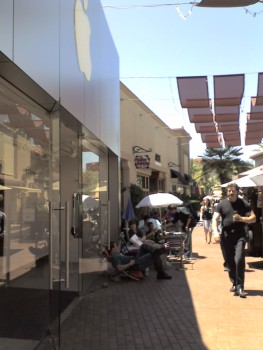
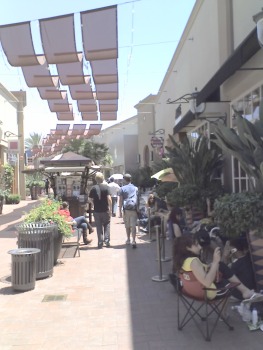
Lining up for the iPhoneSince I was going to the Irvine Spectrum for lunch anyway, I figured I’d drop by the Apple Store and see how many people were there for the iPhone launch. I walked by around 1:50pm, about 4 hours before the event, and sure enough there were a bunch of people lined up all along the shops.

You can see some lawn chairs and umbrellas. The campers are sort of hidden in the shade, which is why I upped the brightness on the second picture. Of course, I’m sure everyone waiting in line appreciated the shade. Those shadows will only get longer over the course of the afternoon, and while there’s a nice breeze once you get out into more open areas, the corridors of the mall are better at channeling people than wind.

Looking toward the Apple StoreWhen I walked by the first time, I only noticed the line running to that corner you can see at the end, maybe 3 storefronts down. About 10 minutes later, after stopping at Kelly’s Coffee, I saw that they were wrapped around that corner, almost the entire length of Forever 21, and stopped at the edge of the patio for the restaurant next door.

Not a huge line—I’ve waited in much longer lines for movies—but bigger than I expected for a phone.

Someone I know encountered a really sneaky eBay phish this weekend. It arrived through eBay’s official “Ask seller a question” system, and consisted of a simple request: Was his auction the same as the auction at the following About Me page?

The URL was a normal eBay URL of the form http://members.ebay.com/aboutme/_____. Pasting the link into another browser brought up the user’s About Me page… which consisted of a spoofed eBay login form that would submit the username and password to a page hosted at Yahoo.

So it not only came through eBay’s official messaging system, but the form appeared on eBay’s own website, meaning it bypasses many of the usual cues. It’s not a secured page, but use of SSL for login pages is still spotty enough that a user could easily miss that. And how many people have noticed that eBay only puts login forms on signin.ebay.com? You have a slightly better chance if you have a browser like Opera, which shows you the target* of a form when you hover over a button. If you think to look at it. Continue reading

A few years ago, it seemed like everyone was using X in their software versions. Mac OS X. Windows XP with DirectX and ActiveX*. Flash MX, ColdFusion MX, and anything else by Macromedia MX. Macromedia managed to confuse things by releasing two rounds of MX versions, such as Flash MX, Flash MX 2004 (essentially versions 6 and 7).

It’s fallen a bit out of favor. Among those still unwilling to use plain version numbers, vintages are still popular. Office 2007, Norton Security Suite 2006, etc. Even though Apple still uses the X to promote its operating system, the last two have put a lot of emphasis on the cat-themed code names: Panther, Tiger, Leopard. And then there’s Windows Vista.

What do you think the next naming fad will be?

*ActiveX was actually a cross between two naming fads. For a while, everything Microsoft did seemed to be Active—Active Desktop, Active Directory, etc.)

A few months ago, I saw a 500-gigabyte hard drive at Fry’s. That’s when I realized that terabyte* drives were not far away.

Oh, sure, you’ve been able to put together multi-terabytes of storage using RAID arrays and clusters, but we’re talking something the average consumer will be able to walk into a store and buy. Something that the slightly-above-average consumer will be able to put in his computer with just a screwdriver and a cable.

It won’t be long. CNET reports that Hitachi anticipates a 1-TB drive by the end of the year.

Naturally, anyone who installs one of these will probably fill it up within a week.

(via Slashdot)

Edit: Something just occurred to me. In light of Mezzoblue’s recent article on naming drives, I’ve come up with the perfect name for my first terabyte drive: Ivan.

*Either 1,000 gigabytes or 1,024 gigabytes, depending on which definition you’re using. Is there a consensus yet?

Windows 95, Windows 98, and Windows Millennium Edition will stop getting security updates next month. Firefox 3, due out next year, will require Windows 2000 or later. A lot of controversy has erupted over the wisdom of these decisions.

But how many people are still using these older versions of Windows? And how quickly are they switching to newer versions?

Exact numbers are tricky to measure on the web, but trends… trends, you can measure. So, I present: the percentage* of Windows users visiting hyperborea.org using the Windows 9x series over the past three years.

 Win9x   Period 
36.8%  June 2003
19.4%  June 2004
9.0%  June 2005
4.8%  June 2006

As you can see, the Win9x/Me share has been dropping precipitously for at least three years, exhibiting a half-life of one year. Assuming this trend continues, it will drop to roughly 2.5% by this time next year. Admittedly still ahead of this month’s Linux stats, but then Linux doesn’t seem to be shrinking by 50% every year. This may be accelerated by Microsoft dropping security support, and by the release of Windows Vista, currently due sometime early next year.

I think it’s safe to say that the Windows 9x series is dying out.

*Calculated by summing the number of hits recorded by AWStats for Windows 95, Windows 98, and Windows ME, then dividing by the total number of hits for all versions of Windows.

ยปAll pages site-wide with this tag