Neil Gaiman remarked on his blog that images his agent emails from Germany end up with the colors inverted, and posts an example of a Coraline poster:
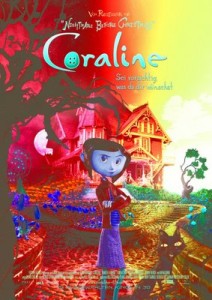
Coraline (German, inverted colors)

“…ah yes, I thought. That’s the sequel, all right. CORALINE APOCALYPSE”

I used to run into this with TIFF images when building websites. (No big surprise, given that there are a million variations on the TIFF format.) I think it was around 2000 or so that I was working on a website for a law firm, and they sent me their logo. The logo, as I received it, was yellow on light blue, so I built a site with black text on a white background for the main areas, and yellow on light blue (matching their logo) for the title, navigation, and borders.

I sent them a link to the test site. They looked at it, and said it was very nice, but could I try to match the color scheme on their logo instead?

It turned out that red and blue had gotten switched around (and possibly more, because I can’t remember how the yellow ended up in there), but anyway it was supposed to be white on light brown. I switched the channels, redid all the graphics and styles for the site, and they stuck with it for several years.

Back on the subject of Coraline, Gaiman adds in his post that the film has become “the second highest grossing stop-motion film ever” after Chicken Run. So why does it seem to be forgotten already? Just two months ago, commentators were falling all over themselves to say Coraline was the turning point for 3-D animation being part of the storytelling and not just a gimmick. Now everyone’s talking about how Monsters vs. Aliens is the turning point for 3-D animation being part of the storytelling and not just a gimmick.

Forget Ashton Kutcher and Oprah, forget #unfollowfriday, forget 25 Random Evil Things about Twitter — the key problems with the social media / microblogging / broadcast IM / whatever you want to call it service boil down to two problems:

  1. It asks the wrong question
  2. It was designed around limitations of cell phone text messaging

The Wrong Question

Twitter’s prompt is not something general like “What’s on your mind?” It’s “What are you doing?” That encourages people to post things like “I’m eating lunch” or “Just got into work,” or “Posting on Twitter.” Presumably what they mean is “What are you doing that you think people would find interesting?” but of course that’s too long a prompt from a usability standpoint.

The thing is, there’s no reason to broadcast the mundane to the world. Don’t tell me “I’m eating soup.” Tell me, “Just learned that gazpacho soup is best served cold. I wonder if they eat it in space?”

Unfortunately, that means the signal-to-noise ratio can get pretty bad at times.

Outgrowing its Limitations

Twitter posts are limited to 140 characters of plain text so that the your name and comments can fit in a standard SMS message. Now, this is great if you use Twitter via text messages on your mobile phone. It’s not so great if you use Twitter on the web, or through a smartphone app like Twitterific on iPhone or Twidroid on Android, or through any of the zillions of desktop apps.

I don’t have a problem with the 140-character limit itself (it can actually be liberating in a way), though it would be nice to have some formatting options beyond all-caps and *asterisk bolding*.

The real problem is that links have to share that limit. URL-shortening services have exploded lately as people try to squeeze links into the tiniest space possible to save room for their precious text. Even if you use something as short as is.gd, just including one link means you’re down to 122 characters.

Plus URL shorteners come with a host of problems, in particular the fact that they hide the destination. That’s no big deal if the target matches the description, or if it’s a harmless prank like a Rick Roll, but it’s all too easy to disguise something malicious.

Seriously, if you got an email that said something like this:

Look at this! http://example.com/asdjh

Would you click on that link? Even if it appeared to be from someone you know? That’s just asking to get your computer infected by a virus, trojan horse or other piece of malware. Or to see something you wish you could unsee.

Better Link Sharing: Facebook

I hesitate to bring up Facebook as a good example of anything, and I know the current layout is largely reviled by its users, but they really got posting links right.

When you want to post a link to your Facebook profile, you paste in the full URL. Facebook reads the page and extracts the title, a short summary, and possible thumbnail images. Then you have the normal amount of space to write your comment. Continue reading

At this point, the only (useful) official word from Amazon as to why thousands of books with LGBT themes disappeared from search results over the weekend is the “embarrassing and ham-fisted cataloging error” statement sent to Seattle Post-Intelligencer and other sources, also mentioning a number of other categories impacted. This article also has the unconfirmed word from former Amazon employee Mike Daisey that it was a matter of user error where someone mixed up some tags while working on the site, and the change just propagated globally.

Before Amazon finally spoke, tehdely posted an interesting theory that it might be might be astroturfing or a Bantown-style troll, deliberately pitting Amazon against the LGBT community to watch them fight each other for the lulz. A writer at Feministing asked her editor to call up Amazon and was told that it was not a glitch, but an automatic policy to hide “offensive” search results. Patrick Neilsen Hayden attributed it to bureaucratic incompetence.*

Now, some thoughts:

1. If this was intentional, on anyone’s part, it was both wrong (as discrimination) and stupid (as bad PR and as throwing away potential sales). If it was unintentional, it was still stupid.

2. Amazon really dropped the ball on PR. They should have responded much sooner (yes, it was a holiday weekend), and with something more detailed than “It was a glitch.” Something like, “We’re sorry, it was an unintentional error and we’re trying to fix it” would have gone a long way toward preventing the outrage from spiraling out of control. And we still don’t have anything more detailed than “ham-fisted cataloging error,” or (as has been pointed out) an apology to the authors and communities affected.

2a. And seriously, you’re an internet pioneer: use the Internet. You have email, you have official Twitter accounts, you have a space to put messages on your home page. Use them.

3. Twitter demonstrates that the internet is now fast enough and ubiquitous enough that people can develop a mob mentality without actually being in close proximity to one another. This includes not just people whipping each other into a frenzy, but people taking more permanent actions (deleting accounts) based on incomplete information.

4. No matter how many times something has been debunked (i.e. the “hacker” who claimed to have hacked the site), someone will see it who hasn’t seen the response and repost it as true. (You’d think I would have learned this from comics discussion forums by now.)

5. Canned responses from customer service are not authoritative statements of company policy. Half the time they’re not even answering the question you asked.

6. There are really two issues: (A) Adults-only books are being hidden from search results. (B) LGBT books were being misclassified as adults-only.

7. Combining #5 and #6, when a CSR monkey answers A, that’s not an official statement of policy on B.

8. Removing adults-only books from sales rankings is a dumb way to hide them from search results. Add a flag and let the user choose whether or not to include them like Google, Flickr, etc.

*The second-paragraph links were originally in a separate post, in the form of a collection of tweets. I’ve since combined the two into a single post.

I’m really impressed with the new version of WordPress Mobile Edition. It handles both the low-end and high-end (iPhone, Android) devices cleanly and efficiently. I was using a three-tiered setup with WP-Mobile for basic phones, WPTouch for iPhone and Android devices, and of course the regular theme for desktops, but it seems simpler to drop WPTouch for now.

ยปAll pages site-wide with this tag