
So, the real cover for the upcoming Flash: The Fastest Man Alive #13 was revealed at Heroes Con this weekend. Things don’t look promising for Bart, especially since there’s a history of Flashes dying… but let’s remember there’s also a history of Flashes (and supporting cast) appearing dead on the cover, but still making it through the issue. The full cover—and more than 20 examples of dead Flash covers—appear below. Continue reading
Our fu is complete
The Whole Foods market in Tustin (the only one in Orange County, as far as I can tell), is moving to the new District shopping center going in at the corner of Barranca and Jamboree, on the site of the former MCAS Tustin Marine base. Several of the big box stores are open already, but they haven’t moved yet. In fact, yesterday, they were only part way through putting up the sign:

We drove around a bit, exploring the shopping center and the two segments of road that have been completed so far. Outside the shopping center, there’s not much to see yet except for barren fields and empty lots sweeping back toward the two blimp hangars and, off in the distance, a building complex on the far side of the former base.

Southeast blimp hangar viewed from corner of Tustin Ranch Rd. and Warner Ave.
Relaunching the Flash—again
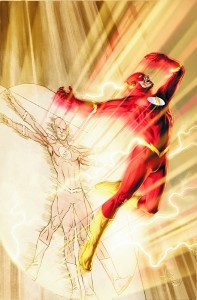 Well, now we know why DC has been infuriatingly vague about what happens in Flash: The Fastest Man Alive #14-15. The answer: Nothing.
That’s right, nothing happens in issues #14-15 — because they don’t exist! In an interview with Newsarama, Mark Waid revealed that DC is canceling the current series after #13, and relaunching it this fall with #231, picking up the numbering from the previous series. To bridge the gap, they’re also releasing a special All Flash #1 in September July.
And the plans have been in the works for almost a year. Given how closely everything is tied to Countdown, the JLA/JSA crossover, etc., DC knew going in that they weren’t going to pick up with #14, which means that the solicitations, the covers that they commissioned, and the retailer incentives were all a smokescreen to keep the relaunch under wraps.
Of course, why relaunch the book if you’re going to keep the same Flash?
On one hand, I think the new book was just hitting its stride, and Bart deserves his shot. On the other hand, Mark Waid on the Flash? And a 1-in-3 chance that it could be Wally? Where do I sign up?
Extinguishing a Speedster’s Smokes
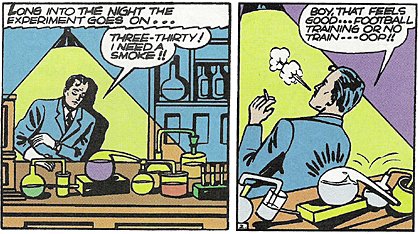
Comic Coverage recently posted a humorous look at the role smoking had in the Golden-Age Flash’s origin. Jay Garrick was working late, took a cigarette break, and knocked over a beaker of “hard water.” Interestingly, later retellings of his origin downplayed and finally deleted the cigarette.
First, here are the original 1940 panels from Flash Comics #1 (copied from Comic Coverage), showing grad student Jay Garrick taking time out for a smoke:
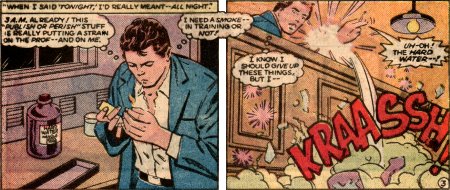
Four decades later, in 1986, Secret Origins #9 would retell his origin. Mindful of the details, but also concerned about modern sensibilities about health, writer Roy Thomas kept the cigarette break, but added Jay thinking, “I know I should give up these things…”
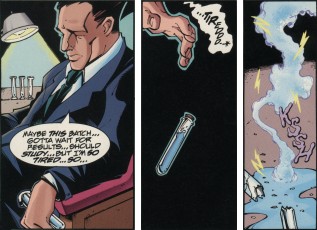
A decade later, the cigarette had disappeared completely. Flash Secret Files #1 (1997) featured a condensed retelling of all three (at the time) Flashes’ origins, and this time, Jay simply succumbed to the hour and nodded off, dropping the beaker.
Safari on Windows: What effect will it have on Opera?
 Following up on my previous post, Apple just dropped a bombshell: the Safari web browser is now available for Windows. I’ve posted some general reactions at K-Squared Ramblings as to how it will benefit web developers and users overall. The most obvious is that Windows-only web designers will no longer have an excuse for not testing in Safari, which might help break the two-browser mindset.
But what about Opera, specifically?
I remember when Apple first announced Safari for the Mac, Opera was very upset that Apple had decided to go their own way instead of licensing Opera as the new default browser. In retrospect, both sides were right: Apple was right to choose something that they could maintain themselves, without being dependent on an outside provider. (I guess they’d learned their lesson from Internet Explorer.) Opera was right that they lost a golden opportunity: as the default browser on MacOS, Safari has since become the most-used browser on that platform and the third-most-used browser overall, surpassing Opera’s marketshare.
So there’s certainly a risk that Safari on Windows could surpass Opera’s users. However, there is one significant difference: Safari is not the default browser on Windows. It’s hard to tell how much of Safari’s uptake on MacOS is due to it being the default, and how much is due to people actively liking it. Personally, I have Opera, Firefox, and a half-dozen other browsers on my PowerBook, but when I fire that box up, I generally use Safari.
If you look at the functionality available in a base install, from simplest to most complex, it probably starts with Safari, runs through Firefox and IE, then finishes with Opera. Firefox has a wide array of extensions available — in fact, it’s pretty much known for them. Safari isn’t nearly as extensible. You can’t install something that will add mouse gestures, for instance.
I suspect that, at least at first, the audience for Safari on Windows will consist mainly of the following groups:
- Web Developers
- Dual-platform users who are used to Safari on Mac
- People who just want a basic browser and don’t want bells and whistles, but don’t want IE for some reason
If anything, I think Firefox has more to worry about than Opera. For every Firefox user who tricks out his browser with every 1337 extension he can find, there are probably many who just wanted something more stable than IE, or faster than IE. There’s a vocal faction of Firefox users who are frustrated with its performance. I don’t know why they haven’t jumped ship to Opera, but depending on how much memory Safari uses when it gets out of beta, it might prove a threat on that front.
This post originally appeared on Confessions of a Web Developer, my blog at the My Opera community.
Safari on Windows
Wow. I have to admit I was not expecting this at all, but Apple has just announced they’re releasing the Safari web browser for Windows.
Increased consumer choice, of course, is a good thing. The most immediate benefit, though, is that Windows-based web developers (the majority) who haven’t been willing to buy a Mac to test their sites in Safari will be able to do full testing on all four major rendering engines: Trident (IE), Gecko (Mozilla/Firefox/etc.), Webkit (Safari) and Presto (Opera).
Also, there’s some really cool stuff available in recent versions of WebKit that will be great to have available for a wider audience.
Interesting thought: this may be the first browser released since Opera expanded to Linux in ~2000 that is available in the same version on Windows and Mac, but not Linux. Even when Internet Explorer was available for the Mac, it used a different engine than the Windows version did.
I wonder what impact this will have on the development of Swift. Its main claim to fame was porting WebKit to Windows, and it’s been months since their last release.
I also wonder what the status is on re-merging the KHTML and WebKit forks. It’s gotten to the point that Konquerer is only an approximation of Safari, making testing on Linux a little harder than it used to be.
(via Asa Dotzler)
No doubt there’s a 500-comment Slashdot discussion already.
Update: Slashdot’s all over it, and Opera Watch has a thread going as well.
Update 2: I’ve posted my thoughts on the implications for Opera. There’s an update at CSS3.info, where they have previews of upcoming CSS features available in Safari 3.
Update 3: I’ve updated the Alternative Browser Alliance to reflect Safari’s new status. This also solves a nagging doubt I’ve had as to whether the default browser on Mac OS should really be considered “alternative.” On Windows, it definitely is.
Update 4: The Webkit team and Web Standards Project have weighed in. The Windows version of WebKit should be available later today, which will be nice for following progress on issues as it moves from beta toward final version. It turns out there’s a regression and at least the Windows version no longer renders the Acid2 test correctly.
Update 5: The author of Swift says that Swift isn’t going away [edit: the blog has since vanished], and points out that “Swift renders more like a Windows Application, both in the GUI and in WebKit. Safari, looks just like OS X, similar to iTunes 6 and below.” Ever since Apple started porting apps to Windows, I’ve found something odd: A common complaint about third-party Mac software is that it doesn’t look and feel native (one of the big reasons we have Camino as well as Firefox), yet when Apple ports their own apps to Windows, it makes them look exactly the same as they do on Mac OS instead of making them work like native apps. I mentioned this to Katie yesterday and she suggested it might be a case of turnabout being fair play.
Inadvertent Language
This morning’s Los Angeles Times article, “A %$#@ slippery slope on raw talk?”, discusses the recent court ruling that relaxed FCC restrictions on inadvertent swearing. On one side, watchdog groups (and the FCC) are complaining that this could lead to swearing and nudity throughout prime time. (Won’t someone think of the children?) On the other side, the networks point out that it’s not likely to open the floodgates of indecency:
Broadcasters could air expletives after 10 o’clock “every night of the week,” one executive said. “We don’t for a reason, because we don’t think our audiences want to hear it.”
My take: this is a much-needed relaxation of rules that, frankly, have gotten overly uptight in the last few years. If an adult screws up and accidentally lets loose with stronger language than is acceptable on TV, and the guy with his finger on the *bleep* button misses it, chances are they both already know they messed up. Give ’em a slap on the wrist. The ton of bricks approach is unnecessary, and ultimately counter-productive.
It takes a spectacularly skewed worldview to think that the occasional slip-up in the heat of the moment is equivalent in naughty content to, say, a scripted scene from The Sopranos. Once a year vs. 10 times in every scene? Big deal. We’re not talking about murder, we’re talking about words—words that everyone (yes, including your kids) has heard plenty of times.
On a related note, the article brings up the infamous Janet Jackson wardrobe malfunction, since it spurred the “war on obscenity” into action. Personally, I think the most disturbing thing about the incident is the fact that all the blame is placed on Jackson herself. No one seems to remember that it was Justin Timberlake who ripped off part of her wardrobe.