
Photoblog Catch-up Week enters its second week! This Sav-on had an odd collection of items in one aisle:

I’m still trying to work out how an aisle can contain “Got milk?” 😕
Photoblog Catch-up Week enters its second week! This Sav-on had an odd collection of items in one aisle:
I’m still trying to work out how an aisle can contain “Got milk?” 😕
eBay must have some sort of blanket advertising deal with Google, because the “sponsored links” you get for some searches really don’t make any sense.
Case in point: I did a Google search for the phrase, “nigerian scam,” and saw the following ad:
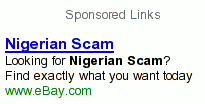
Wow, when they say, “Whatever it is, you can get it here.”—they really mean it! 😉
Interestingly, if you search for “419 scam,” you get the same type of ad, but not if you search for “advance fee fraud.”
I tried a few random search terms, and from what I can tell, eBay’s ad shows up on many—but not all—two-word searches. I’m not sure what the pattern is, but I can’t imagine someone at eBay deliberately asked to buy ad space for some of these phrases.
But in a show of accuracy, if you search for “random stuff,” you’ll find it!
If you have a website, you’ve probably seen link swap spam. People running link farms search for a keyword or phrase, then fire off a zillion emails to the contact addresses about how they’ve looked at the site, their site is clearly relevant to yours, they’ve already linked to you and they want you to link back to their site.
All this without bothering to actually look at the sites in the search results.
For example: last Saturday I posted picture of the marquee in front of San Diego’s Ghirardelli Chocolate shop. By Monday someone had asked me to link to their website about chocolate, because our sites were clearly related.
Today I got one that trips the irony-meter. I’ve made four posts over the past year about targeted—or mistargeted—advertising. Just four. This morning I received three copies (one to my webmaster address and one to each DNS contact) of this message:
Hello,
I have found your website hyperborea.org by searching Google for “targeted advertising”. I think our websites has a similar theme, so I have already added your link to my website.
While catching up with IMDB info on the various actors in Revenge of the Sith, I noticed an appropriate set of ads on Ewan McGregor’s profile:
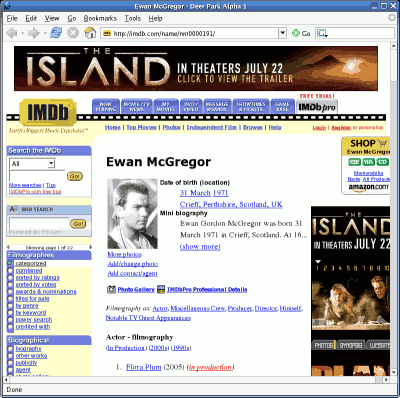
For those who haven’t heard of it, Ewan is the male lead in The Island.
(At the moment, Natalie Portman gets a Windows XP ad, and Hayden Christensen gets… Amazon.com. I assume they’re on the standard rotation.)
 There’s a saying about the elephant in the room that no one will talk about. Everyone knows it’s there, but by some unspoken rule no one will mention it. I’ve noticed that when web browsers are compared, there’s one thing Opera supporters tend to ignore or downplay: Opera’s business model.
Internet Explorer and Safari are bundled with their respective operating systems, and so they’re perceived as free. Firefox is free in both the gratis and libre senses of the word. Opera, however, is ad-supported by default and will disable the ads if you pay for it.
You can use Opera without paying money, but you’re still paying it in attention (a persistent chunk of space dedicated to advertising), so in comparison to the other three leading browsers, it’s perceived as being less free. Think of it in terms of television.
So the perception of cost looks like this:
Most people really do prefer free without ads to free with ads or paid subscriptions. Why else is skipping commercials one of Tivo’s most popular features?
I’m certain this impacts marketshare, and it definitely impacts media coverage. Just look at CNET’s recent IE vs. the world review. Opera 8 gets high marks for features, but what’s the summary? “Despite a ton of great technology in Opera, few consumers will be likely to pay for the app. ” Whether you think the review is otherwise fair or not, the business model clearly lowered it several notches on the reviewer’s scale.
Next: Firefox’s blind spot.
Disclaimer: I’m a regular Firefox user these days, but I’ve also paid to register Opera since version 3.5 was current back in 1999. I used Opera as my main web browser on Windows back when Netscape 4 was aging and Mozilla hadn’t yet stabilized enough to replace it.
A truism of television is that they aren’t in the entertainment business, they’re in the advertising business. Their job is selling commercials, and the shows you watch are nothing but an enticement to get you to watch long enough that you’ll see the ads. This is true for ad-based websites as well. The content is just there to get you coming back so you’ll see and click on the ads. (I’ve always had a problem with the idea of using click-through as the primary measurement of an ad’s success, but that’s another story.)
The problem here is that a balance needs to be struck between content and ads: Tilt too much toward content, and you need another business model to pay for hosting. Tilt too much toward ads, and people will stop visiting your site—or start blocking your ads. The more intrusive and annoying the ads, the more likely people will block them.
I rarely block ads. (Of course, I don’t click on them very often, either.) I figure if the website owner needs an ad banner to pay for hosting and/or make a profit and continue providing the site, that’s fine…as long as it doesn’t distract from the content. Remember, I’m not there for the ads, they have to convince me to come to their page, and if the ads make an otherwise-appealing site too annoying to read…well, sorry, I’m either blocking the ads or I’m not coming back.
DevArticles is a good example of this. The page was so full of animated banners visually screaming for my attention, I could barely focus on the article long enough to read it. This one page prompted me to install the Adblock extension for Firefox at work and block everything coming from their ad server, just to be able to read it. Had they kept their ads sensible, like the dozens of ad-supported sites I frequent without blocking the ads, I probably would have bookmarked it as well. As it is, the site reminds me of a line from Babylon 5: “Too annoying to live.”