When I set up a B2 site just for kicks in 2002, I didn’t really expect to still be posting to it ten years later.

Admittedly, I don’t post as often as I used to, and I think fewer people read it than did back in the day — partly because a lot of my more fannish stuff has moved over to Speed Force, partly because I don’t post as often, and partly because of the changes in the social media landscape, most notably Facebook and Twitter.

Vital stats:

2644 posts
3847 comments

Top 10 posts viewed over the past year:

  1. Setting up a Wireless Network on Linux: Ralink 3062 and Network Manager
  2. Comic Con! (2003)
  3. Getting Flash to work on Google Chrome for 64-bit Linux
  4. Songs Not to Play at a Wedding
  5. Victimized Hero
  6. Avocado’s Number
  7. Super-hero Weaknesses
  8. Flash Foreshadowing
  9. Fuchsia Zoom
  10. How to Get Rid of Windows Live Messenger

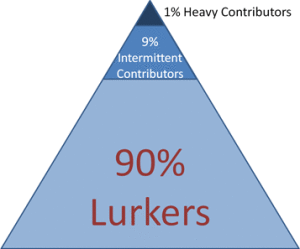
Community participation pyramid: the 90-9-1 Rule (Jakob Nielsen)Sometimes it seems like more people are talking about Google+ than using it, but it really depends on the community you’re looking at. Comics fans? Not well represented. (But they’re even harder to find on Pinterest.) But “Bad Astronomer” Phil Plait has a thriving following.

It seems like Speed Force’s Google+ Page is starting to attract a bit more participation, and I think that might be in part due to it passing the 100-follower mark. I vaguely recalled something about a 90-9-1 Rule for community involvement, which turned out to be pretty easy to find once I searched for it.

Basically, the rule states that:

  • 90% of community members are “lurkers” who read or observe, but don’t contribute.
  • 9% contribute occasionally (i.e. comment, “Like,” +1, share)
  • 1% contribute frequently, and account for most contributions

Continue reading →

The classic link-sharing site Delicious is still around, trying to find a niche in the new social media world. One of the things they’ve recently done is set up a way to import all links you post on Twitter. It does a historical import when you link the account, and then pulls in new tweets going forward.

It’s a cool idea, depending on how you use the sites, and they’ve made it just flexible enough that anyone who might want to do this in the first place will find a way to match their use case.

In my case, I mainly used Delicious as an additional bookmark store that I could access across browsers and accounts, though for the most part that’s been replaced by Xmarks. I haven’t used it as much for deliberate sharing, though I’ve posted the occasional link in the hopes that someone might notice it.

Anyway, I linked it up with my personal Twitter account, left the site for a few hours, then came back to see just how far back it had imported. It went back about 3 years, pulling in over 1,000 links that I’d posted to Twitter.

The Good:

  • It merges duplicates.
  • Links are backdated to the day you posted the tweet.
  • All imported links are tagged with “from twitter” (you can change this), making it easy to filter.
  • Hashtags are imported as tags.
  • The text of your tweet becomes the comment.
  • It extracts titles and thumbnail images from the links.
  • It can follow some redirectors, including Twitter’s own t.co.

The Bad:

  • It doesn’t follow all redirectors. There are an awful lot of bit.ly and is.gd links in there.
  • That also means that if I tweeted the same link twice using different link shorteners, it doesn’t resolve the duplicates.
  • A lot of those links were only of short term interest.
  • Three years is plenty of time for a redirector (or, of course, a target link) to shut down. Fortunately, it looks like I didn’t use tr.im much.
  • My blog automatically tweets links to new posts, which means every post I’ve made in the last three years is in there – the earliest with an is.gd or tinyurl link, the later ones with bit.ly. I don’t need those in my own bookmarks (with a few exceptions), and as far as sharing goes, it makes me feel spammy to plug three years’ worth of backlist at once.
  • Searching for links gives you less-functional results than simply looking at your list or filtering by tag. Not all details appear on the results page, bulk actions aren’t available, and you can’t always delete a link if you edit it from search results. This meant I couldn’t, for instance, search for “New post” or “K-Squared Ramblings,” skim the titles and bulk-delete the bookmarks to my own content.

Over the last couple of weeks I’ve been taking a few minutes here and there to go through what started as 60 pages’ worth of imported links, delete the ones I don’t want to keep and fix up the ones I do. It started out faster than my last Twitter-related cleanup project, but that’s because there were a lot of auto-posted links I could just delete without taking the time to evaluate or label them. It’s already slowing down.

I could just leave all the clutter there, but part of the point is for this to be my bookmarks-away-from-home, and it’s easier to find stuff without the extra junk.

On the plus side, between this and the broken link cleanup, I’m getting to see a bunch of old posts and photos I’d forgotten about. That’s been an interesting process.

It’s also convinced me that linkblogging round-ups really don’t belong on this blog. I still do them on Speed Force, but that’s in part because Speed Force has readers who don’t follow the social networks. (OK, let’s be honest: because Speed Force has readers.) Here, where it’s just a personal site, I’m better off sticking with the best medium for each post. That means Twitter, Facebook and Google+ for short posts (barring a few categories that I’ve got history here, like license plate spotting), the blog for longer posts, and social networks for link sharing.

I turned on the broken link checker plugin at lunchtime, and let it run through the site over the next few hours* before checking back this evening.

Holy crap, there’s a lot of outdated links on this site! Over 300, in fact, linking to things like…

  • News organizations that discard their archives, or hide them behind paywalls.
  • Businesses that have, well, gone out of business.
  • Blogs that have shut down or moved.
  • Personal sites that have been abandoned.
  • Sites that have reorganized without setting up redirect rules for their old link structure. (Even the Star Wars official site did this with the movie pages!)

One of the dead links is, appropriately enough, to an article on top 10 web design mistakes. (I guess they missed one!) Another is actually on one of my articles on link rot from way back when.

And then there are the 700+ links that are being redirected, some of which should probably be updated, but some of which are certainly gateway pages — and some of which are probably pointing to a new site that took over the name, but not the content.

It’s often stated that once something goes up on the Internet, it’s there forever. But that’s not entirely true. What it is, is beyond your control. If someone else makes a copy, you can’t take it down (like the fable about releasing a bag of feathers from a mountain top, and then trying to collect all the feathers). But any individual copy — even the original — exists at the whim of whoever owns or maintains that site.

One question remains: Do these dead links matter?

I think they do, for three reasons:

  1. Links are source trails. A valid link may support what you’re saying, indicating that you know what you’re talking about. (Think of all those [citation needed] notes on Wikipedia.)
  2. Related to that, links provide context. Even today, with the masses chattering in short form on Facebook and Twitter, you’ll find people writing articles and responding to them with other articles. As long as the links remain intact, these aren’t monologues — they’re a conversation.
  3. When a whole site goes offline, you never know who’s going to pick it up. It could be someone with an opposite political agenda. It could be a spammer or malware peddler. A commenter from 5 years ago might lose their site and have it taken over by someone selling knockoffs of little blue pills — and now guess what you’re linking to?

*Something about the plugin really taxes the VPS that DreamHost offers, which is why I don’t have it running all the time anymore, but it only seems to affect the blog it’s running in, and of course it doesn’t impact static pages.

Years ago, I wanted a smartphone so I could write down all the blog posts I compose in my head when I’m away from a computer. Now that I have one, I end up reading Facebook, Twitter, or Google Plus instead, and I compose blog posts in my head when I’m away from both my computer AND my phone. Maybe I just need a pencil and notepad.

I spotted something interesting while walking to lunch, took a photo with my camera, and then took a photo with my phone so that I could post it to Twitter immediately.

Then I thought: why?

  • Is it breaking news?
  • Is it going to be any less interesting if I wait?
  • Would it add to an in-progress conversation?
  • Really, is there any reason that posting it now would be better than posting it later?

And on the flip side:

  • Does the photo quality matter?
  • Does it need more explanation than I can provide at this time?

I decided that in this case, it was self-explanatory, and neither the timing nor the quality made much difference. But since I had the better photo, I might as well wait until I could upload it. (Sometimes the photo quality really matters, though: my phone’s photos of that rainbow cloud just weren’t worth the effort, so it’s a good thing I rushed back to the office for a better camera.)

There was a time when if I wanted to post a photo online, I had to finish a roll of film, send it to a photo lab, wait for them to develop it, and then scan the print. I really like not being limited by that, whether it’s because I’m posting about a current event like Comic-Con or an election, or just because I think something’s fantastic (or hilarious) and really want to share it.

Sometimes it’s really useful to be able to post photos online instantly. Other times, it’s worth asking: Is now better?

A bit of craziness: I wrote this post in June 2010, about this sign. Then I decided it needed a bit of work before I posted it…and forgot about it. Interestingly enough, the post is still just as valid as it would have been a year ago, and it demonstrates that sometimes, now isn’t better, even if it’s not worse.

Of course, it also demonstrates an advantage of posting immediately. There’s no chance of forgetting about it that way!

Cool! I’ve been named in The Comics Reporter’s reader poll on Name Five Writers About Comics You Like That Aren’t On CR’s Home Team Of Tom Spurgeon And Bart Beaty. It’s an impressive list, and with some of the big names on it, almost intimidating to be included.

If you’re visiting here for the first time, let me make a bit of an introduction. This is my sort of general-purpose blog, where I write about anything from comics and science-fiction to photos, life observations and technology. If you’ve dropped in from The Comics Reporter, you’ll probably be most interested in:

Thanks to Richard Pachter for recommending me!

»All pages site-wide with this tag