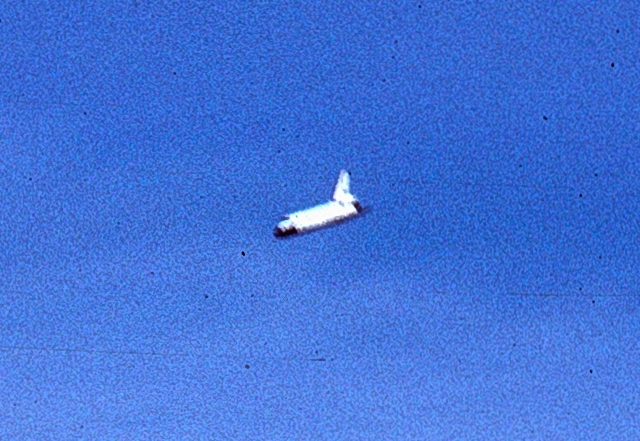
Small view of the space shuttle against a blue sky.

When I was twelve, my family went to see the Space Shuttle land at Edwards Air Force Base. It was the first mission after the Challenger disaster, and the orbiter was Discovery.

I took a roll of slides using a manual SLR camera and (for the landing itself) a telephoto lens. With the last shuttle mission ending tomorrow, I decided to track down the slides and scan them. Continue reading

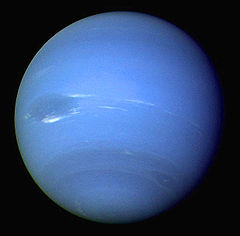
NeptuneThis morning I saw some wavy clouds that reminded me of the patterns you see in pictures of Jupiter. I started thinking about gas giant planets, and had an odd moment of realization: when I was a kid, astronomy books didn’t have actual photos of Uranus or Neptune. They couldn’t have — there weren’t any! There were nice photos of Jupiter and Saturn from the Voyager missions, but Voyager 2 didn’t reach Uranus until 1986, or Neptune until 1989.

The really weird thing, though: modern astronomy books do have photos of Neptune — but the ones for general audiences probably all use the same picture I got as a framed poster when I was in high school. We haven’t been back in 20 years. Jupiter and Saturn have gotten a lot of attention, partly because they’re a lot closer and partly because their ring and moon systems are so fascinating. So we have a more continuous view of those planets and how they change over time.

Neptune? One snapshot (metaphorically speaking) of the planet from 20 years ago. Everything before and everything since then has been done with telescopes. Even the Hubble barely has the resolution to tell that the Great Dark Spot broke up sometime between 1989 and 1994. That’s something that maybe shouldn’t have surprised anyone, given how quickly storms form and dissipate on Earth, but back in 1989 it seemed so much like Jupiter’s Great Red Spot (going on 400 years or longer) that it was easy to think it too would be persistent.

It’s a good reminder that the universe beyond Earth does change with the passage of time…even on a human scale.

The Value of Space Exploration, via Phil Plait.

Neil Gaiman on The Fairy Feller’s Master Stroke, a painting by a madman that’s inspired its share of stories.

And from Comics Worth Reading, our WTF entry for the day: Paradise by the GoPhone Light. It’s a commercial done in the style of a music video, featuring Meat Loaf and Tiffany as the parents of a kid who wants a GoPhone. Completely surreal, especially once the random explosions start.

It’s just occurred to me that, aside from it being some sort of cell phone, I have no idea what a GoPhone is. [/me types “gophone” into Google] Ah, OK. Pre-paid cellphone. Meh. (And now I’m imagining how much spam is going to get posted to this thread. *sigh* )

This is cool: a fascinating tour of the world’s cities as seen in visible light from the International Space Station.

Cities at Night, an Orbital Tour Around the World

It’s interesting to see how just lighting illustrates different patterns in city development. European cities have this star topology, US cities tend to stick to the north/south grid. Different countries tend to use different colors of lighting, with the western cities more yellowish and cities in the middle east and Asia more greenish. There’s a view along the Nile, where the river runs through the middle of a channel of lights, beyond which everything is empty.

There’s also a mosaic of the Los Angeles/Orange County/San Diego area, which really points out that there’s quite a bit of emptiness still in the OC area: The Santa Ana Mountains to the northeast, and the San Joaquin Hills to the sourthwest, make large dark areas. The northwest plain melds seamlessly into the Los Angeles area, while a narrow (but very bright) channel winds its way through the middle before opening up into south county.

The downside, as pointed out in the comments, is that this is all wasted energy. With lamps that direct all of their light downward instead of out into space, we could light our cities with less energy and keep the skies dark for stargazing.

Space Shuttle Atlantis has landed safely. *whew!* I’m getting more nervous about shuttle missions lately. In part, it’s the greater focus on all the things that could go wrong. In part, it’s the realization that you know, the shuttle fleet really is aging.

But mostly, I think it’s the fear that, given reactions to the Columbia disaster, our nation may be only one disaster away from writing off space—or at least humans in space—entirely.

Speaking of Atlantis, the Bad Astronomy posted a fantastic photo by Thierry Legault of the shuttle and the International Space Station passing in front of the sun!

ยปAll pages site-wide with this tag