One of the events I made sure to hit at Comic-Con was the Flash Forward panel. Flash Forward is a new series launching on ABC this fall — you’ve probably seen ads for it — about what happens when everyone in the entire world blacks out for two minutes and has a vision of what they will be doing at a specific time in the future. This incident has two major consequences:
- Millions of people die, worldwide, in the space of moments. Cars and airplanes crash, people standing on staircases or ladders fall to their deaths, swimmers drown, etc.
- The survivors know exactly what they’ll be doing for a two-minute slice of time in the future…but they don’t necessarily know why.
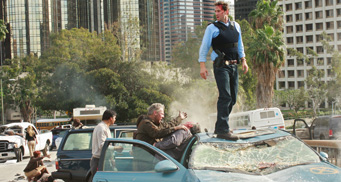
It’s based on the novel Flashforward by Robert J Sawyer, which I reviewed last December. It’s a great book, and I highly recommend it. The focus seems to be different, though: the book follows the scientists whose experiment accidentally triggered the event, in which everyone sees visions of 21 years in the future. The TV show is following, to start with anyway, an FBI agent investigating the event.
So where the book is mostly philosophical science fiction, the show looks like a mix of action, mystery and drama.
Both have, as their major theme, a single question: If you knew what your future was going to be, what would you do? Would you try to change it? Would you try to make it happen? If you saw a future you wanted, would you slack off, confident that things would work out in the end, or would you put in extra effort knowing you’d succeed?
To start with, they brought out the producers of the show, had some discussion, then ran the first two acts of the pilot episode.
Read on for a write-up and photos from the panel. Continue reading