
I didn’t manage daily blogging past day 12, or 31 posts in the month. I wrote 20 posts, including reviews of two books, a game, my dying phone and its replacement. I also finished some older drafts and revived my dormant Les Mis blog with a Star Trek post (really). Read More…
Tag: Moved
That time I had to rebuild a Minecraft Village’s economy

The latest Minecraft update, “Village and Pillage,” has completely revamped villager professions and trading, and made major changes to the village structures as well. Each profession now has a work site defined by a block like a stone cutter, or a loom, or a composter, etc. and unemployed villagers will try to fill jobs based on what’s available.
Now, Minecraft has always been (in my experience, anyway) pretty good about upgrading existing worlds as the game engine changes.
- Unexplored areas will generate using new rules.
- Previously explored areas will remain the same, except…
- Specific blocks will convert as needed (ex: if you built a generic wooden fence before they introduced fences for each type of wood, it will convert to an oak fence.)
- All areas will start operating on new rules.
Normally this works great! But can you see the problem with villages?
Yeah. The villagers operate on the new rules, which means they need work sites to do their jobs, but the existing villages were built without any workstations.
So the village near my current base suffered an economic collapse, or perhaps an attack of existential mass ennui, leaving every villager unemployed.
Fortunately, all the new workstations are craftable. Even the ones that the player can’t use yet. So I spent some time on the wiki, writing down the ingredients I needed, went back to my base, crafted all of the ones I could, and started placing them around the village.
And it worked! Pretty soon I was able to trade with a farmer, librarian, fisherman, butcher, cartographer, etc. I’m still waiting for some of the unemployed villagers to pick up jobs. Maybe they need to actually walk close enough to the job sites or something?
Anyway, here’s the list of ingredients I put together based on the wiki article on villagers. You can get the crafting recipes from the wiki or in the game from the recipe book:
Minecraft Villager Job sites
| Job Site Block | Profession | Ingredients |
|---|---|---|
| Blast furnace | Armorer | 5 iron ingots, 1 furnace, 3 smooth stone |
| Smoker | Butcher | 4 logs, 1 furnace |
| Cartography Table | Cartographer | 2 paper, 4 planks |
| Brewing Stand | Cleric | 1 blaze rod, 3 cobblestone |
| Composter | Farmer | 4 fences, 3 planks (Java) or 7 planks (Bedrock) |
| Barrel | Fisherman | 2 wooden slabs, 6 planks (Java) or 2 wooden slabs, 6 sticks (Bedrock) |
| Fletching Table | Fletcher | 2 Flint, 4 planks |
| Cauldron | Leatherworker | 7 iron ingots |
| Lectern | Librarian | 4 wooden slabs, 1 bookshelf |
| Stonecutter | Mason | 1 iron ingot, 3 stone |
| Loom | Shepherd | 2 string, 2 planks |
| Smithing Table | Toolsmith | 2 iron ingots, 4 planks |
| Grindstone | Weaponsmith | 1 stick, 1 stone slab, 2 planks |
(Yes, a few of these are actually different in Bedrock Edition and Java Edition! I don’t know why Mojang would deliberately introduce differences in something as basic as crafting recipes, but apparently they have.)
Depending on how you play the game, you may never need to do this. If you generate new worlds all the time, or if you’re happy to just pull up stakes and move to a new area in the same world, you’ll encounter the updated villages to start with. But if you play like I do – explore the same world slowly, digging in, building up and establishing bases as I go – you’ll be glad to know that this works to manually upgrade your villages.
How to Post to Mastodon From Anything Using IFTTT
Update October 2024: I’ve moved this article over to my troubleshooting site.
I Finally Saw “Ragtime”

Seeing Ragtime on stage is a vastly different experience from listening to it, and not just because it’s live theater. There’s so much context, so many connections, so much subtext that you don’t get from the songs alone. It’s very much a go-home-and-hug-your-kids kind of show. Read more…
Les Mis: Looking Back at the Book
I found this funny review of Les Miserables (the book) [ack! link deleted!] on GoodReads via Kobo. It’s been 20 years since I read it myself, but it rings true.
…you will not read the abridged version. Don’t you dare. Don’t even think the word “abridged.” Yeah, I know, Victor Hugo frequently turns away from the main narrative to focus on side characters, historical events, religion, philosophy, and other subjects. That’s why this isn’t called “Jean Valjean’s Excellent Adventure.”
The review even mentions the Paris sewers. Because, really, it would have to.
The crazy thing is that, after seeing the movie, digging out my own review of the new stage version, and stumbling on this review of the book…I’m starting to consider re-reading the novel. Because obviously I have gobs of spare time and no new books to read. And at 1200 pages, it’s only 1 1/3 times as long as A Memory of Light! By page count, anyway. It’s not as if the Les Mis edition I have has tiny type, making those page counts not comparable. And it’s not as if Victor Hugo’s prose is that much denser than Robert Jordan, right?
*sigh*
If I do this, it’s going to take me months.
On the other hand, Katie suggested I could live-tweet the re-read. It would be slow, but hey, it could be interesting.
Hmm…
Update: I’m moving forward with the re-read and online commentary!
Goin’ On a Typo Hunt
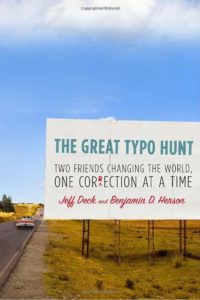 NPR has an article on The Great Typo Hunt: Two friends cross the country with a Sharpie pen, correcting grammatical and spelling errors in road and shop signs. And there’s a book.
I may need this.
When I was in college in the mid-1990s, I kept a “Bent Offerings” newspaper cartoon on my bulletin board. One person was scrawling “I before E…” on a wall. Another was correcting a menu, muttering, “It’s Brussels Sprouts, not Brussel Sprouts!”. A third was examining someone’s T-shirt, disapprovingly asking, “Is that how they taught you to use an apostrophe?” The strip was captioned, “Roving Gangs of Rogue Proofreaders.”
The appeal hasn’t stopped. You may have noticed I have two categories on this blog devoted to weird/funny signs and mistakes in signs.
Yeah, this sounds like a good bet. Update: I finally read it.
Finished The Gathering Storm (Wheel of Time) – It’s Good
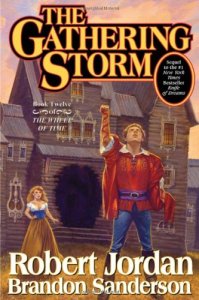 This weekend I finished reading the new Wheel of Time novel, The Gathering Storm. Now that I’ve read it, I can definitely say that Brandon Sanderson was a good choice to finish the series from Robert Jordan’s notes, and that splitting the final book into three was the right approach. It may be a doorstopper, but it would be difficult to cut more than a tiny amount without diminishing the impact of what remained.