Apparently it’s National Donut Day, and WaPo decided to look at regional differences in which chain is on top — if any.

We’re solidly in indie-land here. Even the Winchell’s I remember growing up became a mom and pop shop back in the 80s (though I think it *might* have been a Yum Yum at some point in between). I just looked it up and it’s still there, and still indie.

There are so many ex-Winchell’s in the LA/OC area that were picked up by mom-and-pop shops of all kinds that didn’t want to spend extra money replacing rounded-triangle the structure of the sign that I considered taking photos and starting a Tumblr called used-to-be-a-winchells back when Tumblr was still popular, but I never got around to it.

There’s one near where we live now that was an indie shop when we moved to the area, and had almost-but-not-quite the same name as another indie shop down the street, both using the street name as part of the shop name. The other shop changed its name to use the side street’s name instead…shortly before the ex-Winchell’s one closed. It’s now a completely different kind of business (not even a restaurant), but the sign shape is still the same!
You wouldn’t think that books about astronomy and archaeology would have a lot in common, but Four Lost Cities (Annalee Newitz) and Under Alien Skies (Phil Plait) pack some odd similarities.

Both are about places we (mostly) can’t visit in person: Faraway planets in one case, the distant past in the other.

We have to piece together parts of the experience from what has come to us through time or through space: Telescopic observations, space probes, spectral analysis, and our understanding of physics — ruins, artifacts, aerial surveys and
what we know about people (both contemporary and in general).

For some sites we have very detailed and solid information: Angkor’s stone temples are still standing. Pompeii was well-preserved under volcanic ash and we still have first-hand writings about the city and its destruction. Mars and the moon have been extensively surveyed, including multiple landers and photographs from the surface. (And, in the case of the moon, a handful of people!)

Others require a lot of speculation: There’s a solid core of what we’ve figured out about Cahokia, but a lot of unknowns that we can sorta-kinda extrapolate from the histories and tales of surviving tribes in the area — but only to a point. Similarly, we know the rough structure of the TRAPPIST-1 solar system and some of its planets, but we have to speculate: if one of the planets in the habitable zone actually is habitable, what conditions would that require?

Both include major discoveries made within the last decade: Pluto and Charon were just a pair of dots until the New Horizons mission flew past it in 2015, bringing us pictures and measurements and so much data it took months just to download it from the probe back to Earth. Lidar surveys at Angkor in 2012 revealed the foundations of a vast metropolitan area around the temple complexes, upending our sense of how big the city was and identifying new sites to investigate.

It’s kind of funny how I read them so close together. Synchronicity and all that. They’re also both good (see also my review of Four Lost Cities and review of Under Alien Skies), and I’d definitely recommend them!

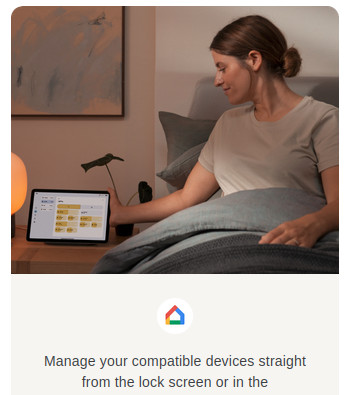
A woman sits in bed, reaching for a tablet device on the night stand. Just behind her hand is a houseplant with a long stem and one leaf, seen almost on edge such that it looks like a claw hammer in profile.

From an ad Google sent out today for their new Pixel Tablet, where they’re plugging it as a hub for controlling “smart home” devices. At first glance, it looked like she was about to smash it with a hammer.

I suppose that says something about my attitude toward IOT?

(At second glance, it looked like a hummingbird sculpture on a post. At third glance I realized it was a houseplant.)

At first I thought this was a followup to another story about an anaphylactic reaction during an airplane flight last week. No, it’s a totally separate incident.

One patient had an expired epi-pen. The other had never had anaphylaxis before.

Both planes had bottles of epinephrine and a syringe, not an auto-injector. Fortunately there were doctors on both flights who knew how to figure out the dosage, properly fill and deliver a shot.

In the second incident, the patient who was experiencing anaphylaxis for the first time is a doctor, but…have you ever tried loading a syringe and injecting yourself while your throat’s rapidly closing up until you can’t breathe? There’s a reason they make auto-injectors!

It could be worse: the same site has an article about another in-flight reaction a month ago, where staff couldn’t get the emergency kit open for 10 minutes! This time it was a pair of nurses who measured and administered the shot.

This…seems to be more common than I thought it was.

And putting an emergency kit on the plane without training your flight crew how to use it is just ridiculous.

(Reminders to self: 1. Check epi-pen expiration date. 2. Make sure it’s easy to find in my carry-on next time I travel.)

One of many cool facts brought up in Phil Plait’s new book, Under Alien Skies is that Martian sunsets are blue!

On Earth, nitrogen scatters light randomly, with bluer colors scattering more than redder colors, so the ambient sky is blue, but when you’re looking toward the sun at a shallow angle (like sunrise or sunset), most of the blue light is scattered into the next timezone and you see red and orange.

On Mars, tiny dust particles of iron oxides (rusty dust?) reflect yellow-orange light, making the daytime sky mostly a butterscotch color…but the particles that can stay aloft in the thin atmosphere are about the size of the wavelength of blue light, so they scatter blue light forward instead of randomly. So at the shallow angles of sunset and sunrise, the sky in the direction of the sun has more blue light than the yellows that are scattered in other directions.

Essentially the same process, but reversed because of the different content of the atmosphere!

Update: I’ve finished the book, and it’s well worth reading! Here’s a link to my review!