A few weeks ago, the floodlight in our entryway went out. This was the first built-in fixture to burn out, so we checked with the apartment office to see whether we should replace it ourselves or ask maintenance do it. They said they’d take care of it.

A few days later, the light was still out, but we got a service report with one line written on it:
Replaced Blub
Upon reading “replaced blub,” the manager joked, “There’s your problem!”

Shortly afterward, the bulb was replaced.

Despite what you might believe, tumbleweeds are actually quite common in suburban Southern California. They often grow by the side of the freeway, occasionally getting picked up by the wind and bouncing across cars.

Never is this more noticeable than during the Santa Ana winds, which seasonally sweep out from the desert to the coast, blowing over trees, knocking out power lines, and sending the smog out to sea. (Unfortunately, by the second or third day, all the dust from the desert has taken its place.) The two of us got some great shots from the most recent Santa Anas which hit during the week leading up to Thanksgiving.

Tumbleweed by the side of the road.
A tumbleweed seeks relief at a fire hydrant.

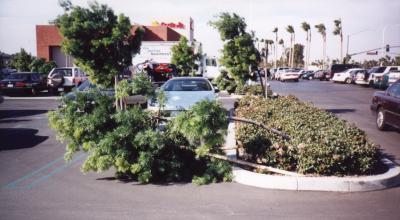
Downed tree in parking lot.
Even a support stake couldn’t keep this tree up.

Tumbleweeds in the *middle* of the road.
Hey! Get off the road! (Yes, tumbleweeds can get that big.)

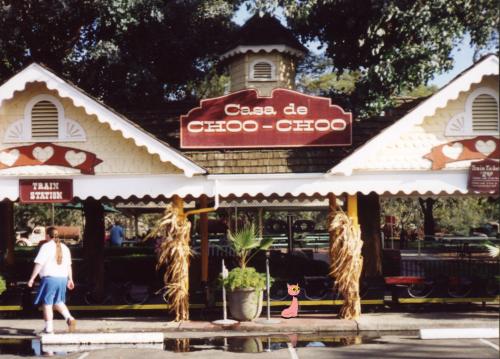
On our trip to Carmel last month we passed by Casa de Fruta, once a simple roadside fruit stand, now a huge complex of stores and restaurants, all with names like Casa de Coffee, Casa de Wine, even Casa de Motel. They even have a mini-railroad for kids, called, naturally, Casa de Choo-Choo.

Of course, we immediately thought of Choo-Choo Bear, the amorphous kitty from Something Positive

Photo of a multi-gabled roof shading a waiting area, with a sign proclaiming CASA DE CHOO-CHOO. Down on the sidewalk, a pink cartoon cat sits up proudly.

I remember back in college we had interesting naming schemes for computers. The ICS labs had the Guilder and Florin Macintosh networks with servers Westley and Buttercup. There was also a Solaris network where each machine was named after a Roman emperor, with names like Aurelian, Caligula, Gothicus, Hadrian, Pacatian, Saloninus, Trajan, etc.

The lab I worked at over in the School of the Arts started naming their Windows NT servers after renaissance artists: Leonardo, Raphael, Michelangelo, Donatello… well, that’s what we told them the origin was, anyway! The first SGI box (for 3D modeling) we got we named Trippy, and then when we got several in we started naming them Happy, Sleepy, etc.

Then we got in a whole mess of computers, expanding our NT network from 3 machines to 14. We were trying to come up with a theme to name them, and started in with names like Pepsi, Mountain Dew, etc. I had to leave after we set up the first 3 or 4 of them, and the next morning I received a mass e-mail stating, “The Artslab liquor cabinet is stocked.” The message went on to list the new computers’ names: Absolut, Alize, Bacardi, Baileys, Bombay_Sapphire, Captain_morgan, CuervoGold, Glennfiddich, Jagermeister, Jimbeam, Midori, Remmy_Martin, Seagrams, and Wildturkey. Soon after, we got a pair of Mac G3s and named them BlackLabel and BlueLabel.

The names stayed at least as long as I did, and may be there still. It was funny, though, to get reactions from people – students who had actually used the machines, or faculty and staff opening up Network Neighborhood – as they realized they were all alcoholic drinks!

I heard an NPR report that 83% of Americans 18-24 cannot find Afghanistan on a map. Following it up on their website, I found a link to the National Geographic survey they used.

Of course, what the report neglected to mention is that nobody had a good rate at finding Afghanistan. The only country where a majority of respondents could identify it was Germany, and they only made 55%. In fact, many people think Sweden’s pretty obscure (although Swedes scored 97%). Across the board, more people could locate Argentina than Sweden or Afghanistan.

It’s all in what you’re looking for. National Geographic was looking to see how well American youth stacked up against those in other countries, and most of us aren’t doing that well. But the fact is, they aren’t doing much better. (NG’s summary page notes that Mexico, Canada, and Great Britain scored almost as poorly.) What the results really show is that people everywhere have an astounding lack of geographical knowledge.

(Still wondering about the 3% of Swedes who couldn’t find Sweden.)