Spotted last summer. In case you were wondering…

…now you know what he does for the rest of the year!
Spotted last summer. In case you were wondering…
…now you know what he does for the rest of the year!
Now this is cool: Image Comics will be releasing a graphic novel anthology with stories based on Tori Amos songs next summer! And Colleen Doran is illustrating one of the stories! (Her blog is where I heard about it.)
We went to Tori’s concert on Saturday at the Grove of Anaheim. The standing-room show was good, though there were some snafus getting to it, made worse by the fact that they opened the doors about 45 minutes late. So late, in fact, that they gave up on security checks and just started letting people in. By the time it started moving, the line snaked all the way along the side of the theater and down at least one side of the (rather spacious) parking lot.
 Her current album, American Doll Posse, is based around a fictional quintet of singer/songwriters, each based on a different facet of her personality, and she performed as three different personas: Pip, Santa (no relation), and Tori. Which should have been more fun, but there was just a bit too much self-parody in the performance.
She brought a band again, which I think helps keep her from the slow-everything-down tendency she showed on the Originial Sinsuality tour (Katie calls it “elf disease,” after the way the elves of Lothlorien speak in the Lord of the Rings movies). Except for an endless vamp at the end of “Waitress,” this concert moved much more than the last two we’d seen.
It was good to hear stuff from Choirgirl Hotel again. It’s been notably missing from the last few concerts we’ve been to. And there was a surprising amount of stuff from her first two albums as well. (Full set list at Undented.)
I’ve seen Tori in concert 6 times: Once in 1999 at Irvine Meadows, when she toured on a double bill with Alanis Morissette, twice on the Scarlet’s Walk tour from 2002-2003 (Universal Amphitheater & the Pond), twice on the Original Sinsuality tour in 2005 (Royce Hall & the Greek), and this show at the Grove. My favorite was the Scarlet’s Walk tour. I reviewed the Universal show during the first few months of this blog, though I don’t seem to have written anything about the one at the Pond.
Update: The Beat has more on the comic project, including a title, Comic Book Tattoo and additional contributors.
Saw The Golden Compass. Enjoyed it a lot, though it felt very rushed, and I think it would have benefitted from having the actual ending instead of cutting it off early. Here’s hoping they do well enough in the long run to greenlight the next film. Now I can re-read the books.
Also watched Tin Man. 5 stars for concept, but only 2 for execution. The Wizard of Oz meets The Dark Crystal by way of 1930s scifi was fascinating as a concept, but they managed to make it dull and tedious. The only reason I watched through to the end was it was Friday night, and I was tired enough that knew I wasn’t going to be doing anything useful with the time anyway, and I knew I could sleep in the next morning.
Speaking of Tin Man, just out of curiosity: how does one manage to have a solar eclipse during a full moon, anyway?
Organization for Transformative Works – dedicated to protecting the expression of fan fiction, fan art, etc. (via Naomi Novik)
Open Standards, One Web, and Opera – Just why are standards important, anyway? (via Opera Watch)
Speaking of Opera, their EU antitrust complaint against Microsoft has been making waves. Responses at CSS3.info, Web Standards Project, Slashdot (edit: more Slashdot), Asa Dotzler, Opera Watch, plus a Q&A w/ Haarvard. My take: Good luck on unbundling, but if they can force Microsoft to catch up with the rest of the market in terms of standards support, I’m all for it.
Nissan vs. Nissan. On my way to work I saw a bumper sticker on an XTerra that said “In support of our freedom, it’s my last Nissan.” Huh? There was clearly a web address below it, but it was too small to read at that distance. So I looked up the phrase, and apparently there’s been a long-running dispute over the domain name nissan.com, between a small computer business named after its founder, Uzi Nissan, and the Nissan car company. The dispute was eventually resolved (correctly, IMO, since he has a legit reason to use the name) in favor of the little guy. On the other hand, I don’t see why the site makes such a big deal about Nissan’s “French Connection” to Renault.
Epic Pooh – Michael Moorcock on the state of fantasy literature, originally written in the 1970s but updated for the 21st century. The title comes from comparing the style of Lord of the Rings to Winnie the Pooh. I have no problem reading and enjoying both his work and Tolkien’s, and it doesn’t bother me that Phillip Pullman dislikes Tolkien’s work as well.
Found this while wandering around the Lemon Heights area a few weeks ago, looking for scenic viewpoints. It’s on the Skyline trail, near Peters Canyon park.
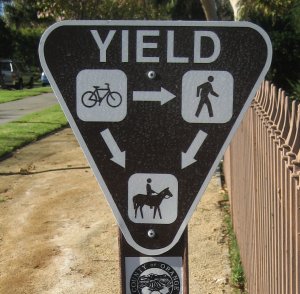
It seems to be saying this:
But if you’ve never seen it before, the meaning isn’t clear at a glance.
Apparently the idea is to make everyone stop and try to work out the diagram, so that they can start moving again in the right order.
*Or perhaps only bicycles, since there’s no rider in the picture.
The Village, a disturbingly-named apartment complex across from the Irvine Spectrum shopping center, has been advertising in the nearby area for a couple of years using the slogan, “A new meaning for…” with various images and phrases. For a while, the following photo and caption seemed to be everywhere:

A New Meaning For Heated Pool
A not-terribly-subtle example of the advertising maxim, “sex sells.” Somewhere along the line I decided she looked like Rebecca Romijn, and dubbed her Mystique.
Eventually I realized what the photo reminded me of: the promotional images for the movie Wild Things:

The apartments have removed the image from their website (you can still find it on the Internet Archive), but it’s still all over the shopping center kiosks. So while watching Beowulf there, it seemed somehow appropriate when Grendel’s mother struck the same pose: