

Found in a new area next to the foothills outside of Irvine that’s clearly being set up for a new housing development. I think the street was Portola Parkway, somewhere around Sand Canyon.
Found in a new area next to the foothills outside of Irvine that’s clearly being set up for a new housing development. I think the street was Portola Parkway, somewhere around Sand Canyon.
Someone walked into the restroom talking on a cell phone, explaining, “it’s going to sound really bad now, because I’m in the executive washroom.”
Executive washroom?
Sure, if by “executive washroom” you mean first-floor lobby restroom that’s available to anyone who walks into the building.
I couldn’t tell whether he was joking, or trying to impress the person on the other end of the call.
 One of the characters I encountered early in my exploration of Golden Age Flash stories was Ebenezer Jones, the Worry Wart. In fact, All-Flash #24 (1946) was one of those first two GA Flash books I bid on just to see if I could win. The story in that book referred to previous meetings. If it had been the Silver Age, it would have included a helpful editor’s note telling me “See issue #X,” instead of just a recap.
As I kept watching auctions and looking on sites like the Grand Comics Database, I identified at least two more appearances. I finally tracked down the last of the three in March, and was able to write up a bio of the character.
Who is the Worry Wart? In short, he was an ordinary man who had a case of anxiety so bad it was contagious.
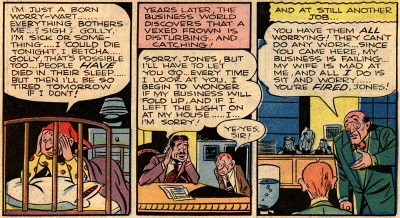
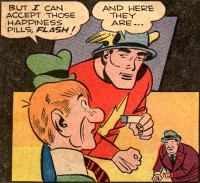 There’s an odd subtext to the character’s stories, though. The reason he returns to Keystone City is that the Flash had previously set him up with a supply of “happiness pills,” which had run out. In Flash Comics #76 (1946), Ebenezer Jones deliberately overdoses on the happiness pills, causing a euphoric delirium just as contagious as his anxiety.
Looking back on this from 2007, it’s hard not to think of it in terms of the vast numbers of people today taking medications for depression or anxiety. Not to mention people who abuse prescription medications. Or just people who abuse drugs. There’s a disturbing drug-dealer vibe in that panel.
It gets better, though. In the Worry Wart’s first appearance, in All-Flash #15 (1944), the Flash makes him a serum to counteract his anxiety:
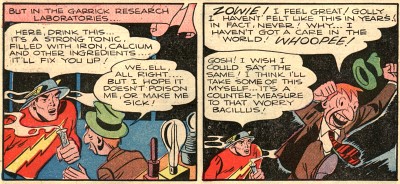
Yes, that’s right. The Flash gives him a bottle, and he drinks his cares away. No subtext here!
 The Opera Web Browser is in the news today. First, they’ve just released version 9.20. In addition to the usual security, stability, and compatibility fixes, they’re promoting a new feature called Speed Dial, to make it easier to reach your most-frequently-visited websites.
Meanwhile, a recent survey by NetApplications and Surveyware found that while Firefox is widely considered the best browser, Opera’s users are more satisfied than users of any other browser. NetApplications’ current marketshare shows 79% IE, 15% Firefox, 4.5% Safari and 0.8% Opera for March 2007. (via OperaWatch)
While Opera is an excellent browser, this high level of satisfaction may be in part because of the size of its userbase. Often, when something is only followed by a small fraction of the potential audience, it’s mainly the hard-core fans. The only way to grow past that size is to bring in the casual users, who are less invested in it. Only time (and increased marketshare) will tell.
Webuser decided to lead with the Opera findings, which is great news for what they call “one of the internet’s best-kept secrets.” But they made an odd choice on the image to run with the article:

Maybe they figured the Firefox logo was more recognizable, and would get more people to stop and read?
While they may tell you that what happens in Vegas stays in Vegas, they’re not entirely correct: some of it escapes onto the internet!
So here’s the lighter side of our recent trip to Las Vegas.
 Let’s start with the drive out. Somewhere between the Cajon Pass and Victorville, we saw a warehouse with this banner. We had to wonder what “really living” furniture was. Trees grown into the shape of chairs, perhaps? A topiary table? We didn’t get the camera out in time to snap a picture, but we caught it on the drive back.
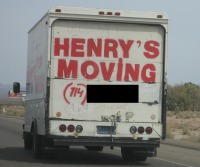 Then there was the moving truck. Somewhere around Barstow we got caught behind this veeerrrryyyy sssslllooooowwwwwlllly moving truck, with the company name and phone number spray-painted on the back. We joked that it was “Henry’s Moving… slowly.” (About 45 MPH on a 65 or 75 MPH highway.) What was really odd was that, two hours out, we’d run into a car from our own area code. Once we could get out of the lane, we passed them and left them way behind. Perhaps 45-60 minutes later, we made a stop in Baker. Bathroom break, new drinks, top off the gas tank, and stop at Alien Fresh Jerky. We pulled onto the freeway…. and there was Henry’s Moving.
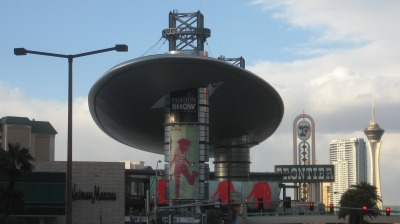
Speaking of Alien Fresh Jerky, perhaps they get their supplies from the flying saucer perched above Las Vegas’ Fashion Show Mall.
I haven’t seen 300 yet. But not because I’m not interested in the story.
I hadn’t heard of the Battle of Thermopylae until a few years ago, when I picked up a book called Atlantis Gate, by Greg Donegan. It was a sci-fi/fantasy thriller involving a war across time for the fate of the world. One front was ancient Greece, with one side aligning with the Spartans, and the other with the Persians. IIRC, the Spartans had to protect a gate in the pass until either someone could get a message through, or someone could close it. I actually found that the most interesting part of the book. The rest felt too much like it wanted to be an action movie. (About 2/3 of the way through I discovered it was actually the final book in a series of four. It didn’t grab me enough to pick up the earlier ones.)
Not long afterward, I started reading Harry Turtledove’s Videssos Cycle, in which a Roman legion gets transplanted to a sword-and-sorcery world. Among their number is a Greek doctor, who remarks at one point about the very same battle. At this point I realized that Donegan wasn’t making everything up, and started reading up on the actual battle.
So when I heard about the Frank Miller/Lynne Varley graphic novel, I put it on my wish list. Eventually I picked it up, read it, and enjoyed it. Then I heard they were making a movie, which sounded really promising.
Then the first previews aired, and it looked… well… overblown and hammy. Even the good reviews make it sound like two hours of hack-n-slash.
I think I’ll wait for the DVD.
(Sort of vaguely a response to Warren Ellis’ recent remarks on “Bad Signal” that he hasn’t seen 300 because he read the book—and didn’t like it.)
![[Logo: Wizard World Los Angeles]](https://journal.kvibber.com/wp-content/uploads/2007/03/wwla-logo.png) I went to Wizard World Los Angeles today. I almost went last year, and decided not to—and regretted it when I learned that Sunday (the day I almost went) was sparsely attended. So not only would I have had no problem getting in, but it should be a low-stress experience overall, rather than the insane crowds of San Diego.
I went to Wizard World Los Angeles today. I almost went last year, and decided not to—and regretted it when I learned that Sunday (the day I almost went) was sparsely attended. So not only would I have had no problem getting in, but it should be a low-stress experience overall, rather than the insane crowds of San Diego.
The convention itself did turn out to be a nice, low-key experience, and I found some interesting stuff, but getting to the convention was a bit of an adventure. Continue reading